Earth ChangesS


Snowflake Cold

Heavy snowfall destroys up to 95% of apricot harvest and damages other fruit crops in Armenia

Image
ITAR-TASS/Alexander Kolbasov
Armenia's annual apricot harvest averages 50,000-55,000 tonnes

A recent cold spell and a heavy snowfall has killed about 90-95% of the apricot harvest in Armenia, causing a damage of $ 25-30 million, chairman of the Armenian Union of Agrarians and Peasants Grach Berberyan told journalists.

"The frost and snow killed forming blossoms," he said. "Damage was done to apricot, plum, peach, cherry trees and early-ripe species of grapes. The most affected areas are in the Ararat plain and in regions near Yerevan."

Armenia's annual apricot harvest averages 50,000-55,000 tonnes, of which 20,000-22,000 tonnes are exported and about 10,000 tonnes are further processed.

A heavy snowfall hit the republic over the past weekend. The snow blanket, according to meteorologists, reached 20 centimetres. Air temperatures dropped to three degrees below zero.

Bizarro Earth

7.8 aftershock hits same area of northern Chile as Tuesday's 8.2 quake

chile earthquake
© Reuters / Ivan Alvarado
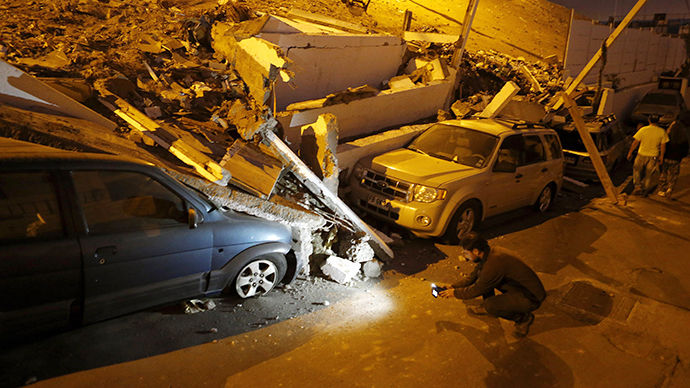
A cameraman records near cars caught under rubble after an earthquake and tsunami hit the northern port of Iquique April 2, 2014.
A 7.8 magnitude earthquake occurred just before 22:00 local time on Wednesday off the northern coast of Chile, 23 km (14 miles) south of Iquique, according to the US Geological Survey (USGS).

The epicenter of the latest quake was located at a shallow depth of 10 km (6 miles). Chile's emergency ministry has ordered a preventative evacuation along the northern Chilean coastline, Reuters reported.

A tsunami warning is now in effect for Chile and Peru following the 7.8 quake, according to the Pacific Tsunami Warning Center. "An earthquake of this size has the potential to generate a destructive tsunami that can strike coastlines in the region near the epicenter within minutes to hours," the PTWC reported.

"Based on all available data a destructive Pacific-wide tsunami is not expected," it added.

Another quake, measured at magnitude 6.4, also struck 47 km (29 miles) west of Iquique at around 21:00 local time Wednesday evening.

This comes one day after an 8.2 magnitude quake hit 95 km (59 miles) northwest of the same area, around Iquique.

Bizarro Earth

The crust is moving - be prepared

Rift
© The Economic Collapse Blog
Why are fault lines and volcanoes all over North and South America suddenly waking up? Are we moving into a time when major earthquakes and volcanic eruptions will become much more common?

For the past several decades, we have been extremely fortunate to have experienced a period of extremely low seismic activity along the west coast of the United States. You see, the west coast lies right along the infamous Ring of Fire.

Approximately 75 percent of all the volcanoes in the world are on the Ring of Fire, and approximately 90 percent of all global earthquakes occur along the Ring of Fire.

Scientists tell us that it is inevitable that "the Big One" will hit California someday, but people have gotten very apathetic about this because things have been so quiet out there for so many years.

Well, now it appears that things are changing in a big way - and not just along the California coast. The following are 12 signs that something big is happening to the earth's crust under North and South America...

Bizarro Earth

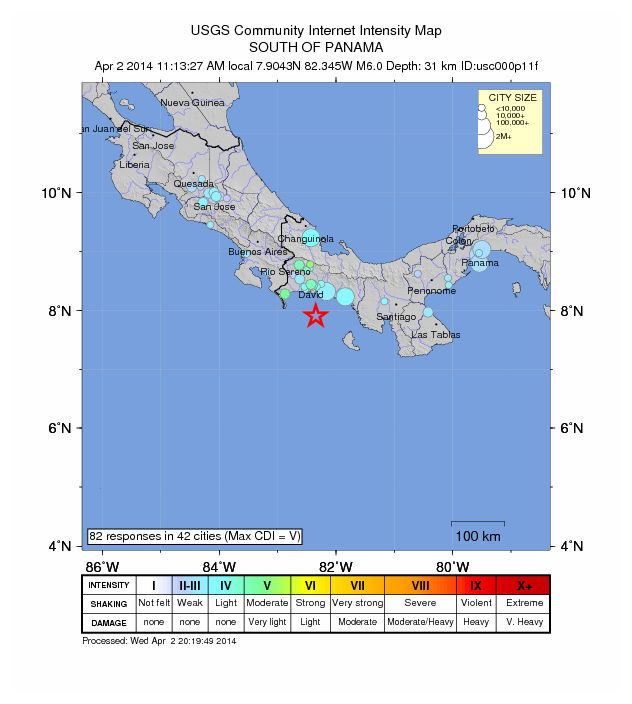
USGS: Earthquake Magnitude 6.0 - 52km S of Pedregal, Panama

Pedregal Quake_020414
© USGS
Event Time
2014-04-02 16:13:27 UTC
2014-04-02 11:13:27 UTC-05:00 at epicenter

Location
7.904°N 82.345°W depth=31.6km (19.6mi)

Nearby Cities
52km (32mi) S of Pedregal, Panama
58km (36mi) S of David, Panama
58km (36mi) S of Las Lomas, Panama
71km (44mi) SE of Puerto Armuelles, Panama
294km (183mi) SE of San Jose, Costa Rica

Technical Details

Fish

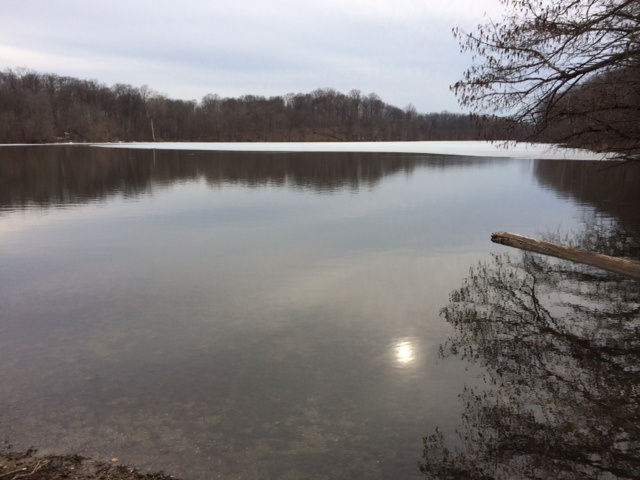
Harsh winter blamed for dead fish at lakes across Indiana

Image
© WANE PhotoMud Lake in Chain O’ Lakes State Park

Some northern Indiana lakes are seeing large numbers of Harsh winter blamed that wildlife officials blame on this winter's severe cold.

Fisherman Robert Schultz tells WSBT-TV he found some banks of Pike Lake near Warsaw covered with hundreds of dead gizzard shad.

That's a species of fish that the Department of Natural Resources says is less tolerant of the freezing temperatures that hit the area over the last few months. The DNR has had reports of similar fish kills at other lakes, including Winona Lake on the other side of Warsaw.

While many of the dead shad have been eaten by birds or other fish, Schultz says he expects to see more.

Source: AP

Bizarro Earth

Chilean M8.2 earthquake may be forewarning of a larger event

Chile Earthquake
© Thinkstock

Chile is beginning to dig out from a massive 8.2 magnitude earthquake that struck the region at 8:46 p.m. local time Tuesday evening about 52 miles northwest of the mining town of Iquique, according to the USGS. At least five people are confirmed dead and tens of thousands have been evacuated from their homes.

The earthquake touched off tsunami warnings and, according to the BBC, waves up to six feet battered the shoreline in some areas. Widespread power outages, fires and landslides were also complicating rescue efforts. As well, numerous aftershocks were felt throughout the night, including a 6.2 tremor.

Several regions have been declared disaster areas by the government in hopes of "avoiding instances of looting and disorder."

Shortly after the quake, President Michelle Bachelet promised troops and police reinforcement would be sent to maintain public order during rebuilding and repair.

"We're leaving with the children and what we can, but everything is clogged up by people fleeing buildings by the beach," said 32-year old Liliana Arriaza, who was driving away with her three children, according to a Reuters report.

Bachelet said the country had "faced the emergency well" and called on those in the affected regions "to keep calm and follow instructions from the authorities."

Fish

Thousands of dead fish washing up on shores of Chicago area lakes

Image
By the thousands, fish are dying in the shallower man-made lakes of the Chicago area.

CBS 2's Mike Parker reports that the long, cold winter is to blame.

At sunset Tuesday night, two neighbors came to the edge of Lake Linden in Lindenhurst to get a first-hand look at the catfish, sunfish, pike and others that have washed up. The deaths are the result of the heavy ice cover that now persists into April.

"The sunlight's not able to penetrate through into the water and that reduces over time, the dissolved oxygen levels and that stresses the fish out and eventually if it gets low enough, the fish will die," said Mike Adam, senior biologist for the Lake County Health Department's lake management unit.


Arrow Up

Yellowstone Volcano Eruption in 2014?

Image
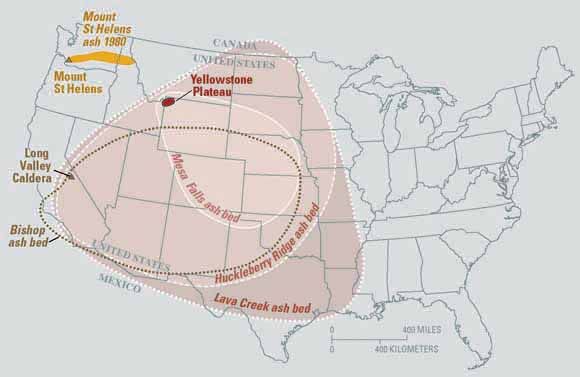
This map from the U.S. Geological Service shows the range of the volcanic ash that was deposited after the biggest of the Yellowstone National Park eruptions around 2.1 million years ago. "These eruptions left behind huge volcanic depressions called “calderas” and spread volcanic ash over large parts of North America," it said. "If another large caldera-forming eruption were to occur at Yellowstone, its effects would be worldwide. Thick ash deposits would bury vast areas of the United States, and injection of huge volumes of volcanic gases into the atmosphere could drastically affect global climate. Fortunately, the Yellowstone volcanic system shows no signs that it is headed toward such an eruption in the near future. In fact, the probability of any such event occurring at Yellowstone within the next few thousand years is exceedingly low."
A number of bloggers are posting videos that show bison and other animals allegedly leaving Yellowstone National Park, prompting theories that as earthquakes ramp up the seismic activity will set off the Yellowstone supervolcano.

Two of the main bloggers behind the discussion stress that there's no way to know when the supervolcano will go off but note that the 4.8 magnitude earthquake that hit on March 30 seemed to set off a reaction from the animals, who are moving for a reason.

Snowflake Cold

Arctic winter brings rare birds to New York City

Image
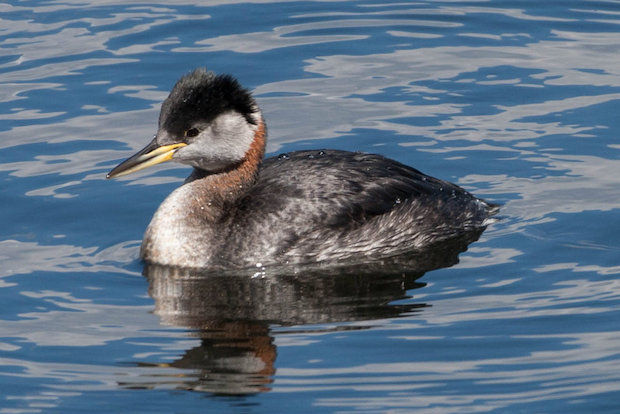
© Flickr/surfbird917A red-necked grebe was spotted in Central Park on March 15.


The bitter winter that kept many New Yorkers shivering well into March had a silver lining for birdwatchers - driving rare ducks typically spotted only in climes further north down to the city.

Red-necked grebes, which normally stay in the northwest and Canada, have set up shop in Central Park and were spotted as recently as March 30, birders said. White-winged scoters, more common upstate but rarely spotted in the city, have been seen in Inwood Hill Park, sparking enthusiastic posts by birders on blogs, YouTube and the popular mapping website eBird.

Both species seemed to have moved south because the colder-than-usual winter temperatures froze their natural habitat - making it difficult for them to feed, said Andrew Farnsworth, a researcher at Cornell's Lab of Ornithology.

"When the freeze happens, they disperse to wherever they can find something that appears to have open water," said Farnsworth, who studies bird travel patterns. "There was a huge movement of water fowl off those lakes.

"The red-necked grebe were moving tremendously this year [traveling] as far south as they needed to go," Farnsworth said of the distinctively plumaged birds.


Target

Tsunami warning and evacuation of thousands after 8.2 earthquake in Chile

chile evacuation
© Javiera Mora Araya/EPAEvacuation under way in Antofagasta, Chile, after an offshore earthquake triggered a tsunami alert

An earthquake of magnitude 8.2 has jolted northern Chile, triggering a tsunami alert and the evacuation of thousands of people from coastal areas. At least five people were killed and more than 300 women escaped from a coastal prison.

The quake was centred under the Pacific Ocean 61 miles north-west of the city of Iquique and struck at 8.46pm as thousands of residents were arriving home from work.

As sirens blared and emergency warnings urged residents to evacuate by foot to higher ground, in coastal cities traffic jams ensued as panicked residents sought to escape the coast. The first tsunami surge measured 2.5 metres (8.2ft) and flooded low-lying areas of Iquique including a medical clinic and bus terminal.