Earth ChangesS


Cloud Lightning

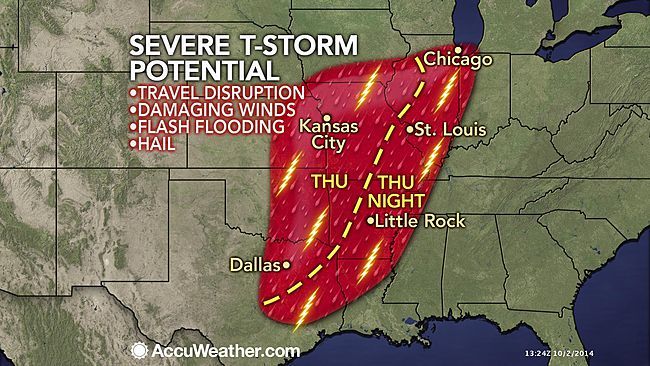
Powerful cold front to target 40 million from Illinois to Texas - 'wind, hail and torrential downpours'

Image
A powerful cold front will send severe thunderstorms towering in the air on Thursday putting many people in harm's way.

A zone from northern Illinois to northeastern Texas will be at the greatest risk for gusty winds, hail and torrential downpours through Thursday night.

"An active cold front sweeping across the center of the country on Thursday combined with a push of Gulf moisture into the Plains will set the stage for severe storms," said AccuWeather.com Meteorologist Evan Duffey.

These storms will threaten more than 40 million people as they target several major cities including Chicago; St. Louis; Springfield and Kansas City, Missouri; Little Rock, Arkansas; Memphis, Tennessee; Shreveport, Louisiana; and Dallas.

People in the path of the storms should expect travel disruptions from poor visibility and excess water on the roadways. Delays are be possible at major airports, including O'Hare and Dallas-Fort Worth.

According to AccuWeather.com Meteorologist Ed Vallee, Chicago will be at risk for storms beginning late in the day.

"Thunderstorms will develop ahead of the front Thursday afternoon and move into the Chicago area Thursday evening," said Vallee. "These storms could bring gusty winds, heavy rain and maybe even some small hail."


Arrow Down

Beluga whale population in St. Lawrence estuary on 'catastrophic' path, Canada

Image
© The Associated PressThe latest figures on beluga calves come amid a debate over whether to allow exploratory drilling off shore of Cacouna, Que., near the breeding ground at the mouth of the St. Lawrence.
Number of dead beluga calves turning up on shore unusually high since 2008

A researcher monitoring belugas in the St. Lawrence estuary is warning of a looming "catastrophe" after another difficult calving season for the endangered whale.

The belugas have been in a slow population decline for the past decade, according to Robert Michaud, the scientific director of Quebec's Marine Mammals Research and Education Group.

His team has found the carcasses of at least five baby belugas so far during the calving period, which officially ends on Oct. 15. The number of dead beluga calves turning up on the shore has been unusually high since 2008, Michaud said.

"It's a catastrophic trajectory we're observing, and we don't yet know exactly what are the causes for that," he said.

Bizarro Earth

Volcanic eruption 1,200 years ago scattered ash from Alaska to Europe

Image
Microscopic image of a sample of White River Ash from the Yukon. The picture is of a polished surface of the pumice grains mounted in epoxy, which is how the samples are prepared for analysis.
A new study led by University of Alberta researchers has shown that a volcanic eruption 1,200 years ago scattered ash from Alaska to Europe - a discovery that will help researchers understand how future eruptions could affect the world.

Britta Jensen and Duane Froese in the U of A's Faculty of Science led the research, which showed that a distinct deposit of white, sand-sized grains of volcanic ash visible just below the modern forest floor over much of the Yukon and southern Alaska is present not only near the originating Mount Bona-Churchill in Alaska, but also in the Greenland Ice Sheet and across northwestern Europe.

The deposit, commonly known as the White River Ash, is so prominent that locals sometimes refer to it as "Sam McGee's Ashes" in reference to the Robert Service poem.

As part of the study, samples of the White River Ash, along with ash previously assumed to be from Iceland, were gathered from northern Canada, eastern North America, Greenland, Northern Ireland and Germany. By comparing characteristic features of these samples, the researchers showed that all of the ash originated from the same large prehistoric volcanic eruption in Alaska about 1,200 years ago.

Cloud Lightning

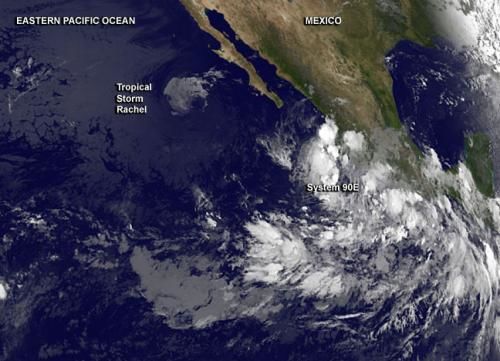
Tropical Storm Rachel is dwarfed by developing system 90E

Image
© NASA/NOAA GOES ProjectNOAA's GOES-West satellite captured an image of the smaller, fading Tropical Storm Rachel and the large developing System 90E in the Eastern Pacific on Sept. 30 at 8 a.m. EDT.
Tropical Storm Rachel is spinning down west of Mexico's Baja California, and another tropical low pressure area developing off the coast of southwestern Mexico dwarfs the tropical storm. NOAA's GOES-West satellite showed the size difference between the two tropical low pressure areas.

NOAA's GOES-West satellite captured an image of the Eastern Pacific Ocean on Sept. 30 at 1200 UTC (8 a.m. EDT). In the infrared image, Tropical Storm Rachel appeared small in comparison to the low pressure area called System 90E, coming together hundreds of miles south. As Rachel spins down over cool waters west of Baja California, Mexico, southwesterly wind shear was obvious in the GOES-West image because the bulk of Rachel's clouds had been pushed to the north. The image was created by NASA/NOAA's GOES Project at the NASA Goddard Space Flight Center in Greenbelt, Maryland.

The National Hurricane Center (NHC) noted that Rachel was still maintaining tropical storm strength on Sept. 30 at 5 a.m. EDT, when maximum sustained winds were near 40 mph (65 kph). Rachel was centered near 23.3 north latitude and 117.5 west longitude, about 485 miles (780 km) west of the southern tip of Baja California. Rachel was stationary at the time.

Question

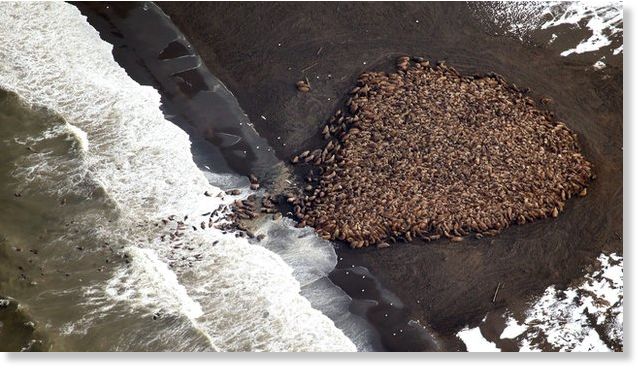
35,000 Pacific walruses gather on Alaskan beach

Image
The animals usually rest on sea ice but will head to beaches if that platform is not available
Huge numbers of Pacific walrus have been coming ashore in northwest Alaska.

An estimated 35,000 animals were pictured at the weekend hauling themselves on to land north of Point Lay, about 500km southwest of Barrow. The gathering was photographed as part of an annual survey undertaken by the US National Oceanic and Atmospheric Administration.

Walrus will generally rest on floes of Arctic sea ice, but when that is not available will head to nearby beaches. Andrea Medeiros, a spokeswoman for the US Fish and Wildlife Service, told the Associated Press wire agency that the animals' mass movement was first detected on 13 September, and that they have been moving on and off shore ever since.

Blue Planet

Antarctica meltdown weakens Earth's gravity

Antarctica
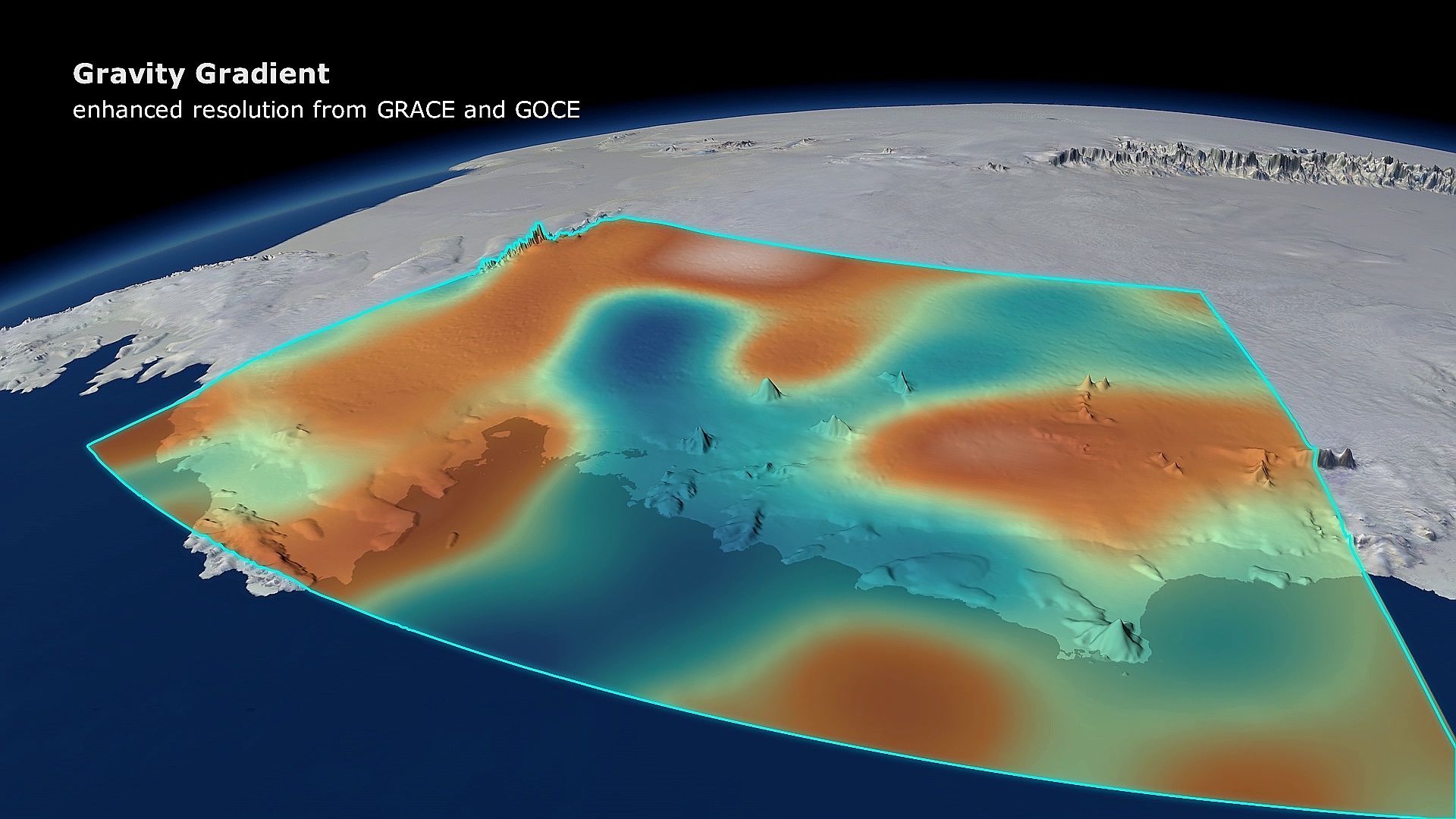
© DGFI/Planetary VisionsChanges in Earth's gravity field caused by West Antarctica ice loss.
West Antarctica's incredible weight loss can be felt from space, a new study reports.

So much ice has disappeared from West Antarctica in recent years that Earth's gravity is now weaker there, researchers reported in the Aug. 28 issue of the journal Geophysical Research Letters.

Earth's gravity fluctuates in small ways that are caused by changes in mass. When hefty ice sheets melt, there is less ice and thus less gravitational force pulling in that area.

The new results come partly from the European Space Agency's GOCE satellites, a four-year endeavor to finely map Earth's gravity. The GOCE gravity map was combined with gravity measurements recorded from the GRACE satellites, an ongoing NASA-Germany mission that tracks changes in Earth's ice sheets via gravity. Merging the information from both satellites allowed researchers to sharply illuminate West Antarctica's ice loss.

Comment: Or...is it something much worse than so-called global warming causing this? "Have proponents of man-made global warming been proven correct, or is something else, something much bigger, happening on our planet?" For an in-depth look at this question, read Earth Changes and the Human Cosmic Connection: The Secret History of the World - Book 3


Cloud Precipitation

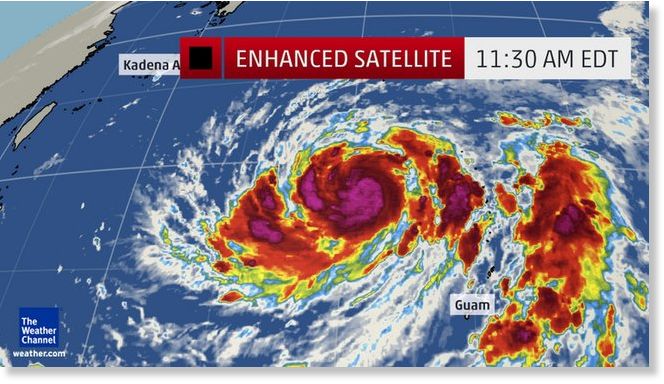
Typhoon Phanfone poised to become powerful typhoon heading for Japan

Image
Typhoon Phanfone has pushed past the Mariana Islands and is poised to become a powerful typhoon in the days ahead, posing a threat to Japan this weekend.

Phanfone pushed through the northern Mariana Islands north of Guam Tuesday night as a tropical storm. High surf advisories continue for Guam, Rota, Tinian and Saipan through Friday night, where 7 to 9 foot surf is expected, particularly on west and south-facing reefs.

Typhoon Phanfone is now in a favorable environment of low wind shear and high sea-surface temperatures as it continues to track toward the northwest.

This should allow it to strengthen into a powerful typhoon later this week. A cycle of rapid intensification could occur, given the favorable environmental conditions. As a result, the U.S. military's Joint Typhoon Warning Center forecasts Phanfone to become the equivalent of a Category 4 tropical cyclone on the Saffir-Simpson Hurricane Wind Scale later this week.

Cloud Precipitation

Week of flooding results in 88 dead and a million displaced, Meghalaya and Assam, India

Image
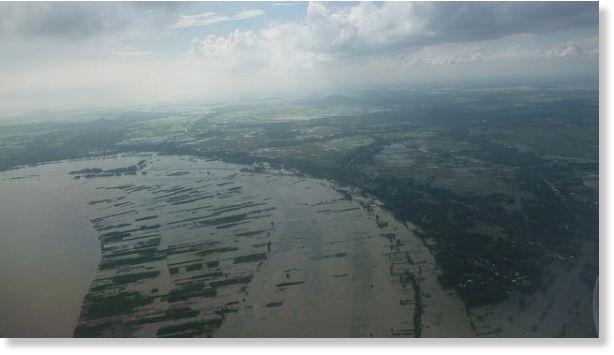
Guwahati floods from the air, August 2014.
Just as the flood water in Jammu and Kashmir started to recede, heavy rainfall caused widespread flooding across the north eastern states of Assam and Meghalaya.

The heavy rain first began around 21 September 2014. The city of Gauhati in Assam saw 203 mm fall in just 24 hours between 21 and 22 September. By 22 September, at least 100 villages were flooded in the state of Meghalaya. Flood water has remained in vast areas of both states for 1 week and has left 88 people dead and over 1 million displaced.

Hundreds of relief camps have been set up for the flood victims. Teams from India's National Disaster Response Force (NDRF) and Border Security Forces have been deployed in rescue and relief operations. Currently focus is on relief work since the majority of rescue operations where over 6,000 were rescued, have been completed.


Bizarro Earth

The demise and resurrection of Kazakhstan's Aral Sea

ships aral sea
© Reuters / Shamil ZhumatovChildren run past ruined ships abandoned in sand that once formed the bed of the Aral Sea near the village of Zhalanash, in southwestern Kazakhstan
The basin of Kazakhstan's Aral Sea, once the fourth largest lake in the world, is now completely dry. The history of the sea, which derived its name from a Kyrgyz word meaning "Sea of Islands," is revealed in a series of 10 videos.

Snowflake

Yes, Colorado has 'golf-ball sized' severe hail storm in September


Denver - Some people in Colorado are cleaning up after hail piled up like snow in some areas. In western Colorado, the National Weather Service says several people reported golf-ball size hail near Pagosa Springs on Monday.

The system that brought the unusual early fall weather to Colorado is headed for the Midwest, where officials have issued warnings about severe thunderstorms across the Great Plains. Quarter-sized hail piled up like snow in Greenwood Village while the unsettled weather led to a tornado watch for 14 counties. Monday's raging storm damaged more than 500 cars and shattered windows at the Hyundai dealership in Arapahoe.

"Never seen anything like it. Only thing close would be a tornado," employee Eric Risch told CBS Denver. "Quarter-sized hail just ripping through the air." "Wind started coming in and all of a sudden it looked like it was snowing in September," sales manager Ray Saccomano said. "What kind of pressure do you need to do something like this? A lot of pressure."

Comment: Just an anomaly? Think again. This is the 'new normal,' and it's only intensifying. Just don't go to Al Gore or Leonardo DiCaprio to find out why.

Read: Earth Changes and the Human Cosmic Connection: The Secret History of the World - Book 3