Earth ChangesS


Boat

Sea lion throws fisherman across trawler like a rag-doll

Image
‘It’s my ship now!’
You can add sea lions to the top of the list of animals you shouldn't mess with.

One Russian fisherman found out the hard way the sheer strength of an angry sea lion, when he was hurled onto his ship's deck by the creature.

The sea mammal had been caught in the nets and the fishermen were quick to cut it free.

But the moment the sea lion gets its head and neck free it grabs one of the fishermen in its teeth and throws him across the deck.

As the huge creature breaks free the fishermen and a very frightened dog keep their distance.

But the sea lion pounces on the dog as it takes a few tentative steps forward, the canine barking as it tries to break free.


Attention

Pet dog chases off bear to save Japan boy from attack

Image
The dog took on the metre-high (three-feet) bear after it attacked the young boy.
A placid pet dog was being hailed a hero after saving a five-year-old boy from a mauling by a wild bear in northern Japan, police and media said Tuesday.

The dog, a six-year-old shiba inu, took on the metre-high (three-feet) bear after it attacked the young boy during a riverside walk with his great-grandfather.

The dog barked "unusually loud" and chased off the animal on Saturday evening in Odate, some 550 kilometres (340 miles) north of Tokyo, a local police spokesman said.

"The boy suffered slight bruises and was taken to hospital but he was released on the same day," the spokesman said.

The boy s 80-year-old great-grandfather, who was a short distance away near his car, raised the alarm.

Local media identified the dog as a six-year-old bitch named "Mego" ("Cute").

Bizarro Earth

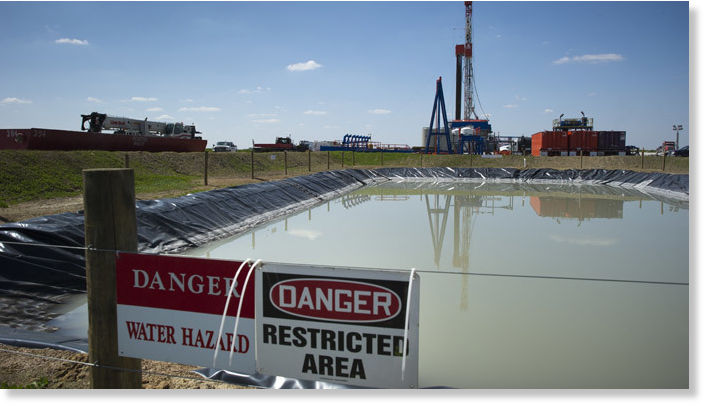
Study finds 400 micro-earthquakes in Ohio were triggered by fracking

Image
© AFP Photo / Mladen Antonov
A new study on the practice of hydraulic fracturing has found a direct connection to some 400 micro-earthquakes in an Ohio town. This is the second report on the Utica Shale this year. The town is one of very few where the quakes took place on a fault.

The new study, published Tuesday in the journal Seismological Research Letters, focuses on the eastern town of Canton, Harrison County, and three particular wells. It has found that the three wells operated in September-October 2013 in the Utica Shale caused 10 quakes of magnitude 1.7-2.2, among others.

But the case of Harrison County is one of a very few where, according to seismologist and lead author Paul Friberg, the quakes happened on a fault line.

Other locations where this happened included the United Kingdom, British Columbia in Canada and Poland Township, Ohio, according to LiveScience.

An earlier March study led to scientists with Ohio's Department of Natural Resources to shut down seven other wells in the Poland Township after fracking there led to two small quakes.

The current spate of Harrison County quakes struck less than 1.4km (1 mile) below ground, with tremors starting to be felt 26 hours after fracking started on September 29, 2013. This was followed by a total of 190 earthquakes in the 39 hours just two days later. When the pressure stopped, so did the quakes, according to the study.


Comment:
There's plenty of evidence that fracking and earthquakes are linked:

Getting more fracking obvious: Study shows hydraulic fracturing linked to earthquakes in Ohio
Fracking: 14 earthquakes recorded in Oklahoma since Friday
US: Fracking Operations Cause Thousands of Earthquakes in Arkansas
Seismologists say fracking-linked earthquakes likely to worsen
More fracking headaches as earthquake evidence grows


Ice Cube

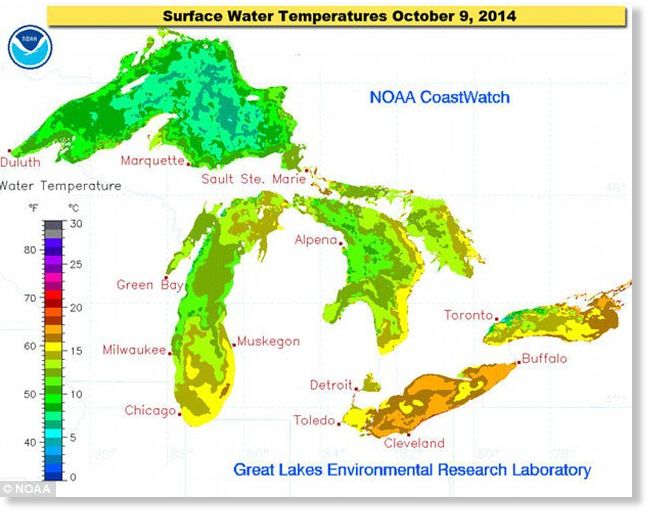
Hmm...Water temperature of the Great Lakes is over 6 degrees colder than normal - threatening earlier and colder winter in Midwest

Image
Michigan residents may see a cold and icy winter arrive sooner this year, reportedly due to lower temperatures in the Great Lakes. Average surface temperatures for both Lake Superior and Lake Michigan have dropped: Superior's went from from 53.7 degrees on October 11, 2013 to 47.6 degrees Saturday, while Michigan's went from 62.1 degrees to 56.0 degrees, MLive.com reported. That means both lakes experienced temperature drops of 6.1 degrees, the news site explained.

Michigan residents may need to bundle up sooner to brace both November and December chilly weather as a result of cooler lakes, MLive.com reported. Lakes may also ice up sooner because of the extra chilly water temperatures, the news site reported. Despite these potential effects, there may be less lake effect snow, the website explained.

'Lake effect snow is heaviest when the lake waters are warm, and the air above is very cold,' MLive.com said. 'The bigger the difference in lake to air temperature, the more intense the snow can fall. Colder lake waters would mean lake effect snow could be not as intense. That is not to say we won't still have what some would call heavy snow. It means the 24 to 36 inch lake effect snows in one to two days would be harder to achieve.'

Igloo

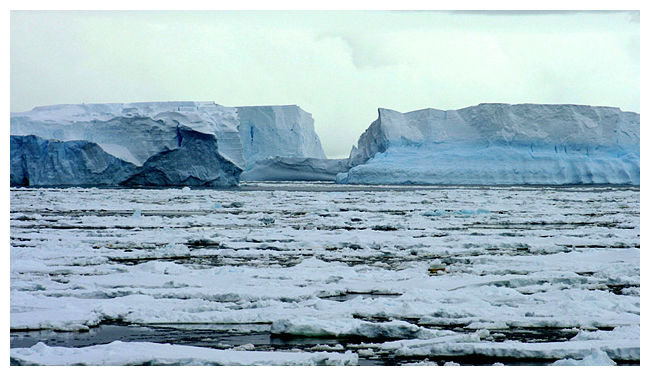
Austrian daily reports: "Huge ice growth surprises climate scientists" ... "Like one not seen in decades"!

Iceage
© Kronen Zeitung/EPA
The Austrian online Kronen Zeitung here has an article about something most German-language media outlets have been too red-faced to report on: The sudden growth in polar sea ice.

The Kronen Zeitung opens with:
A huge growth in ice at the poles has surprised scientists and is casting questions. Is global warming taking a break? [...] For the prophets of climate change the new figures pose questions: At the poles of Mother Earth, in complete contradiction to prognoses of a complete polar melt, there is an ice growth like one not seen in decades."
Almost the entire mainstream media has been quiet about this development. So it is refreshing to see that some media are reporting the "good" news that the planet is not warming alarmingly.

Attention

Camel escapes from cage and kills owner of wildlife sanctuary

Richard Mileski
Richard Mileski
The American owner of a Mexican wildlife center was killed by a camel after the animal escaped its pen and attacked him.

Richard Mileski was walking through Tulum Monkey Sanctuary in Tulum on Tuesday when the camel escaped. The animal dragged Mileski to the ground and kicked, bit and trampled him before sitting on top of the 60-year-old.

One park employee was in another part of the park when he heard Mileski scream, then rushed to the scene and attempted to beat the camel away with a stick. Despite employee efforts, Mileski died on the scene.

Following the incident, the camel was taken to Mexico's federal agency of environmental protection Profepa.

"We had to tie a rope around the animal's neck and pull him with a pick-up truck to remove him," one employee said.

Attention

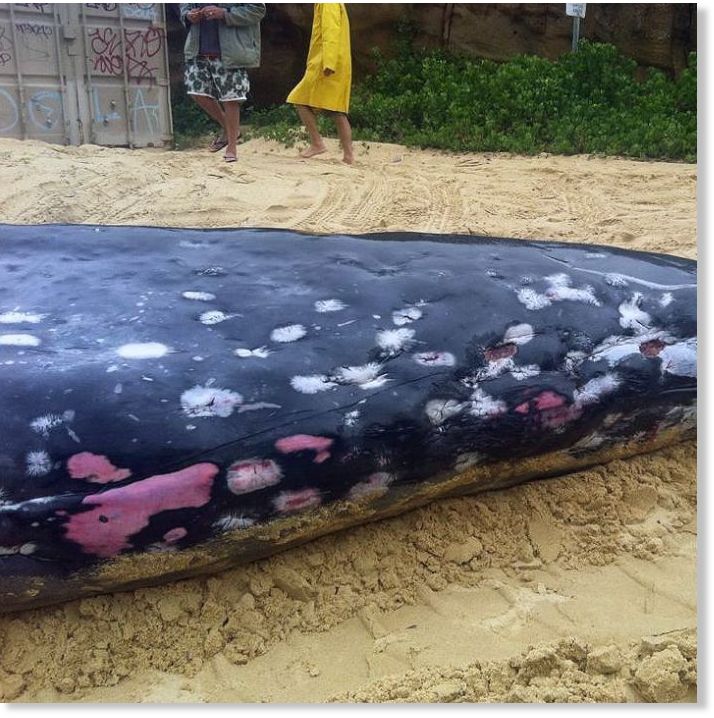
Rare deep sea dwelling beaked whale washes up on beach near Newcastle, Australia

ORRCA
Marine biologists said it was too early to tell what killed the 4m beaked whale.
Marine experts are examining a rare beaked whale that has washed up on a New South Wales beach.

The three to four-metre-long animal was found dead on Redhead Beach, south of Newcastle, this morning.

Marine experts have been called in to examine the whale and take specimens.

Organisation for the Rescue and Research of Cetaceans in Australia (ORCCA) president Ronny Ling said the find was extremely rare.

"It's a deep sea animal called a beaked whale," he said.

Ice Cube

'Unseasonal blizzards and avalanches' kill 12, including hikers, yak herders in Nepal

Image
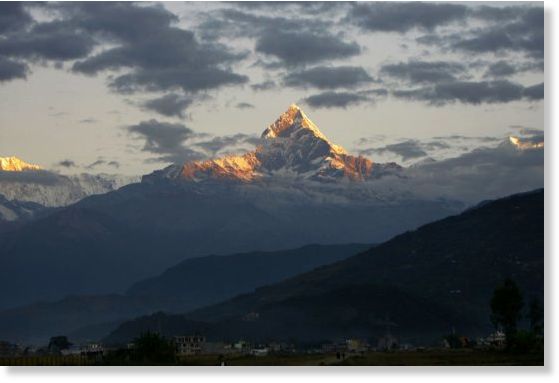
© PRAKASH MATHEMA / AFP/GETTY IMAGESIn this November 2010 photograph, Mount Machhapuchhre is seen from about 200 kilometres west of Kathmandu. A snowstorm and avalanche in Nepal's mountainous north have killed 12, including four Canadians, officials announced Wednesday. Digging out their bodies will take days.
At least 12 people, including eight foreign hikers and a group of yak herders, were killed in Nepal by unseasonal blizzards and avalanches triggered by the tail of cyclone Hudhud, officials said on Wednesday.Two more foreign climbers and three Nepalese guides were reported missing.

The hikers' deaths come during the peak trekking season in Nepal, home to eight of the world's 14 highest mountain peaks, including Mount Everest. For the past two days, Nepal has been lashed by heavy rains brought on by the cyclone that has battered neighbouring India. The weather triggered blizzards at high altitudes.

The bodies of a Nepali citizen, two Polish nationals and an Israeli hiker from the Thorang-La area were found along a popular trekking route near Annapurna, the world's 10th highest mountain, said Baburam Bhandari, governor of the district of Mustang, where the incident took place.

Bhandari said the group perished in a blizzard."We have rescued five German, five Polish and four Israeli trekkers who were trapped in the snowfall early on Wednesday," Bhandari told Reuters by telephone, without giving details. One German tourist fractured his leg, he said.

Cloud Precipitation

Gonzalo becomes 'major hurricane' in the Atlantic - expected to become Category 4 hurricane

Image
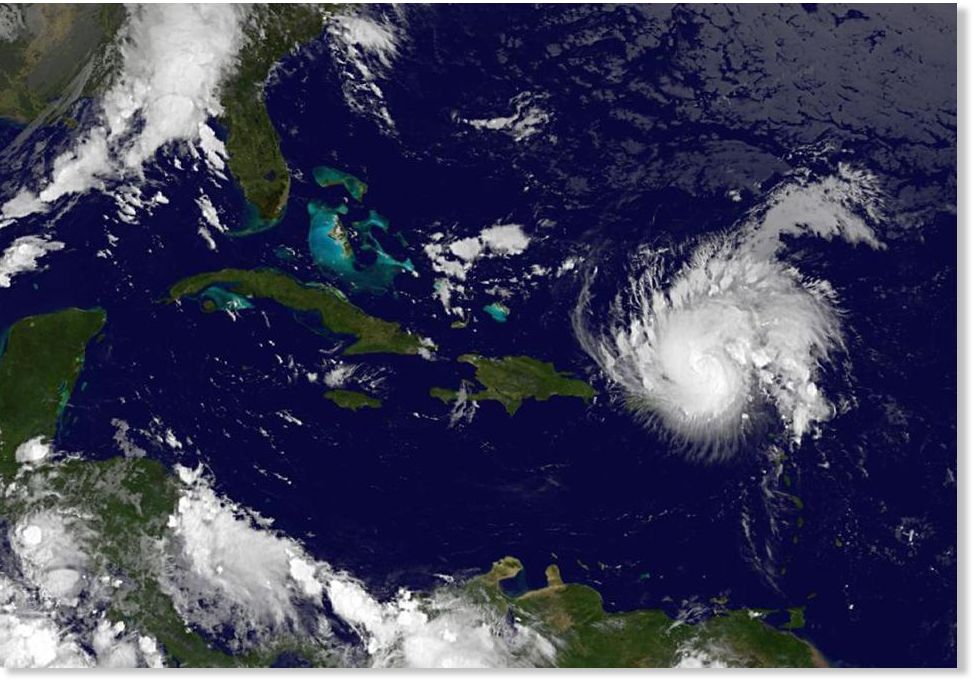
© AFP NASA GOES Project satellite photo shows Hurricane Gonzalo (R) over the Leeward Islands in the western Atlantic Ocean on October 14, 2014
Gonzalo strengthened to a "major hurricane" over the open Atlantic and was expected to continue gaining force, forecasters said.

Packing maximum sustained winds of 115 miles (185 kilometers) an hour, with gusts even stronger, Gonzalo surged to a Category Three on the Saffir-Simpson scale, the Miami-based National Hurricane Center said.

"Additional strengthening is forecast during the next 48 hours and Gonzalo is expected to become a Category Four storm on Wednesday," the NHC said.

The highest category on the Saffir-Simpson scale is five.

The storm skirted the Caribbean and was moving over open ocean, some 770 miles (1,240 kilometers) south of Bermuda.

Bizarro Earth

Getting more fracking obvious: Study shows hydraulic fracturing linked to earthquakes in Ohio

Fracking, global frackdown day
© ap

Hydraulic fracturing triggered a series of small earthquakes
in 2013 on a previously unmapped fault in Harrison County, Ohio, according to a study published in the journal Seismological Research Letters.

Nearly 400 small earthquakes occurred between Oct. 1 and Dec. 13, 2013, including 10 "positive" magnitude earthquake, none of which were reported felt by the public. The 10 positive magnitude earthquakes, which ranged from magnitude 1.7 to 2.2, occurred between Oct. 2 and 19, coinciding with hydraulic fracturing operations at nearby wells.

This series of earthquakes is the first known instance of seismicity in the area.

Hydraulic fracturing, or fracking, is a method for extracting gas and oil from shale rock by injecting a high-pressure water mixture directed at the rock to release the gas inside. The process of hydraulic fracturing involves injecting water, sand and chemicals into the rock under high pressure to create cracks. The process of cracking rocks results in micro-earthquakes. Hydraulic fracturing usually creates only small earthquakes, ones that have magnitude in the range of negative 3 (−3) to negative 1 (-1).

"Hydraulic fracturing has the potential to trigger earthquakes, and in this case, small ones that could not be felt, however the earthquakes were three orders of magnitude larger than normally expected," said Paul Friberg, a seismologist with Instrumental Software Technologies, Inc. (ISTI) and a co-author of the study.


Comment: see also here and here for more evidence linking fracking to increased seismic activity.