
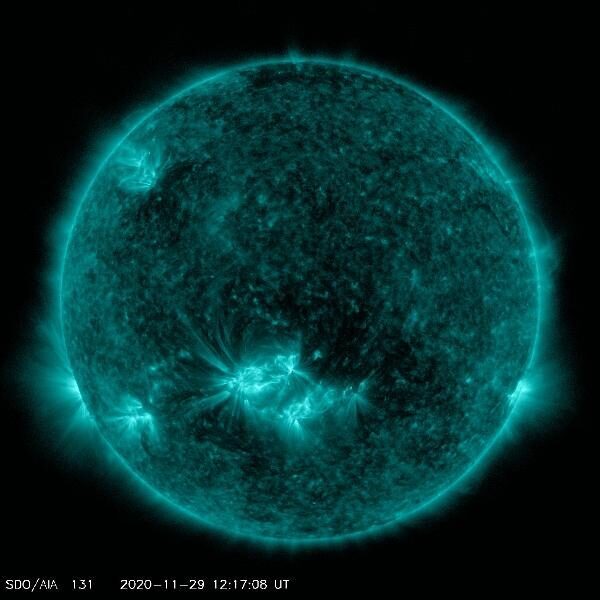
X-rays and UV radiation from the flare ionized the top of Earth's atmosphere, producing a shortwave radio blackout over the South Atlantic: map. Ham radio operators and mariners may have noticed strange propagation effects at frequencies below 20 MHz, with some transmissions below 10 MHz completely extinquished.
Remarkably, this flare was even bigger than it seems. The blast site is located just behind the sun's southeastern limb. As a result, the explosion was partially eclipsed by the body of the sun. It might have been an X-class event.
The flare also hurled a significant coronal mass ejection (CME) into space, shown here in a coronagraph movie from the Solar and Heliospheric Observatory (SOHO).



















Comment: See also:
- Astronomers studying novel atmospheric plasma phenomenon 'STEVE' publish paper on 'pure green sky canonballs'
- Earth's magnetosphere acts as a particle accelerator powered by plasma waves
- Symbolic? Huge lightning bolt strikes Washington Monument
- Recently discovered atmospheric electrical phenomenon 'Green Ghost' captured over West Texas
- Intense lightning storm recorded over Toronto, Canada
- Almost 87,000 lightning strikes in Washington on Saturday - nearly 2/3 annual average!
It looks like we are beginning to observe what the ancients recorded at times of global upheaval/climate shift. See: Symbols of Transition: Shifting sands unveil 'stick man' petroglyphs on Hawaii beach