
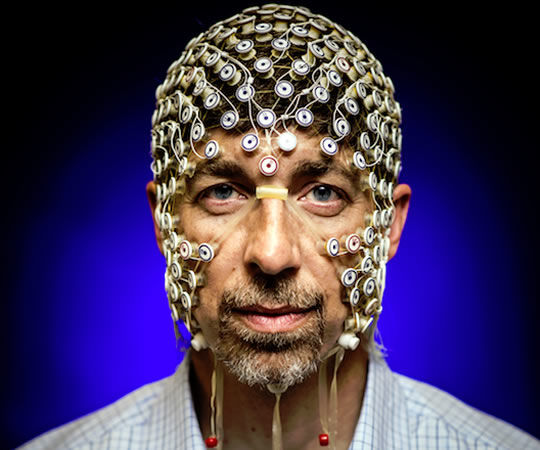
© Nick BerardProfessor Barry Van Veen wearing an electrode net that measures brain activity.
Scientists at the University of Wisconsin-Madison and the University of Liege in Belgium have tracked the electrical activity in the brains of people either watching a video or imagining watching a video (Dentico et al., 2014). The findings could lead to new ways of understanding what happens in our brains when we sleep and dream. The scientists also hope the results will reveal insights into how short-term memory works.
Professor Barry Van Veen, who led the study, said:
"A really important problem in brain research is understanding how different parts of the brain are functionally connected. What areas are interacting? What is the direction of communication?The study used electroencephalography (EEG) to measure the electrical activity in different regions of the brain while people were watching the video or imagining it.
We know that the brain does not function as a set of independent areas, but as a network of specialized areas that collaborate."





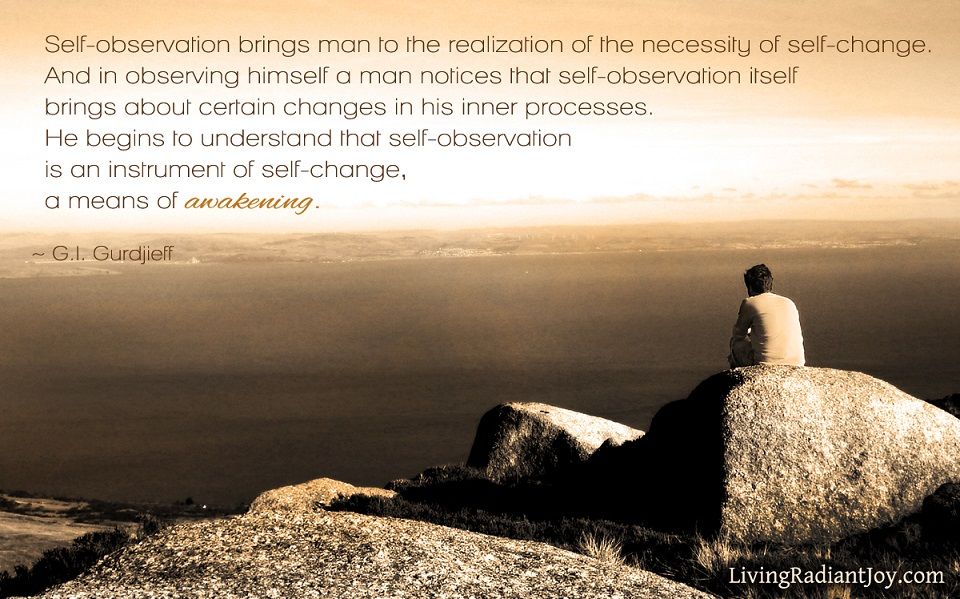












Comment: From In Search of the Miraculous: Fragments of an Unknown Teaching - a 1949 book by Russian philosopher P. D. Ouspensky which recounts his meeting and subsequent association with G.I. Gurdjieff: