Science of the SpiritS


Light Saber

Stepping outside your comfort zone: Ten uncomfortable challenges that will pay off forever

comfort zone
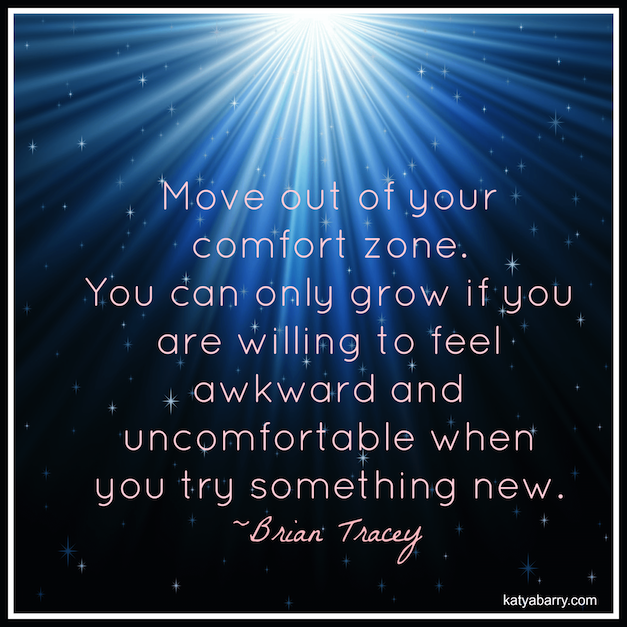
T.S. Eliot was clearly onto something when he asked, "If you aren't in over your head, how do you know how tall you are?" The very act of stepping outside of your comfort zone is critical to your success and well-being.

Our brains are wired such that it's difficult to take action until we feel at least some stress and discomfort. In fact, performance peaks when we're well out of our comfort zone. If you're too comfortable your performance suffers from inaction, and if you move too far outside of your comfort zone you melt down from stress.

Peak performance and discomfort go hand in hand. Stepping outside of your comfort zone makes you better, and it doesn't have to be something as extreme as climbing Mount Everest. It's the everyday challenges that push your boundaries the most, none of which require a flight to Nepal. Step out of your comfort zone and embrace these challenges.


Comment: Sixteen difficult to learn life skills that will pay off forever


Boat

The long road back: What it feels like to wake up from a coma

tunnel
© Pixabay
Being in a coma is a terrifying condition, which is just a step away from death. It is the complete loss of consciousness and there is a small chance of recovery. The stories of people who have come out of a coma are mysterious and at times terrifying.

RIA Novosti correspondent Irina Haletskaya spoke to a few people who have come out of a long coma and shared their experiences with her.

Palette

The art of self-control

man in art gallery
After somebody threw a flask of acid on the Mona Lisa in 1956, they put her behind bulletproof (and presumably acid-proof) glass. Same with Picasso's Guernica, after a man spray-painted "Kill all lies" in giant red letters across the canvas.

I have always found it unbelievable that most very famous paintings have no physical barrier between them and the visitors. At MoMA in New York, I wandered around a small wall, turned, and was alarmed to discover Starry Night by Vincent van Gogh, hardly more than an arm's length away from my distracted, clumsy body.

Comment: See also:
The more you regularly experience gratitude, the more self-control you have


Hourglass

Being busy is killing our ability to think creatively

being busy
The other day, a friend mentioned that he's looking forward to autonomous cars, as it will help lower the accident and fatality rates caused by distracted driving. True, was my initial reply, with a caveat: what we gain on the roads we lose in general attention. Having yet another place to be distracted does not add to our mental and social health.

Little good comes from being distracted, yet we seem incapable of focusing our attention. Among many qualities that suffer, recent research shows creativity takes a hit when you're constantly busy. Being able to switch between focus and daydreaming is an important skill that's reduced by insufferable busyness. As Stanford's Emma Seppälä writes:
The idea is to balance linear thinking-which requires intense focus-with creative thinking, which is borne out of idleness. Switching between the two modes seems to be the optimal way to do good, inventive work.

Comment: The dis-ease of being busy
Tell me you remember you are still a human being, not just a human doing. Tell me you're more than just a machine, checking off items from your to-do list. Have that conversation, that glance, that touch. Be a healing conversation, one filled with grace and presence.


Brain

Switch it up! Different types of meditation strengthen different parts of the brain

meditation
© Mooshny/Shutterstock
Different types of meditation change the brain in different ways, a new study finds.

In one of the largest studies on meditation and the human brain to date, a team of neuroscience researchers at the Max Planck Institute of Human Cognitive and Brain Sciences in Germany examined 300 participants in a nine-month meditation program. The project, called ReSource, consisted of three periods of three months each. During this program, the participants each practiced three different types of meditation focused on improving attention, compassion or cognitive skills.

At the beginning of the program, and then again at the end of each three-month period, the researchers took measurements of the participants' brains using a variety of techniques, including magnetic resonance imaging (MRI). The researchers found that not only did certain brain regions change substantially within the three-month periods, but these regions also changed differently based on the type of meditation the participants had practiced.

"We were surprised [by] how much can actually happen in three months, because three months isn't that long," said Veronika Engert, a neuroscience researcher at Max Planck. Engert was the lead author of one of two papers published on Oct. 4 by the research group in the journal Science Advances.

Brain

Harvard-trained brain scientist's stroke gave insight into meaning of life

Neuroscientist Jill Bolte Taylor
© Collective EvolutionNeuroscientist Jill Bolte Taylor
What if your left brain suddenly shut off and only the right side of your brain were active and working? This is something that can happen when you have a stroke, and exactly what neuroscientist Jill Bolte Taylor experienced in 1996 - and she was conscious of it happening.

Taylor's story is not a new one. She gave a TED talk about the amazing journey she had the morning of her stroke and wrote a book about what she learned. I wanted to draw attention to this story today because 'consciousness' has become a huge topic recently, and Jill's story, which gets at the heart of who we truly are, offers much to the discussion.

Think about some of the shows and movies that have taken over the collective consciousness over the past two years - The OA, Stranger Things, Sense 8, Interstellar, The Arrival, Unacknowledged - and you'll see these share a common theme: the exploration of our reality and consciousness.

Even if these themes weren't obvious to everyone who watched, they planted seeds that continue to germinate a desire to explore more about our reality and who we are.

Shoe

Long-term study concludes that only one hour of exercise per week could reduce depression risk by 44%

exercise
Even relatively small amounts of exercise can help reduce the risk of developing depression.

Only one hour of exercise per week is enough to help prevent depression, new research finds.

In the largest survey of its kind, the anxiety and depression levels of 33,908 Norwegians were monitored for more than 11 years.

The researchers concluded that just one hour of exercise a week reduced the chances of developing depression by a massive 44%.

Comment: How exercise keeps depression at bay

A scientific review of multiple studies looked at what happens within our bodies during and after exercise that might affect and improve our moods. The researchers analyzed 20 past studies in which scientists had obtained blood samples from people with major depression before and after they had exercised. The samples on the whole indicated that exercise significantly reduced various markers of inflammation and increased levels of a number of different hormones and other biochemicals that are thought to contribute to brain health.

See also:


Brain

Diseases of the will: Six psychological flaws that prevent talented people from achieving success

Santiago Ramón y Cajal
Self-portrait by Cajal at his library in his thirties, from Beautiful Brain: The Drawings of Santiago Ramón y Cajal
We all like to think that we are talented enough to make a major impact on the world.

However, for whatever reason, no matter how intelligent or capable someone is they don't always get that big break.

Many people put it down to bad luck or not being in the right place at the right time, but there could be a scientific reason behind that lack of success.

Santiago Ramon y Cajal, widely considered the father of neuroscience, attempted to explore the psychological boundaries that prevented talented people from excelling in life.

In his 1897 book, Advice for a Young Investigator, the Spanish Pathologist detailed six different factors which restrain an individual's talents, which he called 'diseases of the will.'

Pi

45-year-long study finds ultra-successful children share common traits: Exceptional mathematics abilities and spacial awareness

smart kids, smart children, intelligence linked sucess
What does it take to become ultra successful?

An ongoing study suggests that drive and persistence can only take you so far. That's what a team of scientists at Vanderbilt found after a 45-year-long study.

In fact, some of the most influential leaders of our age had what it takes at birth: super intelligence. That means scoring in the top 3% on the SAT by age 13.

Kids who achieved this impressive feat had two main abilities in common: they could solve math problems they'd never been taught and they had exceptional spatial awareness - meaning they could remember spatial relationships between objects exceptionally well.


Fire

The destruction caused by gaslighting

Ingrid Bergman
Many of us have probably heard of gaslighting. In this article, we will explore what is behind this concept and why it is so destructive, disturbing, and toxic.

Origins and definition

Gaslighting is a term used in psychology and common speech that refers to manipulation whose purpose is to create doubt in a person or a group of people. It includes but is not limited to denial, lying, deflection, and contradiction to make the target question their perception of reality.

Comment: See also - Gaslighting: An insidious form of emotional abuse