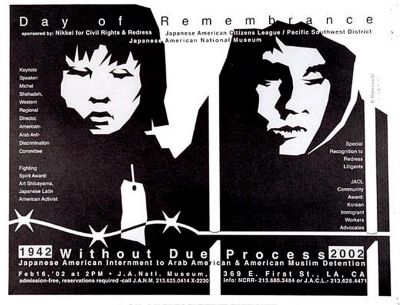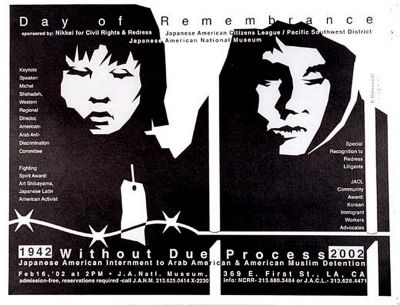
© David Monkawa/NCRR A poster for Day of Remembrance 2002, months after the 9/11 attacks, focused on the detention of Muslim and Arab Americans.
Japanese-Americans are holding a Day of Remembrance this week for community elders who were unlawfully locked in internment camps during World War II. But for many people - including U.S. judicial authorities - the specter of the camps is hardly a thing of the past.
"You are kidding yourself if you think the same thing will not happen again," U.S. Supreme Court Justice Antonin Scalia
told University of Hawaii law students earlier this month. "In times of war, the laws fall silent."
For many former detainees who will tell their stories during remembrance events Wednesday, Scalia's words are a sobering reminder that national security at times trumps constitutional rights. They think of the National Security Agency's mass surveillance of private communications or the indefinite
detentions of alleged terrorism suspects - mostly Arab and Muslim men - under the National Defense Authorization Act (NDAA).
The Day of Remembrance marks not only the day in 1942 when President Franklin Roosevelt signed
an executive order allowing the internment of 120,000 people of Japanese origin after Japan attacked Pearl Harbor; it also serves as "a reminder to our communities - our civil rights are still not protected," said Karen Korematsu, whose father, Fred Korematsu, famously challenged his detention in the landmark Supreme Court case
Korematsu v. United States in 1944.
Karen Korematsu cited the NDAA's indefinite detentions as one attack on civil rights now faced primarily by American Muslims. Among the other issues they say they face are the
mass infiltration of mosque communities by law enforcement and
harassment by Transportation Security Administration staff at U.S. borders.
"Even (Scalia) said this could happen again. That's why education (on Japanese-American internment and civil rights) is so important," Korematsu said.