Society's ChildS


Broom

Homeland Security seeks to restrict immigrants from accessing social assistance programs

social assistance welfare immigrants fraud
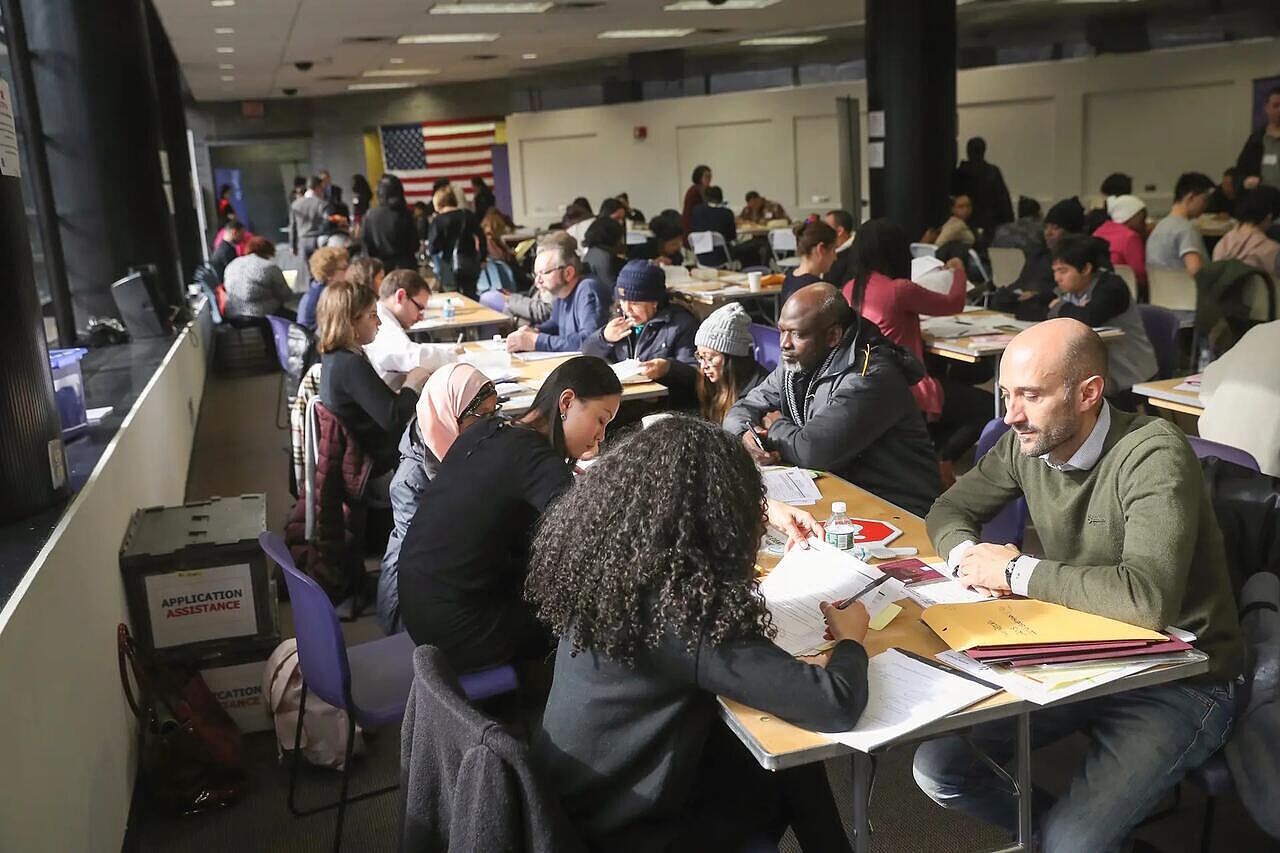
© John Moore/Getty ImagesImmigrants receive help with U.S. citizenship applications at an event in New York City on Feb. 3, 2018.
The Department of Homeland Security (DHS) is seeking to change a rule that determines eligibility for permanent residency — commonly known as a green card — based on whether an applicant is considered a "public charge," someone who is likely to depend primarily on public benefits.

That rule — known as the public charge ground of inadmissibility — generally applies to green card applicants, with the exception of certain categories such as refugees and asylum seekers.

In 2022, 54 percent of households headed by immigrants — naturalized, legal, and illegal — used one or more major welfare programs. That's compared to 39 percent of U.S.-born households, according to Census Bureau data.

In November 2025, DHS issued a proposal to repeal existing public charge regulations and institute a broader, discretionary standard.

X

California GOP asks SCOTUS to block redistricting map

Cal district map
© Adobe StockCalifornia District Map
The emergency request asks the Supreme Court to weigh in by Feb. 9, and accuses the state of violating the United States Constitution by engaging in "racial gerrymandering," by redrawing the lines to favor Hispanic voters.

The California Republican Party on Tuesday filed an emergency application asking the U.S. Supreme Court to approve an injunction to block a newly redrawn congressional map that California voters approved last year from going into effect.

Californians approved Proposition 50, which contained the proposed map, in November. The map intends to boost the Democratic majority in the state's congressional delegation and offset possible gains from redistricting efforts in red states.

California GOP Chairwoman Corrin Rankin said in a statement:
"Our emergency application asks the Supreme Court to put the brakes on Prop. 50 now, before the Democrats try to run out the clock and force candidates and voters to live with unconstitutional congressional districts. Californians deserve fair districts and clean elections, not a backroom redraw that picks winners and losers based on race."
The emergency application comes after a federal court upheld the new map last week.

Comment: Court upholds Prop. 50:
A federal court has rejected a legal challenge by California Republicans seeking to block a voter-approved congressional map ahead of the 2026 midterm elections.

Governor Gavin Newsom announced Wednesday that a three-judge panel of the U.S. District Court for the Central District of California ruled against the lawsuit, which aimed to nullify Proposition 50, a measure approved by California voters last November.

Republicans argued the ballot initiative should not take effect and were joined in the lawsuit by the U.S. Department of Justice. Proposition 50 was passed after Texas Republicans redrew their own congressional map, a move California leaders said was designed to favor Republicans in the upcoming midterms.

"Republicans' weak attempt to silence voters failed," Newsom said in a statement. "California voters overwhelmingly supported Prop. 50 — and that is exactly what this court concluded."

The ruling clears the way for Proposition 50 to remain in effect as California prepares for the 2026 midterm elections, keeping the voter-approved congressional map in place.
Is political gerrymandering illegal?
Not under the U.S. Constitution. The Supreme Court, in a 2019 case originating from North Carolina, ruled that federal courts have no authority to decide whether partisan gerrymandering goes too far.

Chief Justice John Roberts wrote: "The Constitution supplies no objective measure for assessing whether a districting map treats a political party fairly."

The Supreme Court noted that partisan gerrymandering claims could continue to be decided in state courts under their own constitutions and laws. But some state courts, including North Carolina's highest court, have ruled that they also have no authority to decide partisan gerrymandering claims.

Are there any limits on redistricting?

Yes. Though it's difficult to challenge legislative districts on political grounds, the Supreme Court has upheld challenges on racial grounds. In a 2023 case from Alabama, the high court said the congressional districts drawn by the state's Republican-led Legislature likely violated the Voting Rights Act by diluting the voting strength of Black residents. The court let a similar claim proceed in Louisiana. Both states subsequently redrew their districts.

What does data show about gerrymandering?

Statisticians and political scientists have developed a variety of ways to try to quantify the partisan advantage that may be attributable to gerrymandering.

Republicans, who control redistricting in more states than Democrats, used the 2010 census data to create a strong gerrymander. An Associated Press analysis of that decade's redistricting found that Republicans enjoyed a greater political advantage in more states than either party had in the past 50 years.

But Democrats responded to match Republican gerrymandering after the 2020 census. The adoption of redistricting commissions also limited gerrymandering in some states. An AP analysis of the 2022 elections — the first under new maps — found that Republicans won just one more U.S. House seat than would have been expected based on the average share of the vote they received nationwide. That was one of the most politically balanced outcomes in years.


NPC

DEI still runs rampant in Trump's Small Business Administration

small business administration US
© Chip Somodevilla/Getty Images
The Trump administration awards government contracts on the basis of race and sex. It needs to stop.

On the campaign trail, President Donald Trump promised to end federal spending on diversity, equity, and inclusion (DEI) programs. Yet the government has continued to award contracts based on race and sex. Despite rampant fraud and multiple court rulings against the practice, the Small Business Administration (SBA) has used "disadvantage" essays from business owners to skirt the rules and continue discriminatory programs that dole out billions in government contracts.

For decades, the federal government has awarded certain special contracts exclusively to so-called disadvantaged businesses and women-owned small businesses. Until 2023, SBA presumed that racial minorities were "disadvantaged." The resulting discrimination was absolute: according to an analysis conducted between 2020 and 2023, these programs made not a single award to white men.

Though the second Trump administration has taken steps to limit these contracts, the largest disadvantaged-business initiative — the SBA's 8(a) program — is thriving. The program "is still one of the most lucrative and sought after" SBA certificates, one contracting lawyer said in November. In fact, fiscal year 2025 saw the largest 8(a) spending on record, totaling $26 billion.

Sheriff

ICE launches new operation in Maine amid Trump's crackdown

police ICE Minneapolis Minnesota US
© Victor J. Blue/Bloomberg via Getty ImagesA federal law enforcement agent outside a home during a raid in Minneapolis, Minnesota, on Tuesday, Jan. 13, 2026.
U.S. Immigration and Customs Enforcement (ICE) made dozens of arrests in Maine on Tuesday amid an effort known as Operation Catch of the Day.

Fox News' Griff Jenkins reported on Wednesday that authorities had arrested more than 50 people on Tuesday, and had informed him more arrests were taking place on Wednesday.

"We have approximately 1,400 targets here in Maine," ICE Deputy Assistant Director Patricia Hyde said on Tuesday, going on to mention crimes such as "rape of a child, drug trafficking" as well as "sexual assaults, simple assaults" and "driving while under the influence."

Skull

Moscow reports mass graves in region liberated from Ukraine

Evacuation
© SputnikRussian servicemen evacuate civilians from the town of Sudzha in Kursk Region
Russia has accused Kiev of committing numerous war crimes during the occupation of Kursk Region.

The Russian authorities have found 524 bodies in "mass burial sites" in the border region of Kursk after a large-scale Ukrainian incursion was repelled last year, Russia's human rights commissioner, Tatyana Moskalkova, has said.

Ukrainian forces launched an offensive on Kursk Region in August 2024 and initially made some gains, a move that Kiev framed as a way to pressure Moscow and strengthen its hand in future talks. The incursion soon stalled, with Russia gradually pushing back the Ukrainian forces. The region was fully liberated in April 2025.

Russian officials have reported numerous testimonies alleging war crimes, indiscriminate shelling, and violence against civilians, as well as abuses of POWs, during the Ukrainian presence.

Speaking to reporters on Wednesday, Moskalkova said Moscow mobilized all its resources to trace civilians caught up in the fighting, adding that 524 bodies have been found in mass graves since August 2024. She did not give a breakdown of their nationality or whether they were military or civilians.

Sherlock

Netherlands Silver Museum Emptied in Massive Overnight Heist

Zilvermuseum Doesburg
In the early hours of Wednesday, 21 January 2026, the Zilvermuseum Doesburg, a small museum housed inside the historic Martinikerk in the Gelderland town of Doesburg, was completely robbed of its antique silver collection in what authorities are treating as a major burglary. The theft — involving more than 300 precious silver objects representing centuries of craftsmanship from around the world — has left museum officials, local authorities, and heritage advocates stunned.

At approximately 4:30 a.m., two unknown individuals forced their way into the church through a tower entrance, used a crowbar to breach the museum's doors, and smashed all 14 display vitrines before departing with the entire silver collection, police and museum statements confirm.
"The entire collection of antique silver has been stolen." — Museum press release, Zilvermuseum Doesburg (translated)

Magnify

Ghislaine Maxwell ordered to tell all at House Oversight Epstein deposition

Ghislaine Maxwell
© REUTERS
Rep. James Comer (R-Ky.) revealed Wednesday that Jeffrey Epstein's imprisoned accomplice, Ghislaine Maxwell, will sit for a deposition before the House Oversight Committee on Feb. 9.

Maxwell — who has already been interviewed by Deputy Attorney General Todd Blanche — is serving a 20-year prison sentence for conspiring with Epstein to sex-traffic dozens of girls, some as young as 14.

Comer announced Maxwell's appearance during a markup of contempt resolutions against former President Bill Clinton and former Secretary of State Hillary Clinton.

Neither had answered subpoenas compelling their appearance, prompting Republicans on the Oversight panel to initiate contempt of Congress proceedings.

Alarm Clock

AI could replace doctors in life-and-death decisions - 'suicide pod' inventor

Philip Nitschke enters a 'suicide pod'
© AP Photo/Ahmad SeirFILE PHOTO. Philip Nitschke enters a 'suicide pod' known as 'The Sarco' in Rotterdam, The Netherlands.
The inventor of the controversial Sarco suicide pod, Philip Nitschke, said artificial intelligence could one day replace psychiatrists in assessing whether people seeking assisted dying are mentally capable of making the decision, Euronews reported on Thursday.

The Sarco, short for sarcophagus, is a 3D-printed capsule designed for one person to enter, lie down, and press a button. The device rapidly reduces oxygen levels and fills the capsule with nitrogen, causing death by hypoxia.

Nitschke, an Australian euthanasia campaigner and the pod's creator, said AI could determine who has the "mental capacity" to end their own life. He told the outlet that doctors should not be "running around giving you permission or not to die" and that the choice should rest with those "of sound mind."

Comment: What a horrible way to reduce the population with an AI making the decision. What could possibly go wrong? How about bringing out the touted MedBed.


Arrow Down

Lords vote brings UK 'Social Media Ban' one step closer

Social Media Ban
© Off-Guardian Org
Yesterday, the British House of Lords brought the looming end of online anonymity one step closer when they voted to support an amendment to the pending Children's Wellbeing and Schools Bill that would ban children under 16 from using social media.

It's been said more times than anyone can count, but any "social media ban" based on age would - in reality - be an excuse to require all users to verify their identity and thereby end online anonymity, and eventually usher in government backed digital ID apps.

The good news is that some dissenters in the Lords seems to be aware of this danger, and spoke of it openly:

...though I would add, in this case, the consequences are far from "unintended". The side effect is the intended effect.

Arrow Down

Somalia and the high cost of a low trust society

somalia usaid africa charity
When news broke of the massive child nutrition fraud in Minnesota, many Americans reacted with disbelief. During the pandemic, roughly $250 million intended to feed hungry children was siphoned off, prosecutors say, and spent on luxury cars, real estate, and other indulgences. To most people, it appeared to be a shocking betrayal of public trust.

To me, it felt unsettlingly familiar.

Decades ago, long before Minnesota became synonymous with one of the largest fraud cases in U.S. history, I had an experience in Somalia that permanently altered my perspective on aid, trust, and good intentions. It is why I read the indictments differently, not with surprise so much as recognition.

What struck me most about the Minnesota case was not only the scale of the theft but the silence surrounding it. The fraud appears to have operated in plain sight within tightly knit circles, yet few people spoke out.