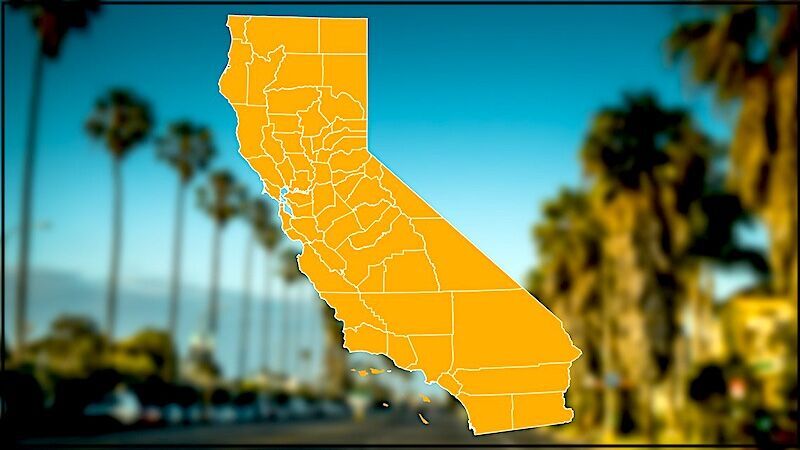
© Adobe StockCalifornia District Map
The California Republican Party on Tuesday
filed an emergency application asking the U.S. Supreme Court to approve an injunction to block a newly redrawn congressional map that California voters approved last year from going into effect.
Californians approved Proposition 50, which contained the proposed map, in November. The map intends to boost the Democratic majority in the state's congressional delegation and
offset possible gains from redistricting efforts in red states.California GOP Chairwoman Corrin Rankin said in a statement:
"Our emergency application asks the Supreme Court to put the brakes on Prop. 50 now, before the Democrats try to run out the clock and force candidates and voters to live with unconstitutional congressional districts. Californians deserve fair districts and clean elections, not a backroom redraw that picks winners and losers based on race."
The emergency application comes after a federal court upheld the new map last week.
Comment: Court upholds Prop. 50:
A federal court has rejected a legal challenge by California Republicans seeking to block a voter-approved congressional map ahead of the 2026 midterm elections.
Governor Gavin Newsom announced Wednesday that a three-judge panel of the U.S. District Court for the Central District of California ruled against the lawsuit, which aimed to nullify Proposition 50, a measure approved by California voters last November.
Republicans argued the ballot initiative should not take effect and were joined in the lawsuit by the U.S. Department of Justice. Proposition 50 was passed after Texas Republicans redrew their own congressional map, a move California leaders said was designed to favor Republicans in the upcoming midterms.
"Republicans' weak attempt to silence voters failed," Newsom said in a statement. "California voters overwhelmingly supported Prop. 50 — and that is exactly what this court concluded."
The ruling clears the way for Proposition 50 to remain in effect as California prepares for the 2026 midterm elections, keeping the voter-approved congressional map in place.
Is political gerrymandering illegal?
Not under the U.S. Constitution. The Supreme Court, in a 2019 case originating from North Carolina, ruled that federal courts have no authority to decide whether partisan gerrymandering goes too far.
Chief Justice John Roberts wrote: "The Constitution supplies no objective measure for assessing whether a districting map treats a political party fairly."
The Supreme Court noted that partisan gerrymandering claims could continue to be decided in state courts under their own constitutions and laws. But some state courts, including North Carolina's highest court, have ruled that they also have no authority to decide partisan gerrymandering claims.
Are there any limits on redistricting?
Yes. Though it's difficult to challenge legislative districts on political grounds, the Supreme Court has upheld challenges on racial grounds. In a 2023 case from Alabama, the high court said the congressional districts drawn by the state's Republican-led Legislature likely violated the Voting Rights Act by diluting the voting strength of Black residents. The court let a similar claim proceed in Louisiana. Both states subsequently redrew their districts.
What does data show about gerrymandering?
Statisticians and political scientists have developed a variety of ways to try to quantify the partisan advantage that may be attributable to gerrymandering.
Republicans, who control redistricting in more states than Democrats, used the 2010 census data to create a strong gerrymander. An Associated Press analysis of that decade's redistricting found that Republicans enjoyed a greater political advantage in more states than either party had in the past 50 years.
But Democrats responded to match Republican gerrymandering after the 2020 census. The adoption of redistricting commissions also limited gerrymandering in some states. An AP analysis of the 2022 elections — the first under new maps — found that Republicans won just one more U.S. House seat than would have been expected based on the average share of the vote they received nationwide. That was one of the most politically balanced outcomes in years.








Comment: Court upholds Prop. 50: Is political gerrymandering illegal?