Fire in the SkyS


Fireball 5

"Flash in the sky" above New Mexico was a meteor, 21 January 2013

Just before midnight on Monday, a bright flash occurred, lighting up the entire sky.

"It was a bright fireball," said Thomas Cupillari, director of the Thomas G. Cupillari '60 Observatory at Keystone College.

The all sky camera at the observatory caught footage of the fireball.

"They graze the top of the atmosphere and can stay for quite awhile," Cupillari said. "This fireball was so bright it lit up the entire sky around it. They usually burn up within one to three seconds. There was one I saw years ago that lasted for 5-20 seconds. It's very unusual for them to be so bright and last that long."

The all sky camera caught 3-4 seconds of the fireball, but Cupillari predicts it actually lasted 5-6 seconds.

The all sky camera is a fish eye lens that is pointed straight up into the air and can see 360 degrees around.

Evil Rays

Booms in downstate Indiana still a mystery

A series of late-night, window-rattling booms reported in two Southwestern Indiana counties has left investigators stumped.

Several residents of Vanderburgh and Warrick counties reported hearing loud booms and feeling vibrations on the nights of Jan. 7 and 8, spurring an investigation into the noises.

The Evansville Courier & Press reported Monday that local public safety agencies have found no concrete evidence about the source of the noises. The sounds had generated speculation that they might have been caused by explosions in nearby coal mines or produced by aircraft.

Comet 2

Researcher suggests that predawn spectacle over California and Nevada last week was a 'small flaming comet'

The fireball that lit up the predawn Northern California sky last week was a small comet that flamed out when it hit the Earth's atmosphere, a researcher said Tuesday.

The comet "instantly turned into dust and gas," resulting in the flash of light seen by many at 5:21 a.m. Thursday, said meteor hunter Peter Jenniskens, a scientist at the Seti Institute in Mountain View.

Because the comet vaporized, no pieces fell to Earth, Jenniskens said.

The comet came into contact with the Earth's atmosphere just north of Yosemite National Park at a speed of 160,000 mph, Jenniskens said.

Fireball 4

Bright fireball a captivating sight across Kanto region of Japan

Meteor
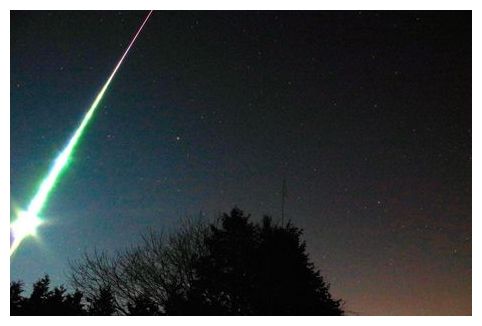
© Fumiaki GotoA shooting star observed before dawn on Jan. 20 near the Dodaira astronomical observatory in Tokigawa, Saitama Prefecture. Exposure time: 16.8 seconds.

A shooting star accompanied by a loud boom was observed before dawn Jan. 20 across broad areas of the Kanto region, igniting intense interest on the Internet with the posting of video footage and eyewitness accounts.

Fumiaki Goto, 28, an office worker in Tokigawa, Saitama Prefecture, captured footage of the fireball by chance while taking photos of the night sky just after 2:40 a.m.

The plume was enhanced suddenly after its color turned to bluish white from light green and fell toward Ibaraki Prefecture, finally with a reddish hue, said Goto.

The fireball was likely a meteorite, experts said. Video footage taken from a car had more than 200,000 hits.

Chikara Shimoda of the Japan Fireball Network, a group of amateur astronomers, said the fireball disappeared at an altitude of about 30 kilometers.

"It may have burnt up, or perhaps it hit the sea," said Shimoda, 55.

Fireball

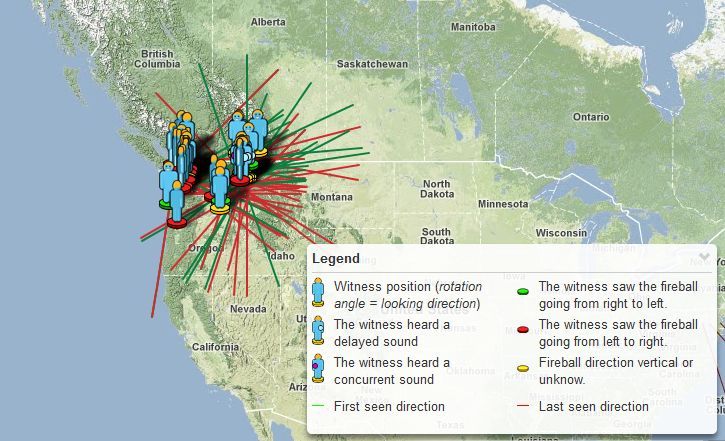
Multicolored fireball blazes over Northwestern U.S., 11 January 2013

Image
© AMS
The American Meteor Society has received 40 reports of a bright meteor that occurred near 06:30 PST on Friday morning January 11, 2013. Brightness estimates of this fireball vary considerably, but the average lies near magnitude -18, which lies between the light produced by the full moon and the sun. Every color of the rainbow has been reported with blue and white being most mentioned. A great majority of the reports have come from Washington, but sightings of the same event have also been received from Oregon, Idaho, and British Columbia. Individual reports may be viewed in the 2013 AMS Fireball Table Refer to event #63 for 2013.

For those not familiar with meteors and fireballs, a fireball is a meteor that is larger than normal. Most meteors are only the size of small pebbles. A meteor the size of a softball can produce light equivalent to the full moon for a short instant. The reason for this is the extreme velocity at which these objects strike the atmosphere. Even the slowest meteors are still traveling at 10 miles per SECOND, which is much faster than a speeding bullet. Fireballs occur every day over all parts of the Earth. It is rare though for an individual to see more than one or two per lifetime as they also occur during the day, on a cloudy night, or over a remote area where no one sees it. Observing during one of the major annual meteor showers can increase your chance of seeing another one of these bright meteors.

Fireball 2

Fireball lights up early morning sky from Nevada to California, 17 January 2013

Image
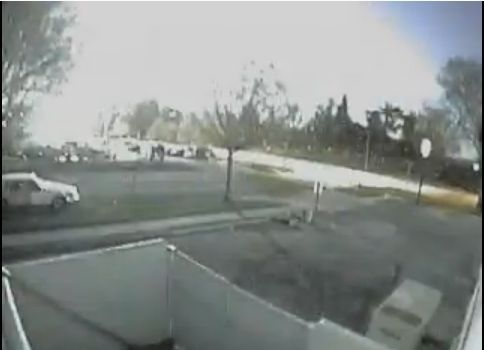
Still from a security camera that captured an exploding fireball turn night into day over Cedar Rapids, Iowa, U.S.A. on 14 April 2010
Bob Young's bedroom was black and quiet Thursday morning, just as it normally would be in the hours before sunrise, and the West San Jose resident said he was barely awake.

Then ...

"Without warning," he said, "the bedroom just lit up. I mean, just lit up. The whole thing. It made me wonder if something had blown up, like maybe a transformer."

Turned out, it wasn't a transformer but a meteor being transformed. The spectacular bright light in the sky that stunned Young and other Bay Area residents was an exploding meteor called a fireball, said Chabot Space and Science Center astronomer Ben Burress.

The flash of light lit up the skies about 5:25 a.m., Burress said. People from as far away as Monterey County and into Nevada reported the fireball to the Space and Science Center, Burress said.

Fireball 4

Northern California fireball lights up early-morning sky

San Francisco -- A fireball lit up the predawn Northern California sky Thursday, according to reports from early risers.The possible meteor was reported about 5:25 a.m. by people across California and as far away as Fernley, Nev., about 30 miles east of Reno."Wow, what a sight to have seen!" David Rivas of Seaside (Monterey County) wrote in an e-mail to The Chronicle.

He said he and his wife saw the streak as they were driving on Highway 1 north of Monterey. "It first appeared as a quick movement of sorts, maybe similar to a shooting star or quick lightning strike off to the east."Then, Rivas said, "it grew into "something shaped like a giant orange crayon."

Others described what they had seen on the American Meteor Society website.

Fireball 4

Green fireball flashes through Winnipeg, Manitoba sky, 15 January 2013

Many Winnipeggers were stunned by a sudden whitish-green flash in the night sky Tuesday.

It happened at about 10 p.m. and the mystery light was gone as suddenly as it appeared.

Scott Young at the Manitoba Museum said he's not 100 per cent certain about it, but all signs point to the light being a meteorite.

"They slow down so quickly and they heat up so quickly that often they just explode in what's called a terminal burst and that's often a greenish colour," he said.

"So the colour sort of tips me off and also just the speed that this comes over."

If it was a meteorite, it would only be the 14th time in Manitoba history that one has come through the atmosphere in this province, Young said

Question

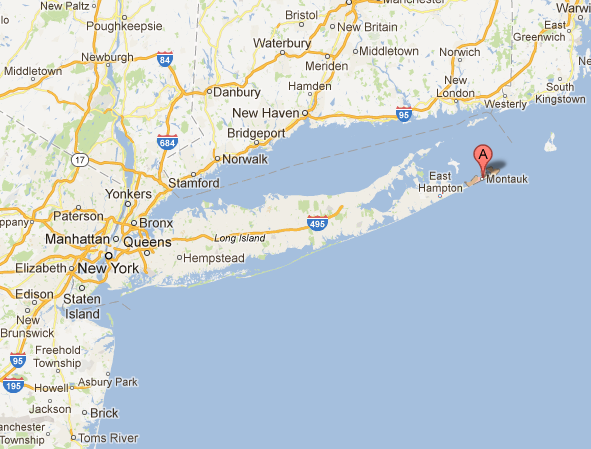
Sky explosion?: Mysterious "explosion" sound, heard for at least last three months, Montauk, New York

Montauk map
© Google Maps
Police are investigating a mysterious exploding sound that has been occurring intermittently in Montauk for months.

Investigators believe someone is setting off a large mortar fireworks, but they have no arrests have been made since officially beginning an investigation in October.

The explosions, about a half-dozen or so, mainly occur in the evening, on weekends, sporadically, and only once on any given day. The most recent sound was reported on Sunday, police said.

Fireball 3

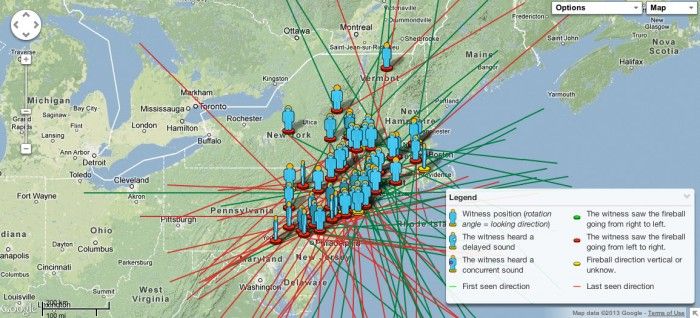
Multicolored fireball blazes over Northeastern U.S., 5 January 2013

Image
© American Meteor SocietyJanuary 5th, 2013 East Coast Fireball
The American Meteor Society has received 50 reports of a bright meteor that occurred near 06:33 EST on Saturday evening January 5, 2013. Brightness estimates of this fireball vary considerably, but the average lies near magnitude -18, which lies between the light produced by the full moon and the sun. Every color of the rainbow has been reported with green being most mentioned. Below is a map of the witness reports for the NE USA fireball event and can also be found in the fireball logs, refer to event 28 for 2013. Click the image below to see the interactive event map.

For those not familiar with meteors and fireballs, a fireball is a meteor that is larger than normal. Most meteors are only the size of small pebbles. A meteor the size of a softball can produce light equivalent to the full moon for a short instant. The reason for this is the extreme velocity at which these objects strike the atmosphere. Even the slowest meteors are still traveling at 10 miles per SECOND, which is much faster than a speeding bullet. Fireballs occur every day over all parts of the Earth. It is rare though for an individual to see more than one or two per lifetime as they also occur during the day, on a cloudy night, or over a remote area where no one sees it. Observing during one of the major annual meteor showers can increase your chance of seeing another one of these bright meteors.