Fire in the SkyS


Fireball

What we know about the Russian meteor event on Feb 15, 2013

We have the technology to provide warning about these potential disasters

What we know (subject to change as more information comes in): At 9:20 a.m. local time in Russia, videos show an impactor coming in from the North. Asteroid 2012 DA14 is approaching Earth from the South. These two events are not related. The body is estimated to have been 15 meters across and weighed roughly 8 tons 8000 tons. The resulting airburst would have the equivalent yield of a 1-10 megaton 500 kiloton explosion. Note that these are very rough and extremely preliminary estimates.


Comment: The problem isn't a lack of technology; the problem is that our leaders have chosen to ignore the problem.

From Letters From The Edge:
Awareness of the possibility of large impact events on Earth, although long present among a handful of the most imaginative thinkers, has come of age in this century as a result of studies of Arizona's Meteor Crater and the Tunguska fireball of June 30, 1908, in Siberia, spacecraft observations of cratering on Earth and other rocky bodies, and astronomical surveys of the near-Earth asteroid and comet populations. Appreciation of the effects of large impacts has developed in response to these studies and to the unclassified literature on the effects of large nuclear weapons. [...]

The most intensively studied impact phenomenon, impact cratering, is of limited importance, due to the rarity and large mean time between events for crater-forming impacts. Almost all events causing property damage and lethality are due to bodies less than 100 meters in diameter, almost all of which, except for the very largest and strongest, are fated to explode in the atmosphere. ... Since explosions greater than 1 gigaton TNT are rare on this short of a time scale, we are forced to conclude that the complex behavior of smaller bodies is closely relevant to the threat actually experienced by contemporary civilization. [...]

The large majority of lethal events (not of the number of fatalities) are caused by bodies that are so small, so faint, and so numerous that the cost of the effort required to find, track, predict, and intercept them exceeds the cost of the damage incurred by ignoring them.

(John S. Lewis, Professor of Planetary Sciences at the Lunar and Planetary Laboratory, Co-director of the NASA/University of Arizona Space Engineering Research Center, and Commissioner of the Arizona State Space Commission in: Comet and Asteroid Impact Hazards on a Populated Earth, 2000; Academic Press)


Meteor

Flashback Best of the Web: Military Hush-Up: Incoming Space Rocks Now Classified


Comment: Editorial note, 17 February 2013: The following article and SOTT editorial comment (below) was first published in 2009.


Image
For 15 years, scientists have benefited from data gleaned by U.S. classified satellites of natural fireball events in Earth's atmosphere - but no longer. A recent U.S. military policy decision now explicitly states that observations by hush-hush government spacecraft of incoming bolides and fireballs are classified secret and are not to be released, SPACE.com had learned.

The satellites' main objectives include detecting nuclear bomb tests, and their characterizations of asteroids and lesser meteoroids as they crash through the atmosphere has been a byproduct data bonanza for scientists.

The upshot: Space rocks that explode in the atmosphere are now classified.

Comment: Anyone who has been closely following the geopolitical situation over the last decade would not be in the least surprised or baffled at why this information is now being withheld from the public. Objects in the heavens will be playing a greater and greater role in events down here on the Big Blue Marble over the next few years, if our hypotheses here at SOTT are close to correct.

The masters of our world want more "hype and fear of the unknown". World events are orchestrated for just that effect.

Too bad these scientists aren't reading SOTT!


Fireball 3

Confirmed: Fireball exploded over Cuba last week - Shock wave shook buildings, caused panic

Cuba apparently experienced a phenomenon similar to the meteorite that detonated over Russia this week, island media reported, with startled residents describing a bright light in the sky and a loud explosion that shook windows and walls.

There were no reports of any injuries or damage such as those caused by the Russia meteorite, which sent out shockwaves that hurt some 1,200 people and shattered countless windows.

In a video from a state TV newscast posted on the website CubaSi late Friday, unidentified residents of the central city of Rodas, near Cienfuegos, said the explosion was impressive.

"On Tuesday we left home to fish around five in the afternoon, and around 8:00 we saw a light in the heavens and then a big ball of fire, bigger than the sun," one local man said in the video.

"My home shook completely," said a woman. "I had never heard such a strange thing."


Comment: Yes, they're so rare that on the same day two of them can hit opposite sides of the globe while a third one performs 'the closet fly-by ever' of such an object...

Sarcasm aside, it's clear that authorities around the world have no clue what they are dealing with here.


Fireball 4

Russian meteor blast bigger and more powerful than thought, NASA says

The meteor that exploded over Russia Friday was slightly larger than previously thought and more powerful, too, NASA scientists say. The Russian meteor explosion over the city of Chelyabinsk, on Friday (Feb. 15), injured more than 1,000 people and blew out windows across the region in a massive blast captured on cameras by frightened witnesses. Friday afternoon, NASA scientists estimated the meteor was space rock about 50 feet (15 meters) and sparked a blast equivalent of a 300-kiloton explosion. The energy estimate was later increased to 470 kilotons.
Image
But late Friday, NASA revised its estimates on the size and power of the devastating meteor explosion. The meteor's size is now thought to be slightly larger - about 55 feet (17 m) wide - with the power of the blast estimate of about 500 kilotons, 30 kilotons higher than before, NASA officials said in a statement. [See video of the intense meteor explosion]

The meteor was also substantially more massive than thought as well. Initial estimated pegged the space rock's mass at about 7,000 tons. Scientists at NASA's Jet Propulsion Laboratory in Pasadena, Calif., now say the meteor weighed about 10,000 tons and was travelling 40,000 mph (64,373 km/h) when it exploded.

"These new estimates were generated using new data that had been collected by five additional infrasound stations located around the world - the first recording of the event being in Alaska, over 6,500 kilometers away from Chelyabinsk," JPL officials explained in the statement. The infrasound stations detect low-frequency sound waves that accompany exploding meteors, known as bolides.

Fireball 2

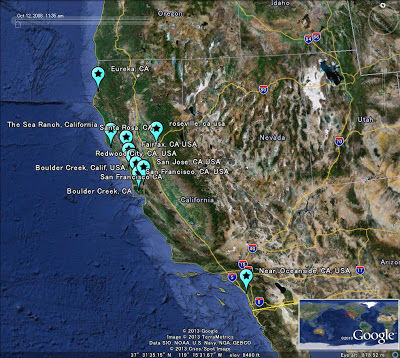
Fireball explodes over Bay Area, California, 15 February 2013 - Fifth bright fireball seen in Northern California in past five months

Image
© lunarmeteoritehunters.blogspot.com
15 February 2013 - David Reis, Redwood City, CA @ 19:45 PST
2 seconds duration. E-W direction. Bright white color, as bright as the sun. No fragmentation and it had a very short tail.
15 February 2013 - Christine Grau, Roseville, CA @ 19:44 PST
2-3 seconds duration. E-W direction. Green and orange tail. Very bright, it was vibrant and huge.
15 February 2013 - Alex, Santa Rosa, CA @ 7:43 PST
1.5 seconds duration. Southwest direction. White color. Brighter than the moon. Pulling into my driveway, I witnessed this bright white fireball in the southwestern sky. It had minor breakup and was a quick streak that started small and grew in size before it extinguished.

Comment: Fireball lights up early morning sky from Nevada to California, 17 January 2013

Bright fireball wows Californians, 27 December 2012

Fireball "bright as the moon" seen across California and Nevada, 24 November 2012

Fragmentation and Sonics! Northern California Fireball Meteor +19'42 PDT 17OCT2012 - Unrelated to the Orionids


Fireball 5

Huge fireball over Japan on Valentine's Day


Source: SonotaCo.JP

Fireball 5

Suspected meteor explosion reported in Cuba, 13 February 2013

An object fell from the sky over central Cuba on Thursday night and turned into a fireball "bigger than the sun" before it exploded, a Cuban TV channel reported Friday, citing eyewitnesses.

Some residents in the central province of Cienfuegos were quoted as saying that at around 8 p.m. local time Thursday (0100 GMT Friday) they saw a bright spot in the sky comparable to a bus in size.

The object then turned into a fireball "bigger than the sun," said the witnesses, adding that several minutes later they heard a loud explosion.

One resident told the TV station that his house shook slightly in the blast.

Cuban experts have been dispatched to the area to look for possible remains of the meteor-like object, said the report.

It remains unknown whether the reported phenomenon in Cuba is related to Friday's meteor strike in central Russia, which set off a shockwave that shattered windows and left some 1,000 people injured.

Source: Xinhua

Comment: This was actually reported to have happened on Wednesday night (13th of February 2013).


Fireball 4

Yet another fireball lights up the skies, this time over Northern California, 15 February 2013

Russian Meteor Still
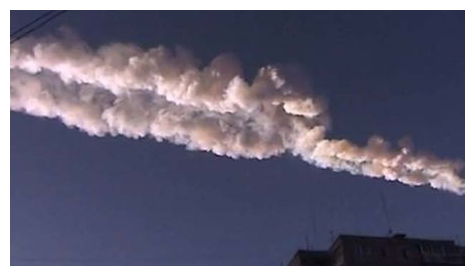
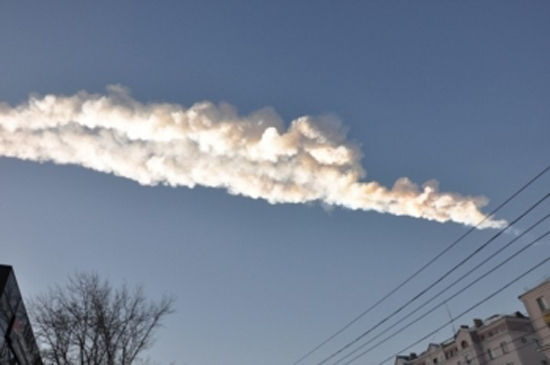
© AFP/Powered By NewslookThis video still image shows the smoke trail created by the meteor that exploded over the Chelyabinsk region of Russia on Feb. 15, 2013.
It's really starting to look like the sky is falling.

According to media reports, a fireball streaked through the skies above California's Bay Area Friday evening (Feb. 15), just hours after another bright meteor exploded over the Russian city of Chelyabinsk and a 150-foot-wide (45 meters) asteroid gave Earth a historically close shave.

The Bay Area fireball blazed up around 7:45 p.m. local time Friday (10:45 p.m. EST; 0345 GMT Saturday), NBC Bay Area reported. The meteor apparently had a bluish tinge and was visible over a wide swath of the region, from Fairfield north of San Francisco Bay down to Gilroy, which is south of San Jose.

There were no immediate reports of injuries, which distinguished the California fireball from its Russian counterpart. The Chelyabinsk blast generated a powerful shock wave that damaged hundreds of buildings and wounded more than 1,000 people.

Comment: "Truly improbable cosmic coincidences"... or something else?

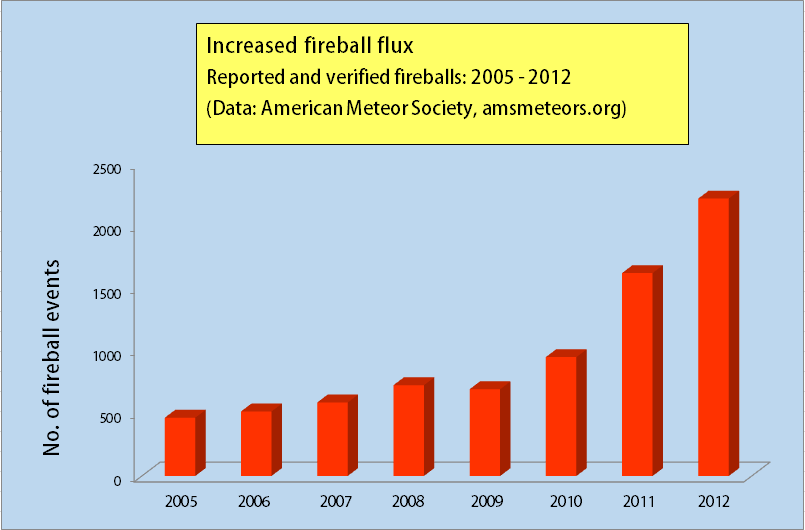
Fireball reports are increasing all the time:

Image
© SOTT.netSource data available here: www.amsmeteors.org/fireball_event/2012/


Fireball 4

Two asteroids in one day: Coincidence? NASA addresses the Russian meteor explosion


A small asteroid entered Earth's atmosphere early Friday, February 15, 2013 over Chelyabinsk, Russia at about 9:20 am local Russian time. Initial estimates, according to Bill Cooke, lead for the Meteoroid Environments Office at NASA's Marshall Space Flight Center, is that the asteroid was about 15 meters (50 feet) in diameter, with a weight of 7,000 metric tons. It hit the atmosphere at a shallow angle of about 20 degrees, at a speed of about 65,000 km/h (40,000 mph).

It traveled through the atmosphere for about 30 seconds before breaking apart and producing violent airburst 'explosion' about 20-14 km (12-15 miles) above Earth's surface, producing an energy shockwave equivalent to a 300 kilotons explosion. That energy propagated down through the atmosphere, atmosphere, stuck the city below - the Chelyabinsk region has a population of about 1 million - and windows were broken, walls collapsed and there were other reports of minor damage throughout the city.

The official impact time was 7:20:26 p.m. PST, or 10:20:26 p.m. EST on Feb. 14 (3:20:26 UTC on Feb. 15).

Fireball 2

Meteor blast in Russia biggest in 100 years

Image
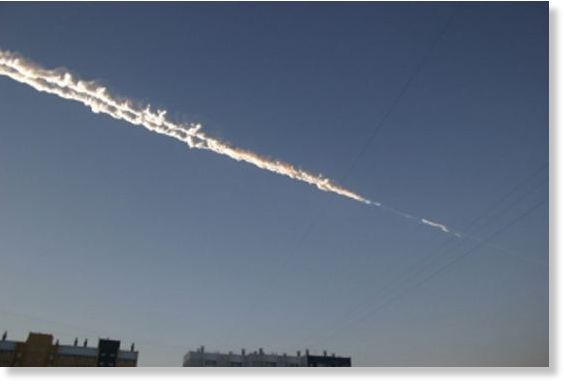
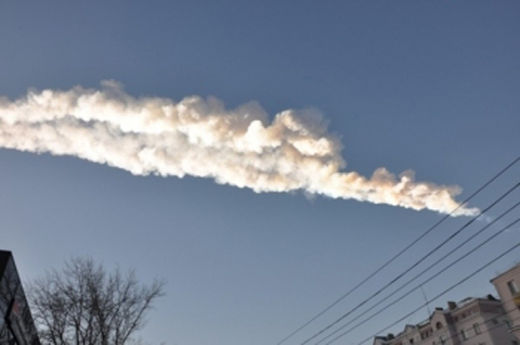
© Russian Emergency MinistryWhat appears to be a meteor trail over eastern Russia is seen in this image released Feb. 15, 2013, by the Russian Emergency Ministry. The meteor fall included a massive blast, according to Russian reports.
The dramatic fireball that exploded over Russia today (Feb. 15) was apparently the biggest such blast in more than a century, scientists say.

The object that caused the Russian fireball, which damaged hundreds of buildings and wounded perhaps 1,000 people in the Chelyabinsk region, was originally probably about 50 feet (15 meters) in diameter and weighed roughly 7,000 tons, said Peter Brown, director of the Center for Planetary Science and Exploration at the University of Western Ontario in Canada.

From multiple sensors using multiple technologies, a best initial estimate of the total energy of the event is about 300 kilotons of TNT-equivalent, Brown said, though he stressed that the number could change as scientists learn more.

"This could easily be in error by a factor of two," he told SPACE.com. "I am confident, however, that it is in excess of 100 kilotons, making it the largest recorded event since the 1908 Tunguska explosion." [Photos of Russia's Meteor Fireball Blast]

In that 1908 event, a 130-foot-wide (40 m) object exploded over the Podkamennaya Tunguska River in Siberia, flattening about 825 square miles (2,137 square km) of forest.

In a cosmic coincidence, the most recent Russian fireball exploded just hours before the 150-foot-wide (45 m) asteroid 2012 DA14 was set to cruise within 17,200 miles (27,000 km) of Earth today, marking the closest approach of such a large space rock that scientists had predicted ahead of time. The two events today are unrelated, NASA researchers say.