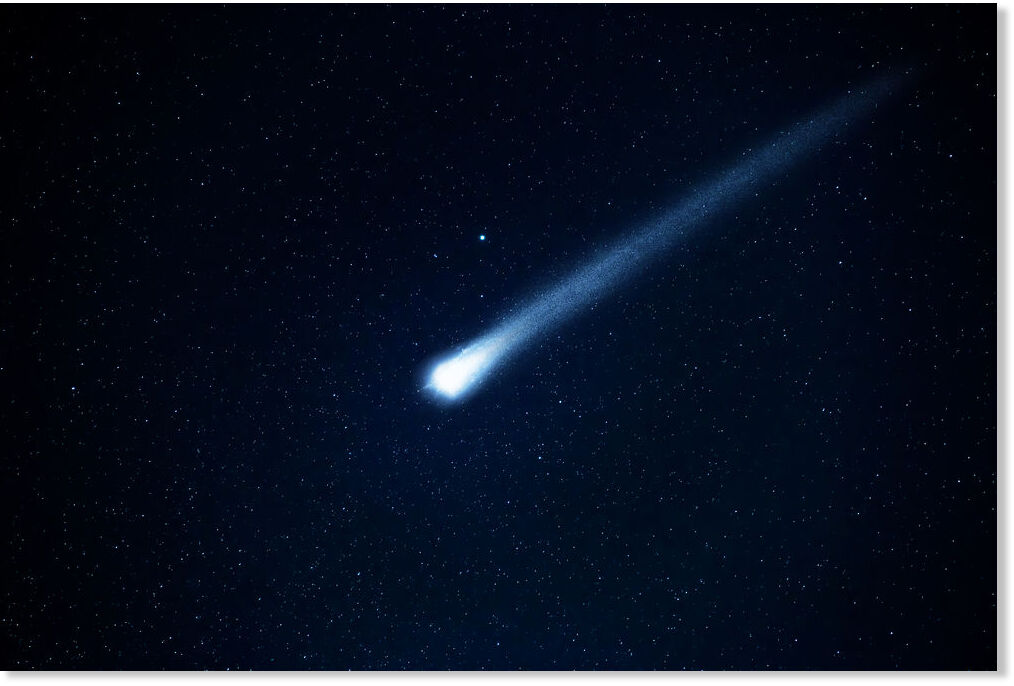
A bright fireball was seen over Malaga, Granada, Almeria and other parts of Andalucía on Saturday night, 18 October. It originated as a rock from an asteroid that entered the atmosphere at 67,000 kilometres per hour. The interesting thing is that, although the fireball appeared to pass through the Andalusian sky, it was actually located more than 600 kilometres away.
According to Professor José María Madiedo of the Instituto de Astrofísica de Andalucía (IAA-CSIC), the ball actually crossed Morocco, but its great luminosity made it visible from Andalucía. In fact, most of the reports came from people in Malaga, Granada and Almeria. "It was also widely seen from Morocco," Madiedo said. The phenomenon was detected by the Smart project.
"These rocks entering our atmosphere at high speed are called 'meteoroids'. When it hit the air so suddenly, its surface heated up and became incandescent, generating a fireball that started at an altitude of about 82 kilometres over Douar Fej Ennassar (northern Morocco). From there, it moved to the north-west and ended at an altitude of about 38 kilometres over Douar Leqloue," the researcher's report stated.
A similar fireball was detected over Spain and Portugal on 15 October. It flew over the north of the Iberian Peninsula, but could also be seen from southern Spain.
Dozens of eyewitnesses reported seeing a green fireball, or an unusually bright meteor, in the skies over western Finland on Sunday evening.
The flash occurred just after 9pm, and the reports registered with the Ursa Astronomical Association came from locations including Vaasa, Seinäjoki, Lapua, and Kokkola.
Vaasa resident Timo Alanko, a member of the region's astronomical society, captured footage of the meteor as he has special-purpose surveillance cameras pointed at the sky from the roof of his home — which record day and night.
He checked the cameras after a neighbour tipped him off about a flash in the sky, and he was stunned by what he found.
This amazing bolide was spotted from Spain on October 19, at 6:01 local time (equivalent to 4:01 universal time). It was as bright as the full Moon. The event was generated by a rock (a meteoroid) from a comet that hit the atmosphere at about 249,000 km/h. The fireball overflew Spain. It began at an altitude of about 140 km over Fresno de la Ribera (province of Zamora), moved west, and ended at a height of around 82 km over Villardiegua de la Ribera (province of Zamora).
This bright meteor was recorded in the framework of the SMART project, operated by the Southwestern Europe Meteor Network (SWEMN) from the meteor-observing stations located at Huelva, La Hita (Toledo), Calar Alto, Sierra Nevada, La Sagra (Granada), and Sevilla. The event has been analyzed by the principal investigator of the SMART project: Dr. Jose M. Madiedo, from the Institute of Astrophysics of Andalusia (IAA-CSIC). Its code in the SWEMN database is: SWEMN20251019_040112.
This video shows a stunning bolide recorded from Spain on October 15, at 20:38 local time (equivalent to 18:38 universal time). It was brighter than the full Moon. The fireball was observed by a wide number of casual eyewitnesses, who reported it on social networks.
The event was generated by a rock (a meteoroid) from an asteroid that hit the atmosphere at about 76,000 km/h. The fireball overflew the north of Portugal and Spain. It began at an altitude of about 88 km over the locality of Argozelo (Braganza district, Portugal), moved southeast, and ended at a height of around 29 km over Villar del Buey (province of Zamora, Spain).
This bright meteor was recorded in the framework of the SMART project, operated by the Southwestern Europe Meteor Network (SWEMN) from the meteor-observing stations located at La Hita (Toledo), Calar Alto, Sierra Nevada, Coruña, and Marçà (Tarragona). The event has been analyzed by the principal investigator of the SMART project: Dr. Jose M. Madiedo, from the Institute of Astrophysics of Andalusia (IAA-CSIC). Its code in the SWEMN database is: SWEMN20251015_183847.
We received 38 reports about a fireball seen over Campania, Emilia-Romagna, Lazio, Lombardia, Marche, Sicilia, Toscana, Tuscany, Umbria and Veneto on Monday, October 13th 2025 around 17:09 UT.

