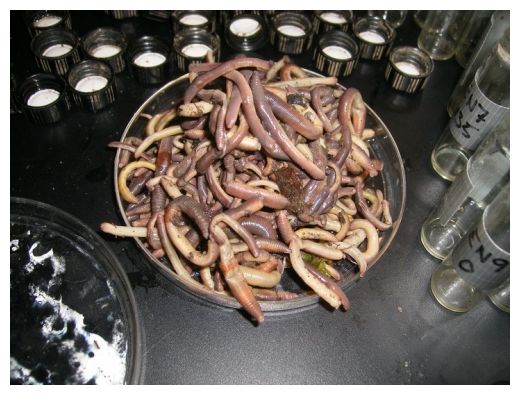
© Lindsey Shartell/U.S. Fish and Wildlife ServiceA bowl of exotic European earthworms species federal scientists recently found in National Wildlife Refuge sites throughout the Upper Midwest.
Most earthworms may be tiny, but a new study suggests their impact on the climate could be mighty.
Researchers had long assumed the creepy crawlers help store carbon in soils by consuming fallen leaves and other decaying plant matter, which they deposit in soil in their cast, or droppings. But newer studies suggest the worms may actually increase soils' output of two key greenhouse gases, carbon dioxide and
nitrous oxide.
A new meta-analysis, published Sunday in the journal
Nature Climate Change, found that the presence of earthworms appears to increase soils' output of CO2 by 33 percent and of nitrous oxide by 42 percent.
"We've known for only a couple of years that they can really increase nitrous oxide emissions, but it was not really clear how much," said study co-author Jan-Willem van Groenigen of
Wageningen University in the Netherlands, whose work is based on a review of 57 previously published analyses.
As for claims that the worms help store carbon in soils, van Groenigen said that traditional argument has always seemed suspect to him.
"It's strange to claim on the one hand that earthworms are good for soil fertility by decomposing organic matter in soil, and on the other hand that they increase organic matter in soil," he said.



















Comment: Is it a deeply entrenched religious belief at the root of the American Establishment's megalomania... or is it deeply entrenched psychopathology?
From Political Ponerology by Andrew Lobaczewski: