Puppet MastersS


Eye 1

Egyptian Copts in Libya allegedly detained, tortured following 'missionising' claims

Image
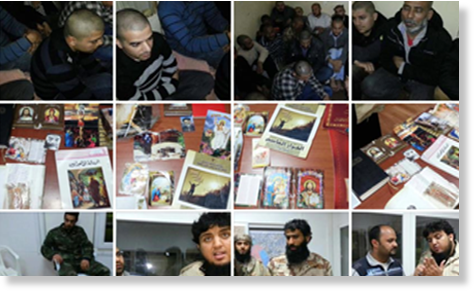
Photos published on Facebook of detained Copts in Libya accused of proselytisation.
Scores of Egyptian Coptic Christians are detained, abused by Salafists in Benghazi after being accused of proselytising, says Coptic Church source

Activists in Libya on Thursday posted photographs on Facebook allegedly portraying Egyptian Coptic-Christians detained in Libya on charges of proselytising.

The activists asserted that the images would also be sent to the United Nations, the Egyptian embassy in Libya, the Egyptian foreign affairs ministry, the Libyan Observatory for Human Rights and Human Rights Watch, in hopes that "action would be taken to secure their release."

According to a source from Egypt's Coptic Church, a group of Salafist Muslims attacked a church in Benghazi this week and detained roughly 100 Egyptian Copts working in the country.

The detained Copts had been tortured by their captors, who had also shaved their heads and used acid to burn off the crosses tattooed on their wrists, the source - who preferred anonymity - told Ahram Online.

Handcuffs

Mass arrest and torture of Christians in Libya

Image
Last week's news of four Christian missionaries in Libya placed under arrest, possibly facing the death penalty for "proselytizing," is apparently the tip of the iceberg. Yesterday, Arabic media reported that over 100 Christian Copts from Egypt, who have been living and working in Libya, were recently arrested in Ben Ghazi - also on the accusation, or pretext, of being "Christian missionaries."

One video, apparently made by the Libyan militia interrogators - most of whom look like Islamic Salafis, with long beards and clipped mustaches - appeared on the Internet yesterday. It shows a room full of detained Copts. They sit hunched over on the floor - with all their hair shaven off, looking like dejected, or doomed, concentration camp prisoners. According to one source, many of these Copts have been tortured. Some have had the famous Coptic cross often tattooed on the wrists of Copts burned off with acid.

Next, the camera-man zooms in on the material which got them in this predicament: atop a table, several Bibles, prayer books, and pictures of Jesus, Mary and other saints appear spread out. The Libyan interrogators being video-taped complain about how these Christians could dare bring such material into Libya, and that they, their abductors, are sure that the Copts were going to such Christian materials to proselytize Libya, to sporadic ejaculations of "Allah Akbar!" from across the room.

Stormtrooper

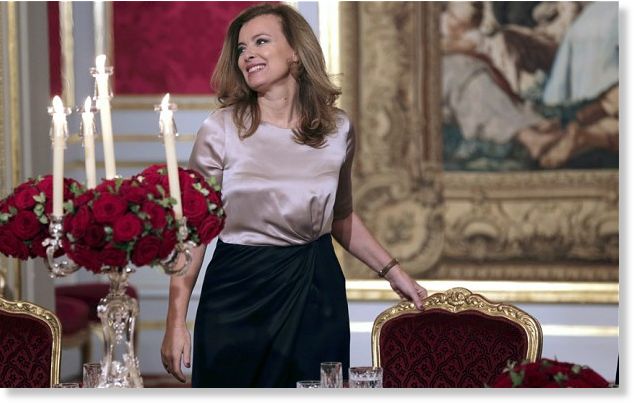
Valérie Trierweiler 'succumbs to Marie-Antoinette syndrome of life of luxury'

Image
© AFP/GETTYMiss Trierweiler met Mr Hollande, 57, at a political rally 15 years ago and have been a couple for five years.
President François Hollande's 47-year old partner was slammed for eschewing her Left-wing principles in favour of unabashed champagne Socialism despite the threat of "thousands of job losses in the coming weeks" in companies ranging from Renault to Air France.

VSD, the weekly magazine, trained its ire on the 47-year-old divorcee's decision to attend the haute couture shows of Paris fashion week.

It described photos of the first lady beaming alongside France's richest man Bernard Arnault at the Dior catwalk show as a "political fault".

"While thousands of French are fighting to avoid redundancy ... (she) attended the fashion shows," it wrote.

"Valérie Trierweiler, who often claims to be 'Socialist to her soul' ... ultimately prefers supporting the one industry that has no particular need of her help - the luxury fashion world.

Bad Guys

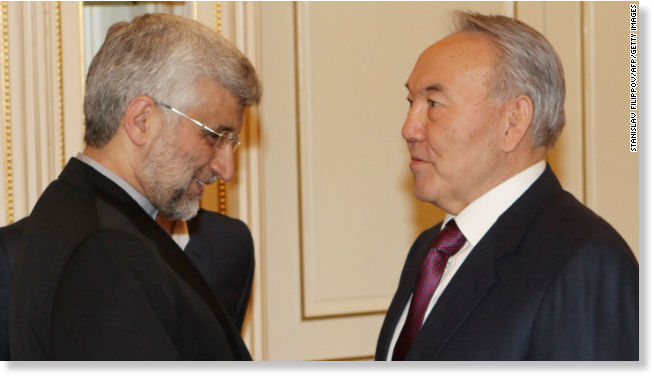
World powers restart nuclear talks with Iran after 8-month break

Image
© Getty Images
Talks began Tuesday between six world powers and Iran over its controversial nuclear program for the first time in nearly eight months.

But the mood going into the negotiations was as bleak as the fog that hung over this snowbound Central Asian city.

"I don't think tomorrow (Tuesday) is likely to be a day in which we can announce a great success," a diplomat participating in the negotiations told journalists on condition of anonymity on the eve of the first meeting.

Other officials were not so optimistic either.

MIB

Friend of Prisoner X: Mossad made 'big mistake' recruiting Zygier

Image
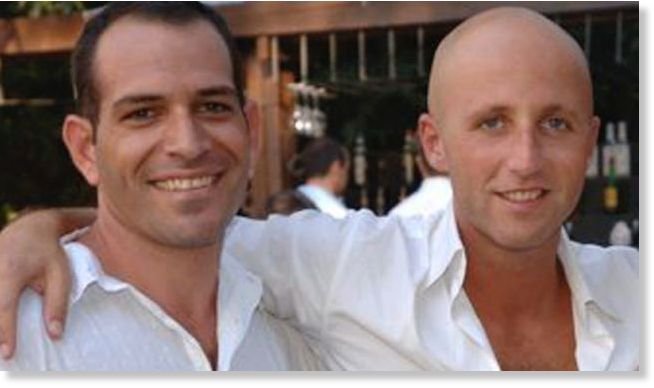
© UnknownLior Brand (left) with Ben Zygier at his wedding in Israel.
Lior Brand, who knew Ben Zygier when he lived next door to him on Kibbutz Gazit as a lone IDF solider in the mid-1990s, tells Haaretz he believes had he been permitted to see him in jail, he wouldn't have killed himself.

Ben Zygier's friends in Israel are "angry and upset" they could not visit their Australian-born mate now known as Prisoner X before he apparently committed suicide in Ayalon prison in 2010.

Lior Brand has known Zygier since he lived next door to him on Kibbutz Gazit in the mid-1990s when the Melbournian was a lone soldier in the IDF.

"We really believe had we been permitted to go and see him he wouldn't have killed himself," Brand told Haaretz this week.

Zygier is understood to have been placed in solitary confinement in February 2010 and hung himself in the shower on December 15, 2010, according to a report by Judge Daphna Blatman-Kedrai.

Twenty of the 28 pages in her report were suppressed.

Books

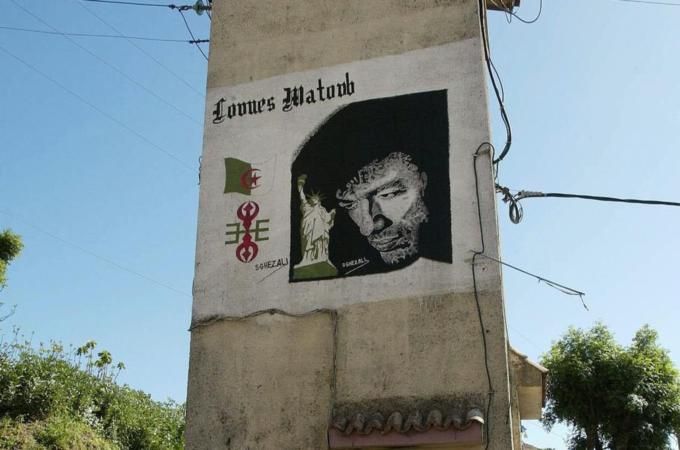
The Kabyle Berbers, AQIM and the search for peace in Algeria

This article is the fourteenth in a series by Ambassador Akbar Ahmed, a former Pakistani high commissioner to the UK, exploring how a litany of volatile centre/periphery conflicts with deep historical roots were interpreted after 9/11 in the new global paradigm of anti-terrorism - with profound and often violent consequences. Incorporating in-depth case studies from Asia, Africa and the Middle East, Ambassador Ahmed will ultimately argue that the inability for Muslim and non-Muslim states alike to either incorporate minority groups into a liberal and tolerant society or resolve the "centre vs periphery" conflict is emblematic of a systemic failure of the modern state - a breakdown which, more often than not, leads to widespread violence and destruction. The violence generated from these conflicts will become the focus, in the remainder of the 21st century, of all those dealing with issues of national integration, law and order, human rights and justice.
A heavy-handed solution to the Kabyle in Algeria is doomed to failure and bloodshed, as history has shown.

Image
© AFPThe Kabyle people have a history of staunch resistance against assimilation and colonialism
When UK Prime Minister David Cameron stood before Parliament in London and announced a "generational struggle" against Islamic terrorism, he unwittingly tied the future of his country with that of a little known people of northeastern Algeria - the Kabyle Berbers. Speaking in the wake of the Algerian hostage crisis at a gas plant in which over eighty people were killed, he mobilised the international community to confront al-Qaeda in the Islamic Maghreb (AQIM), an organisation founded by a Kabyle and based in the mountainous Kabylie region. Cameron had elevated these mountain tribes, in the eyes of Europe and the West, to an existential threat to their way of life.

Yet, his grandiose rhetoric of a great battle against "Islamists" and "jihadists" only serves to further cloud the history of the Kabyle people and their struggles against the Algerian centre. Today, the world remains in a state of ignorance about the Kabyle. This ignorance has consequences, as not only is it impossible to comprehend Algeria and its history without understanding the Kabyle and their relationship with central authority, but it is also impossible to make any sense of the US-led war on terror in North Africa.

Dollar Gold

Why should taxpayers give big banks $83 billion a year?

Image
© Bloomberg View
On television, in interviews and in meetings with investors, executives of the biggest U.S. banks -- notably JPMorgan Chase & Co. Chief Executive Jamie Dimon -- make the case that size is a competitive advantage. It helps them lower costs and vie for customers on an international scale. Limiting it, they warn, would impair profitability and weaken the country's position in global finance.

So what if we told you that, by our calculations, the largest U.S. banks aren't really profitable at all? What if the billions of dollars they allegedly earn for their shareholders were almost entirely a gift from U.S. taxpayers?

Granted, it's a hard concept to swallow. It's also crucial to understanding why the big banks present such a threat to the global economy.

Let's start with a bit of background. Banks have a powerful incentive to get big and unwieldy. The larger they are, the more disastrous their failure would be and the more certain they can be of a government bailout in an emergency. The result is an implicit subsidy: The banks that are potentially the most dangerous can borrow at lower rates, because creditors perceive them as too big to fail.

Lately, economists have tried to pin down exactly how much the subsidy lowers big banks' borrowing costs. In one relatively thorough effort, two researchers -- Kenichi Ueda of the International Monetary Fund and Beatrice Weder di Mauro of the University of Mainz -- put the number at about 0.8 percentage point. The discount applies to all their liabilities, including bonds and customer deposits.

USA

Neo-Imperialism and the Arrogance of Ignorance

Image
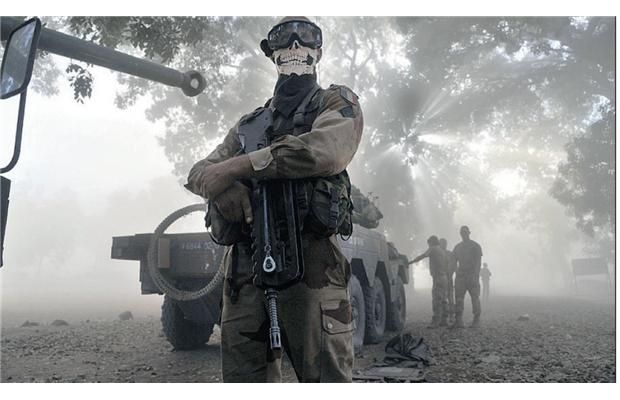
"We've come for your gold, your uranium, your cocoa, your coffee... we're taking it all"... A French soldier wearing a skeleton mask stands next to a tank in a street in Niono, Mali.
Most Americans do not realize the extent to which the U.S. is becoming involved militarily in the welter of conflicts throughout Saharan and sub-Saharan Africa (check out the chaos as mapped here).

Although recent reports have tended to focus on the French effort to kick Al Qaeda in Islamic Maghreb (AQIM) out of Mali - an effort that may now be devolving into a far more complex guerrilla war, that French operation is just one operation in what may be shaping up to be a 21st Century version of the 19th Century Scramble for the resources of Africa. It's a policy that, from the U.S. point of view, may not be unrelated to the pivot to China, given China's growing market and aid presence in Africa. Together, the scramble and the pivot will be sufficient to offset the near term effect of a sequester in the Pentagon with a torrent of money flows in the future.

Last year, Craig Whitlock of the Washington Post provided a mosaic of glimpses into the widespread U.S. involvement in Africa. He authored a series of excellent reports, including here, here and here. The map below is my rendering of the basing information in Whitlock's report (and others), as well as the relationship between that basing information to distribution of Muslim populations in central Africa. Consider the distances involved in this swath of bases loosely portrayed by the red dots: the distance between these bases along the axis from northwest to southwest on the African continent alone is greater that the distance from New York to Los Angeles. Think of the ethnic and tribal differences between Burkina Faso and Kenya, not to mention the differences within those countries! And remember, virtually all of North Africa, from Morocco to Egypt is over 90% Muslim.

Stock Down

Obama signs order to begin $85B in spending cuts

Image
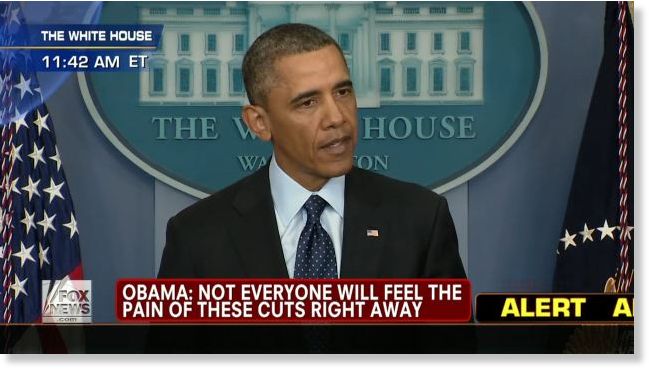
Washington - President Obama signed an order authorizing the government to begin cutting $85 billion from federal accounts, officially enacting across-the-board spending reductions.

Obama acted Friday, the deadline for the president and Congress to avoid the steep, one-year cuts.

The president placed blame squarely on Republican lawmakers at a Friday press conference for failing to stop automatic spending cuts that were to begin kicking in later in the day, calling the cuts "dumb, arbitrary."

Republicans, for their part, said the fault was his, for insisting that increased taxes be part of the resolution

The president said the impact of the cuts won't immediately be felt, but middle class families will begin to "have their lives disrupted in significant ways." He said that as long as the cuts stay in effect, Americans will know that the economy could have been better had they been averted.

"The pain, though, will be real," Obama said.

He said he still believed the cuts could be replaced but he wanted a deal that includes more tax revenue.

"Let's be clear: None of this is necessary," Obama told reporters at the White House. "It's happening because of a choice that Republicans in Congress have made. We shouldn't be making a series of dumb, arbitrary cuts to things."

Megaphone

Woodward at war with the White House

Image
© politicalbooks.org
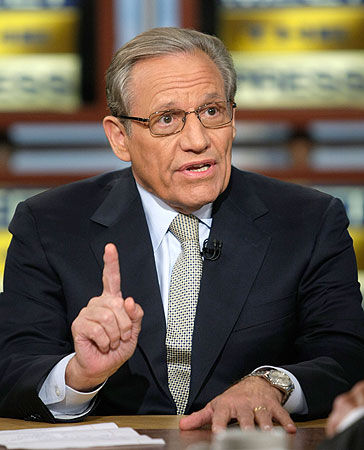
Bob Woodward called a senior White House official last week to tell him that in a piece in that weekend's Washington Post, he was going to question President Barack Obama's account of how sequestration came about - and got a major-league brushback. The Obama aide "yelled at me for about a half-hour," Woodward told us in an hourlong interview yesterday around the Georgetown dining room table where so many generations of Washington's powerful have spilled their secrets.

Digging into one of his famous folders, Woodward said the tirade was followed by a page-long email from the aide, one of the four or five administration officials most closely involved in the fiscal negotiations with the Hill. "I apologize for raising my voice in our conversation today," the official typed. "You're focusing on a few specific trees that give a very wrong impression of the forest. But perhaps we will just not see eye to eye here. ... I think you will regret staking out that claim."

Woodward repeated the last sentence, making clear he saw it as a veiled threat. " 'You'll regret.' Come on," he said. "I think if Obama himself saw the way they're dealing with some of this, he would say, 'Whoa, we don't tell any reporter 'you're going to regret challenging us.'"

Comment: No threat intended?
Woodward's not alone - Fmr. Clinton aide Davis says he received White House threat