Puppet MastersS


Attention

Coup complete: Rousseff removed by Brazilian senate despite her innocence and her opponents' rampant corruption

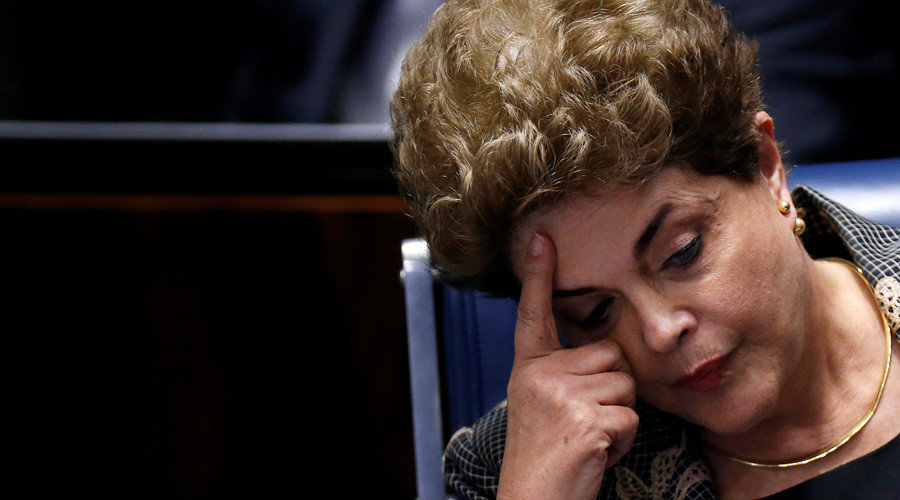
rousseff
© Jeslei Marcelino / ReutersSacrificed on the altar of imperialism.
After a nine-month impeachment process, Dilma Rousseff has been dismissed as president by the Brazilian senate. The lawmakers convicted her of breaking budget laws.

The vote that finalized Rousseff's dismissal from Brazil's highest office came on Wednesday, two days after she delivered an emotional speech to defend herself before legislators.

Sixty-one senators of the 81-strong body voted against the now-former president. Twenty senators voted against the impeachment.


Comment: Sixty-one heartless, spineless, treacherous Judases.


But 68-year-old Rousseff was handed a lifeline after Senate voted not to bar her from holding government office for the next eight years. According to the constitution, an impeached president faces this ban, but Chief Justice Ricardo Lewandowski, presiding over the hearing, allowed a separate vote on the matter.

Comment: We truly live in a mad world.


Vader

U.S. arrogantly claims 'window closing' on Russia for deal on Syria

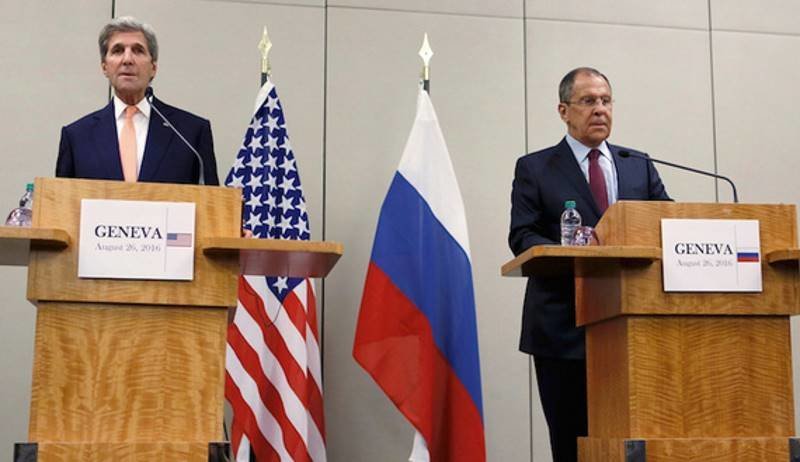
Kerry Lavrov
© Pierre Albouy/ReutersUS Secretary of State John Kerry (L) and Russian Foreign Minister Sergey Lavrov attend a news conference after a meeting on Syria in Geneva, Aug. 26, 2016.
Despite US Secretary of State John Kerry and Russian Foreign Minister Sergey Lavrov's saying that they had made progress in 10 hours of talks in Geneva on Aug. 26 and that just a few issues remained to be resolved, it seems increasingly unlikely that the United States and Russia will conclude a deal on Syria before US President Barack Obama and Russian President Vladimir Putin are expected to meet on the sidelines of the G-20 summit in China on Sept. 4, and perhaps at all, diplomatic contacts said.

US-Russian negotiations in Geneva are due to resume Aug. 31, but it "doesn't look particularly promising," a diplomat involved in the discussions, speaking on condition of anonymity, told Al-Monitor. It's "probably the last chance before Obama and Putin meet on Sunday in China."

"I think the message to the Russians does have to be that there's a window closing here, and we need to see that they can reach a real agreement and that they can back it up," deputy national security adviser Ben Rhodes told journalists at the White House press briefing Aug. 29.

"Even if we are able to get an agreement, that's only going to happen if we are assured that it's going to provide the necessary humanitarian access into Aleppo," Rhodes continued.

"So I think this is a critical time," Rhodes said. "In the coming days, we'll have an opportunity to see whether the Russians can get to the agreement that meets those requirements."


Info

Arizona election hack story is an embarrassment to everyone involved

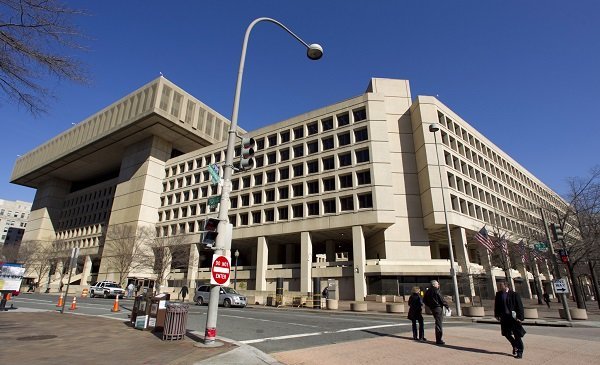
FBI Headquarters in Washington
© Manuel Balce Ceneta / AP
It's an embarrassment to Ellen Nakashima and the Washington Post who ran the salacious and inaccurate headline "Russian hackers targeted Arizona election system", and to every news organization that ran the same story including Financial Times (Geoff Dyer), the Washington Times (Douglas Ernst), and of course Yahoo (Michael Isikoff) who broke the story and published an FBI TLP:Amber alert that is need to know only / not to be shared with media.

It's an embarrassment to Rich Barger at ThreatConnect along with their investors GroTech and SAP. Barger has been pumping the media with his Red Menace speculation at every opportunity, and in the case of this non-story, he's basing it solely upon the fact that the attacker used a Russian-owned hosting service called King Servers, along with IP addresses from two Netherlands-based hosting companies. The Russian hackers who coordinated the attack against Georgian government websites in 2008 used Texas-based Softlayer Technologies as their hosting provider. According to Barger's logic, the attackers must have been Texan, not Russian.

Comment: Putin did it again! Cyber-security company blames hacks into DC think-tanks on Russia


Yoda

Syrian Kurds: Russia plays important role in balancing various powers in Middle East

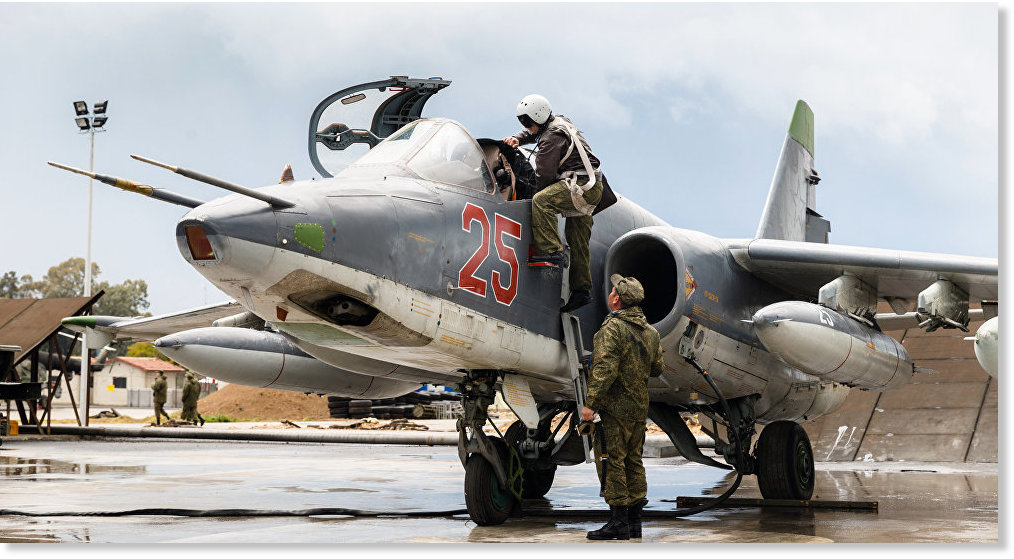
russian bomber
© Press service of the Russian Defense Ministry
Russia plays an important role while addressing Middle Eastern conflict.

Syrian Kurds are interested in preserving friendly relations with Russia because it plays an important role balancing various powers engaged in the Middle East, Rodi Osman, the head of Syrian Kurdistan's representative office in Moscow, told Sputnik Wednesday.

"We do understand that Russia has its own interests and policies in the Middle East. Actually, it plays an important role balancing the sides [of the conflict] and it greatly contributes to the fight against the Islamic State. This is why we hope for the preservation of the friendly relations between Russia and the Kurds," Osman said.

He added that the Russia played a vital role in putting an end to the August 16-23 clashes between the Kurdish militia and the Syrian army in the eastern city of Hasakah. "The hostilities... were stopped only under Russia's mediation. We agreed for the ceasefire only out of respect for Russia," Osman said.

Syrian Kurds announced the creation of the federal region in the country's north at a conference in the Hasakah province on March 17.

The initiative was criticized by the Syrian government. Syria has been mired in civil war since 2011, with government forces fighting numerous opposition factions and extremist groups, including the Islamic State, which is outlawed in Russia, the United States and a number of other states.

Jet5

Saudi jets launch new airstrikes in Yemen, 20 killed

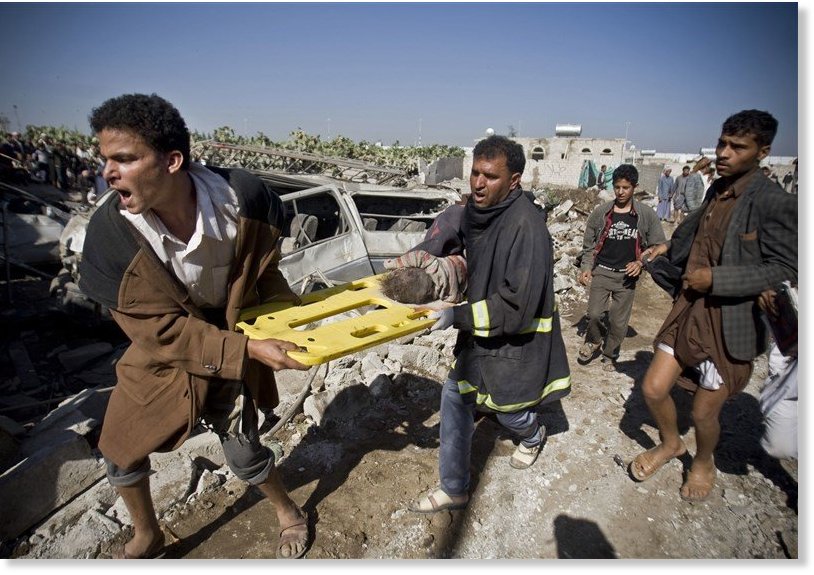
airstrikes yemen
At least 20 people have lost their lives and many others sustained injuries in a number of Saudi airstrikes against residential neighborhoods across Yemen.

On Wednesday morning, Saudi military aircraft pounded al-Rawdah Village and the Nihm district in the western-central Yemeni province of Sana'a in addition to an area close to a military academy in the capital, Sana'a, leaving four people dead and scores of others injured, Yemen's al-Masirah television network reported.

Sixteen people, mostly women and children, also lost their lives and a number of others were wounded when Saudi warplanes pounded houses in the Sahan district of Yemen's northwestern mountainous province of Sa'ada.

Later in the day, Saudi jets launched an aerial attack against a gas station in the northwestern city of Hajjah, located 127 kilometers (78 miles) northwest of Sana'a. There were no immediate reports of casualties and the extent of damage caused. The Mustaba district in Hajjah Province was also hit, though no reports of casualties were available.

Comment: Interesting logic on the part of this Jubeir (and his fellow Saudi death-dealers): Iran is supporting the Houthis, therefore, it is ok to bomb and murder innocent civilians. Sounds like a chapter right out of the IDF's 'how to kill Palestinians and get away with it' playbook.


Light Sabers

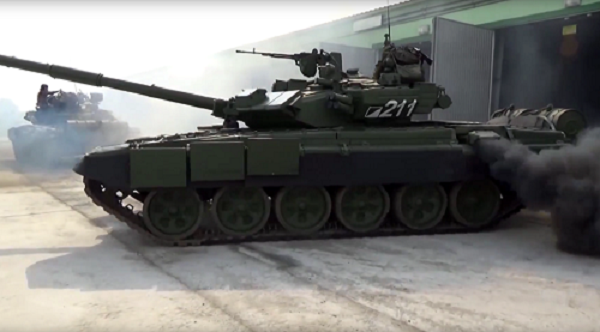
Russian military training for war freaks out West, but that's what militaries do

russian tanks
The latest series of military exercises in Russia have unnerved its Western neighbors, who are concerned that Russia may be preparing for a military campaign. The Russian military is indeed preparing for war, but that does not mean the Kremlin actually plans to initiate one anytime soon. Rather, the current and pending exercises are meant to, well, exercise the troops, for all contingencies, including worst-case scenarios, but also to send a signal to potential adversaries and "disloyal" neighbors.

These countries, of course, remember vividly how less than a month after conducting the Kavkaz-2008, or Caucasus-2008, exercises in July of that year Russian armed forces marched into South Ossetia to rout Georgia as it attempted to retake its separatist province by force. Then, in spring 2014, Russia's military-political leadership used one of the so-called surprise selective checks of its armed forces' combat readiness to deploy the troops needed to facilitate the taking of Crimea.

No wonder each time Moscow decides to hold a major snap check or regular drill along Russia's western or southwestern flank, such maneuvers generate concern in some of the countries located along those borders. The latest surprise check—launched August 25 on territories comprising Russia's Southern, Western and Central military districts—was no exception.

USA

Top USA National Security officials admit to Turkey coup

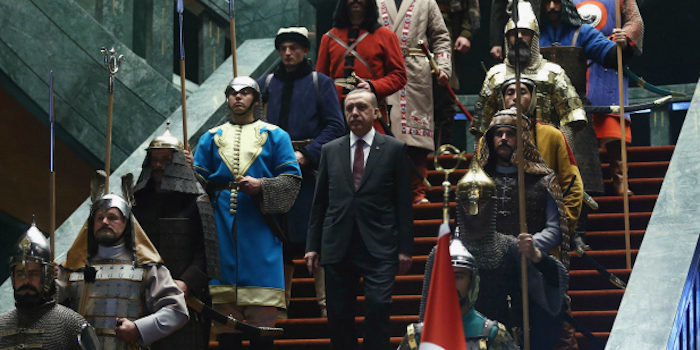
President Recep Tayyip Erdogan
While the Obama Administration and the CIA officially cling to the fig leaf lie that US intelligence was innocent of any involvement in the failed July 15 coup d' etat attempt by the CIA-run Fethullah Gülen organization in Turkey, the truth is coming out from senior US intelligence insiders themselves. It reflects a huge internal faction struggle within US leading circles in what by all accounts is shaping to be the most bizarre Presidential election year in American history.

The first admission that US intelligence had their hand in the anti-Erdogan coup, a coup launched just days after Erdogan announced a major strategic shift away from NATO and towards Russia, came from Zbigniew Brzezinski. Brzezinski is one of the most senior members of the US intelligence establishment, a former Obama Presidential adviser and former National Security Council architect of the Jimmy Carter 1979 Mujahideen Afghanistan terror operations against the Soviet forces in that country.

Comment: The broken chessboard: Brzezinski gives up on Empire


Attention

High alert: Commander-in-Chief Putin tests army's readiness in massive snap exercise in west & south - UPDATES

 Ministry of Defence of the Russian Federation
© Ministry of Defence of the Russian Federation / YouTube
Russian Army units as well as the Air Force, Airborne Troops and the Navy's Northern Fleet have been put on high alert as part of a large-scale snap exercise which the Defense Ministry says will check troops' readiness to tackle emerging crises.

"According to the decision of the Commander-in-Chief of the Armed Forces [President Vladimir Putin], a regular snap exercise begins today," Defense Minister Sergey Shoigu said at a briefing with top military commanders on Thursday.

"Troops in the Southern Military District, some units of the Western and Central Military Districts, as well as the Northern Fleet, the Air Force and the Airborne Troops, are to be put on full alert starting from 7.00am [local time]," the minister added.

The exercise will last until August 31, Shoigu said, ordering the deputy defense minister - who is in charge of military-to-military cooperation - to inform foreign defense attachés of the war games.

Comment: Update - August 31

Russia, Mongolia troops hold first joint drill at Selenga 2016 exercise
The first joint drill was held at the Burduny range (Russia's Buryatia republic) on Wednesday within the framework of the Russian-Mongolian military exercise Selenga 2016, spokesman for the Russian Eastern Military District Colonel Alexander Gordeyev told TASS.

"During the joint training units of the Eastern Military District and the Mongolian armed forces practiced tactical groups' movement on approach routes and the organization of communication between the units. The Joint Staff of the exercise command agreed the command and liaison signals common for both sides," the official said.

The exercises started on August 30 and will last until September 7. The manoeuvers involve some 1,000 troops and up to 200 units of military equipment on both sides. In particular, the drills involve a tank battalion, a motorized infantry company, a mortar battalion, howitzer self-propelled artillery and rocket batteries, air defense, reconnaissance and NBC protection units of Russia's Eastern Military District. The Mongolian Armed Forces are represented in the exercise by motorized infantry companies with infantry combat vehicles and armored personnel carriers, a tank platoon, a mortar and a rocket battery.

The Russian-Mongolian Selenga manoeuvers are held annually since 2008. Before 2011, it was a tactical exercise with live firing that was called Darkhan, which means "Builder" in Mongolian. Last year, the exercise was held in Russia's Trans-Baikal Territory. Then the drills participants practiced assault river crossing and tactical landing.
Russian Ships Hold Landing Drills, Range Practices as Part of Snap Check
Russian warships of the Black Sea Fleet and the Caspian Flotilla trained different missions, including landing drills and range practices as part of ongoing snap combat readiness inspections, Russian Defense Ministry said in a statement Wednesday.

"Within the framework of snap combat readiness inspections' events at the Black Sea Fleet, Saratov, Caesar Kunikov, Azov and Yamal large landing ships have trained activities aimed at creation of a landing group and landing of amphibous assault landing, backed by aviation," the statement said.

The statement added that the crews of the Caspian Flotilla's corvettes had participated in missile-landing drills, as well as in range practices.


Bad Guys

EU appears set to prolong anti-Russian sanctions

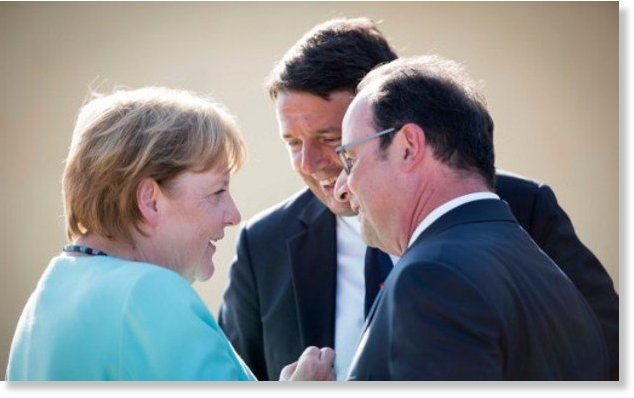
merkel hollande
© AFPA handout picture released by Bundesregierung, the Cabinet of Germany (From L) shows German Chancellor Angela Merkel talks with Italian Prime Minister Matteo Renzi and French President Francois Hollande on the island of Ventotene on August 22, 2016.
European Union ambassadors appear set to prolong asset freezes and visa bans against 146 individuals and 37 entities that, according to the EU, are responsible for actions against Ukraine's territorial integrity.

EU sources have told RFE/RL that the decision to prolong the measures by six months will be taken ahead of a September 15 deadline without much discussion.

The targets of the sanctions include companies in Crimea and various battalions formed by the Russia-backed separatists in eastern Ukraine, as well as Russian politicians like Deputy Prime Minister Dmitry Rogozin and Dmitry Kiselyov, a state media executive and presenter whom many regard as the Kremlin's chief propagandist.

The sanctions were first introduced in March 2014 after Russia's seizure and illegal annexation of Ukraine's Crimean Peninsula.

The EU's economic sanctions that target Russia's energy, military, and financial sectors are up for renewal on January 31. EU sources told RFE/RL that those sectoral sanctions will be discussed at a Brussels summit of EU leaders in October.

Comment: There appears to be a difference of opinion among EU countries regarding the extension of anti-Russian sanctions:


Attention

Uzbekistan: Fears of instability surface as President Karimov suffers stroke

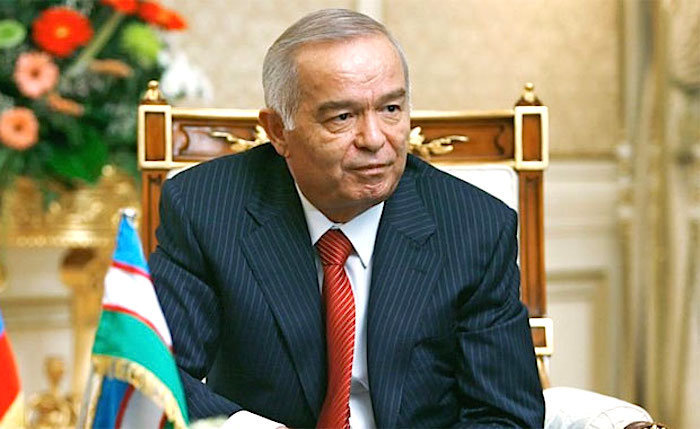
Karimov
© www.jamestown.orgUzbekistan President Islom Karimov
Stroke fells autocratic leader with whom Moscow has had a difficult relationship but whose brutal methods have kept his country stable. Confirmation that Uzbekistan's President Islom Karimov has been taken critically ill following a brain hemorrhage will be causing concern in Moscow.

Along with Kazakhstan's leader Nursultan Nazarbayev, Karimov is the last remaining leader of a former Soviet republic to have achieved power as his republic's Communist Party First Secretary before becoming the republic's President when the USSR fell apart. He has exercised autocratic control over Uzbekistan ever since, being the only leader Uzbekistan has known since it became independent.

Karimov has run Uzbekistan with an iron fist, heading a regime notorious for its human rights abuses and its brutal treatment of internal dissidents. These methods have been ruthlessly effective, with no evidence of any serious opposition to Karimov's rule at the present time.

Though Uzbekistan is a poor country, it is rich in natural resources and with a population of 31 million is one of the biggest of the former Soviet republics. It has also historically been the cultural centre of Central Asia, with cities like Samarkand and Bukhara famous for their monuments and history. Its size, potential wealth and location at the heart of Central Asia make its stability critically important for Moscow.

Comment: Uzbekistan became an independent nation on 31 August 1991. Anti-Islamism and ethnic identity have been the state's primary claims to fortify a hard authoritarian regime consisting of little to no civil society progression coupled with horrific human rights abuses. Like the Eye of Sauron, the West will be attracted to this turn of events and attempt to proxy a successor, in suit to its "surround Russia" agenda. Russia, as well, will be on guard for any societal upheaval, be it a natural fallout or instigated by Western subterfuge.

UPDATE: Rumors are spreading that Karimov died, but his daughter says that he is alive and recovering. Official Uzbek channels have been silent since the stroke, leading to speculation that a efforts to find a successor are under way.
The Uzbek Constitution states that if the president is unable to perform his duties, the head of the upper chamber of parliament, the Senate, assumes presidential authority for a period of three months.

No public comments have come from Senate Chairman Nigmatulla Yuldashev, who has led the upper house since January 2015.