OF THE
TIMES
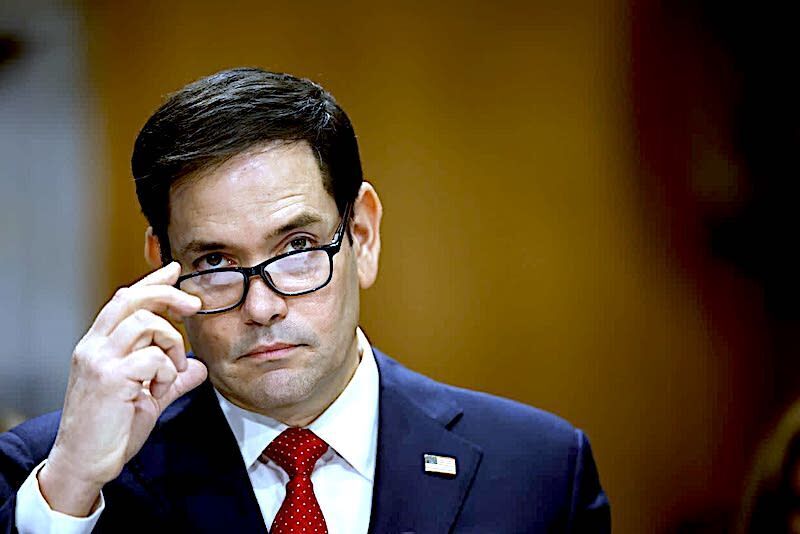
It appears to go further than President Donald Trump's recent executive order, which instructed the department to pause foreign aid grants for 90 days pending review by the secretary. It had not been clear from the president's order if it would affect already appropriated funds or Ukraine aid.Rubio also outlined the Trump administration's stance on spending, saying
The new guidance means no further actions will be taken to disperse aid funding to programs already approved by the U.S. government, according to three current and two former officials familiar with the new guidance.
- Politico
"Every dollar we spend, every program we fund, and every policy we pursue must be justified with the answer to three simple questions: Does the action make America safer, stronger, and more prosperous?The new order reportedly shocked State Department officials. "State just totally went nuclear on foreign assistance," a State Department official told Politico.
Sec. 2. Policy. It is the policy of the United States to identify and take appropriate action to correct past misconduct by the Federal Government related to the weaponization of law enforcement and the weaponization of the Intelligence Community.
Sec. 3. Ending the Weaponization of the Federal Government. (a) The Attorney General, in consultation with the heads of all departments and agencies of the United States, shall take appropriate action to review the activities of all departments and agencies exercising civil or criminal enforcement authority of the United States, including, but not limited to, the Department of Justice, the Securities and Exchange Commission, and the Federal Trade Commission, over the last 4 years and identify any instances where a department's or agency's conduct appears to have been contrary to the purposes and policies of this order, and prepare a report to be submitted to the President, through the Deputy Chief of Staff for Policy and the Counsel to the President, with recommendations for appropriate remedial actions to be taken to fulfill the purposes and policies of this order.

What does the executive action call for?
Trump's DEI rollback revokes a number of former executive orders and memorandums that promoted or otherwise specifically set in place laws to prohibit discrimination based on race, color, religion, sex, or national origin.
Trump's executive action rescinds the following:"Sec. 3. Terminating Illegal Discrimination in the Federal Government. (a) The following executive actions are hereby revoked:But what does it actually revoke? Here's the breakdown and what it means:
(i) Executive Order 12898 of February 11, 1994 (Federal Actions to Address Environmental Justice in Minority Populations and Low-Income Populations);
(ii) Executive Order 13583 of August 18, 2011 (Establishing a Coordinated Government-wide Initiative to Promote Diversity and Inclusion in the Federal Workforce);
(iii) Executive Order 13672 of July 21, 2014 (Further Amendments to Executive Order 11478, Equal Employment Opportunity in the Federal Government, and Executive Order 11246, Equal Employment Opportunity); and
(iv) The Presidential Memorandum of October 5, 2016 (Promoting Diversity and Inclusion in the National Security Workforce).
(b) The Federal contracting process shall be streamlined to enhance speed and efficiency, reduce costs, and require Federal contractors and subcontractors to comply with our civil-rights laws. Accordingly:
(i) Executive Order 11246 of September 24, 1965 (Equal Employment Opportunity), is hereby revoked. For 90 days from the date of this order, Federal contractors may continue to comply with the regulatory scheme in effect on January 20, 2025."
Details on the executive orders and memorandum Trump's actions are revokingExecutive Order 12898 of February 11, 1994 (Federal Actions to Address Environmental Justice in Minority Populations and Low-Income Populations)What is the federal government not allowed to do now?
This specific order was issued by President Bill Clinton with an aim for the federal government to focus on the environmental and human health impact that federal actions will have on minority and low-income populations to achieve environmental protection for all communities.
Executive Order 13583 of August 18, 2011 (Establishing a Coordinated Government-Wide Initiative to Promote Diversity and Inclusion in the Federal Workforce)
This executive order was signed by President Barack Obama. It states that "commitment to equal opportunity, diversity, and inclusion is critical for the Federal Government as an employer. By law, the Federal Government's recruitment policies should ''endeavor to achieve a work force from all segments of society.'' (5 U.S.C. 2301(b)(1)). As the Nation's largest employer, the Federal Government has a special obligation to lead by example. Attaining a diverse, qualified workforce is one of the cornerstones of the merit-based civil service."
Executive Order 13672 of July 21, 2014 (Further Amendments to Executive Order 11478, Equal Employment Opportunity in the Federal Government, and Executive Order 11246, Equal Employment Opportunity)
The executive order signed by Barack Obama amends Executive Order 11478 and Executive Order 11246 by changing wording that prohibits discrimination based on sexual orientation and gender identity.
The Presidential Memorandum of October 5, 2016 (Promoting Diversity and Inclusion in the National Security Workforce)
The goal of this memorandum, signed by Obama, was "to provide guidance to the national security workforce in order to strengthen the talent and diversity of their respective organizations."
Executive Order 11246 of September 24, 1965 (Equal Employment Opportunity)
This executive order that has been in place since it was signed by President Lyndon B. Johnson in 1965 as part of the Civil Rights Act of 1964. It specifies non-discriminatory practices and affirmative action in the hiring process and employment of U.S. government contractors. It prohibited "federal contractors and federally assisted construction contractors and subcontractors, who do over $10,000 in Government business in one year from discriminating in employment decisions on the basis of race, color, religion, sex, or national origin."
According to Trump's action, the Office of Federal Contract Compliance Programs within the Department of Labor must immediately stop, among other things:Additionally, Trump's presidential action calls for, among other things, that all federal agency heads to include in every contract or grant award:
- promoting "diversity";
- holding federal contractors and subcontractors responsible for taking "affirmative action" and allowing/encouraging them to "to engage in workforce balancing based on race, color, sex, sexual preference, religion, or national origin"
What about the private sector?
- require counterparties or recipients to certify it is not promoting DEI.
Trump's presidential action encourages the private sector to end DEI programs/participation.
In the weeks leading up to Trump's return to power, major corporations, such as Meta, McDonald's and Walmart, have announced they are ending some or all of their diversity practices.
What is the Equal Employment Opportunity Act mentioned in Trump's presidential action?
The Equal Employment Opportunity Commission was created by Title VII of the Civil Rights Act of 1964. Its goal has been built on by various pieces of legislation: laws, amendments and executive orders.
THE EEOC enforces federal workplace equal employment opportunity laws that prohibited discrimination based on age, sex, pregnancy status, race, religion, or origin.
Among the many pieces of legislation that makes up the EEOC is Executive Order 11246, signed by President Lyndon B. Johnson in 1965, which calls for nondiscrimination and affirmative action requirements as a condition of doing business with the federal government. Something that Trump, as previously mentioned, has ordered to stop immediately.
The Equal Employment Opportunity Act of 1972 strengthened protections against employment discrimination, allowing the EEOC to enforce the law by taking action against those (whether individuals, employers or unions) for violating the law. It also required places of work to make reasonable accommodations for employees to practice their religions.

Comment: Kiev must face its consequences and own them.