Puppet MastersS


X

AAG Harmeet Dhillon details just how much a 'mess' US voter rolls are

Maria Bartiromo AAG Harmeet Dhillon
© Fox News/Rumble“Sunday Morning Futures” host Maria Bartiromo interviews AAG Harmeet Dhillon on her efforts to clean up voter rolls, April 19, 2026
Assistant Attorney General for Civil Rights told "Sunday Morning Futures" host Maria Bartiromo that federal officials discovered tens of thousands of dead people and non-citizens on voting rolls.

The Trump administration has sued multiple states for failing to turn over voter rolls to the Department of Justice, which is seeking to ensure compliance with the National Voter Registration Act, the Help America Vote Act, and other federal laws aimed at protecting the right to vote. Dhillon told Bartiromo that, even in states trying to comply with the laws, issues concerning voting eligibility were still being identified.

"States are not in compliance, even those ones who want to. So, for the ones that we've run so far — 60 million records that we've run — we found at least 350,000 dead people currently on the voter rolls in those jurisdictions, and we've referred approximately 25,000 people with no citizenship records to [the Department of] Homeland Security to look at, you know, dig into that further and see the extent to which people voted," Dhillon told Bartiromo. "I'm in touch with voting rights activists who are showing me information about people who have voted who are not American citizens. So the Left told us this never happens and it's a myth, it definitely happened."

Bizarro Earth

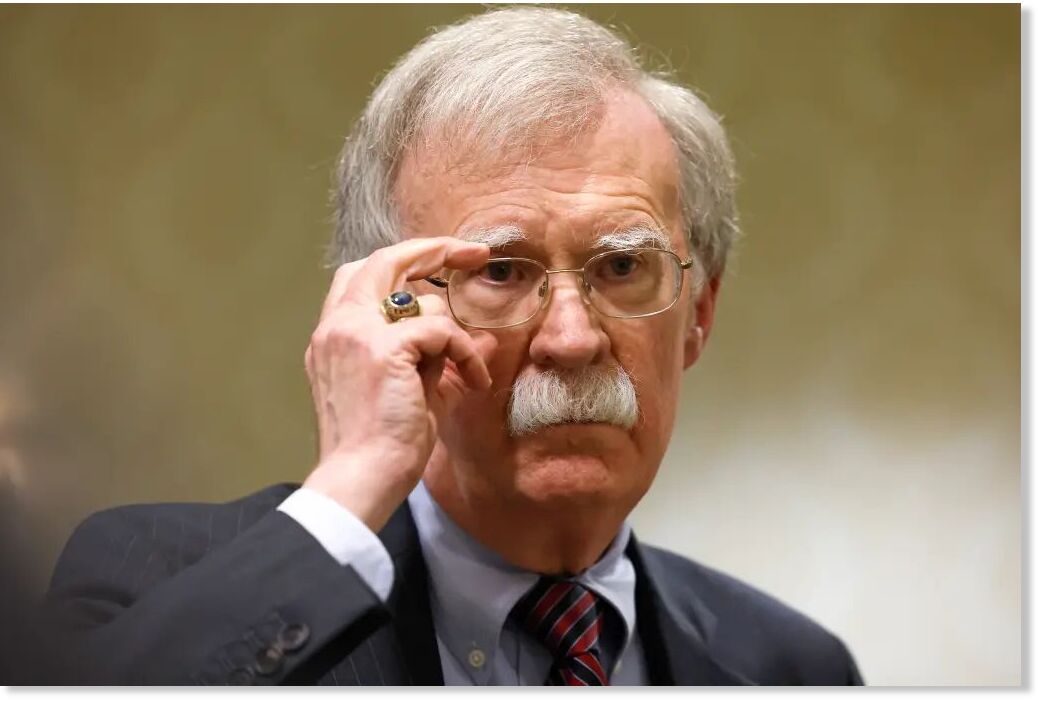
US envoy Tom Barrack downplays idea Türkiye could be 'next Iran' for Israel

Tom Barrack us ambassador
© Handout / Antalya Diplomacy Forum / AFPUS Special Envoy for Syria and US Ambassador to Türkiye Tom Barrack speaks during the 5th edition of the three-day Antalya Diplomacy Forum on 17 April 2026
Trump's special envoy says Türkiye not a country to be 'messed with' at forum in Antalya

US Envoy Tom Barrack has downplayed escalating tensions between Türkiye and Israel as just "rhetoric" and pushed for regional cooperation between the two countries in security and energy projects.

Speaking during a panel at the Antalya Diplomacy Forum, Barrack pushed back against comments from some officials in both countries that suggested they could come into conflict in the near future.

"I think Türkiye is just not a country to be messed with," Barrack said.

Barrack said that both countries were seeing a distorted image of each other as a result of sensationalised media coverage that painted both as expansionist.

Star of David

Netanyahu left 'personally stunned' by Trump rhetoric prohibiting air strikes that drive out Lebanese population

Benjamin Netanyahu
Israeli Prime Minister Benjamin Netanyahu and his inner circle were reportedly blindsided - left "stunned" - after President Trump dropped a surprise line effectively clipping Israel's wings in Lebanon, according to Axios, citing sources familiar with the exchange.

On Friday, Trump declared the US had "prohibited" further Israeli strikes just as the administration-brokered 10-day ceasefire with Lebanon kicked in. The US President was unusually harsh in rhetoric with America's longtime #1 Mideast ally, writing on Truth Social that "enough is enough".

The words were clearly not directed at Lebanon, or Hezbollah, but squarely at Israel and its deadly air campaign which had included intense bombing of Beirut at the South for the last week-and-a-half.

Comment: Trump can bluster, but is anyone surprised at how things actually go?


Take 2

Trump may want out of the Iran war, but the first round of negotiations showed the challenges ahead

Vance
© Gage Skidmore/FLICKRUS Vice President J.D. Vance • Americafest • Phoenix, Arizona • December 21, 2025
It's clear the Trump administration recognizes the Iran war has been a catastrophe. But while the U.S. may want a way out, the first round of negotiations with Iran showed that finding an exit may be difficult.

When U.S. Vice President JD Vance took to the podium after a long day of talks to end the American and Israeli war of choice on Iran, he made one thing clear. This had not been a serious attempt to reach a deal.

Although the talks went on for more than twenty hours, it's just one day of negotiations. The very fact that the headline was that there had been no "breakthrough" in just one day displayed a fundamental lack of seriousness.

Despite Vance's attempt at drama, neither side shut the door on continuing negotiations. The U.S. has even proposed extending the ceasefire, as Pakistani emissaries have arrived in Tehran to arrange further talks. Washington has even pressed Israel for a ceasefire in Lebanon, something that does not sit well with either Israeli Prime Minister Benjamin Netanyahu or the Israeli Jewish population.

At the same time, the United States has moved to block Iranian ships from using the Strait of Hormuz, a sort of counter-blockade, and has dispatched thousands more troops to the region.

What does all of this mean?

SOTT Logo Radio

SOTT Focus: NewsReal: Dire Strait: Deciphering Trump's Crazy Messaging on Tense Iran Situation

trump iran war israel lebanon newsreal
© Sott.net
It's not easy to do, and it's tempting to just 'turn it off', but we're all unfortunately doomed to have to endure Trump's erratic statements on Iran and wider geopolitics for the duration of this crisis (which he himself caused). For now a tentative ceasefire is holding, and further talks are scheduled in Pakistan this week, but from one hour to the next no one can tell which way things will go: towards a 'deal', or back towards hot war?

Trump, though manifestly not presidential material, really is the quintessential American to be 'saving America' at the end of empire. Decades ago, the 'quiet American' would covertly 'fix' things abroad, all in service of maximizing American power and wealth. Now a distinctly LOUD American is blurting out loud what we've long suspected the Washington elite think privately: "let's just go take all their stuff and kill them if they refuse..."


Running Time: 01:43:26

Download: MP3 — 94.7 MB


Attention

The Consequences of Incompetence

The US lost the first round of the war with Iran decisively. If Trump decides to go a second round, the results will be disastrous for American and its allies.
DJT go out
© Real Scott Ritter
For nearly 40 days, Israel and the United States carried out an extensive aerial campaign against Iran designed to topple the government and suppress Iran's ability to defend itself. This campaign failed to achieve any of its stated objectives. Instead, it devolved into a numbers game where inflated outcomes were sold to an unquestioning public by military professionals and politicians alike. The Iranian government not only withstood the efforts at decapitation-induced regime change, but actually strengthened its hold on power when the people of Iran, instead of turning on the Islamic Republic, rallied to its cause. Moreover, rather than suppressing Iran's ability to launch ballistic missiles and drones against US military bases, critical infrastructure in the Gulf Arab States, and Israel, Iran not only sustained its ability to strike, but deployed new generations of weapons that readily defeated all missile defense systems while, using intelligence information that permitted accurate targeting, destroyed critical military infrastructure worth tens of billions of dollars.

Regional experts had long warned about the consequences of entering an existential conflict with Iran, noting that Iran would not simply allow itself to be erased as a viable nation state without ensuring that the other nations of the region were subjected to similar existential threats to their survival, and that global energy security would be disrupted in such a manner as to trigger a world economic crisis. These assessments were backed up by a belief that Iran would not only be able to shut down shipping transiting the Strait of Hormuz, but also effectively target and destroy the major energy production potential of the Gulf Arab States.

It wasn't that the politicians and military planners in the US and Israel doubted Iran's ability to impact global energy markets or strike targets in Israel and the Gulf region.

They knew Iran had the potential.

They just believed that they would be able to achieve regime change in Tehran in relatively short order, thereby mooting any threat Iran might pose to energy supplies and infrastructure.

They were wrong, which is why the US was looking for an offramp from the war soon after it started.

The end result was this current ceasefire, which was ostensibly entered into to buy time for US and Iranian negotiators to hammer out a lasting peace plan.

There is a fundamental problem, however.

Bad Guys

Best of the Web: The EU's digital gulag is (apparently) ready to roll

digital prison gulag identification wallet
"It is for parents to raise their children, and not the platforms."

Those were the words of European Commission President Ursula von der Leyen on Wednesday as she announced the readiness of the EU's online age verification, ahem, platform. As we've been warning since November 2024, these platforms are ultimately a Trojan Horse for digital identity systems, which are in turn intended to serve as the cornerstone for the digital gulags being quickly assembled around the world.

What gets rarely mentioned in the public debate, including in Von der Leyen's 11-minute speech below, is the fact that online age verification inevitably traps everyone, not just minors, in its web. "Protecting the children", however, is always a seductive pretext for launching otherwise socially unpalatable policies. And there are few more socially unpalatable policies than the controlled death of online privacy and anonymity.

Attention

Europe, the peace project, mutates into a warmongering dictatorship

NATO vs Russia
© Strategic Culture Foundation
European nations are being destroyed by war and militarism, and adding to the madness, their political class and media are driving the process with ever-increasing speed.

The fate of the continent could hardly be more tragic, given that it emerged from the ashes of World War II with the hope of being a model for international peace.

Hungary's divisive elections this week, which saw the government of Viktor Orban ousted from power, were dominated by political and financial pressures exerted by the EU leadership on Budapest owing to Orban's steadfast rejection of Brussels' warmongering towards Russia. Hungarians cast their vote amid turmoil caused by Brussels and the energy blackmail of the NATO-backed Kiev regime. There are concerns that other EU nations, such as Slovakia, will face a similar assault on their democratic process if they do not conform to the elite agenda of making everything about an existential confrontation with Russia.

European citizens are enduring an economic crisis that has been brought on by NATO and the EU's proxy war with Russia. Fuel, energy, food, and other living costs are going through the roof as a direct result of war and militarism. First, the energy supplies from Russia were cut off through government-led sanctions. Now, Trump's aggression against Iran has hit energy supplies from the Persian Gulf, leaving Europe doubly exposed.

Instead of reversing course, the European NATO states seem intent on going full throttle towards a disastrous crash. This raises fundamental questions about democratic representation. Does it even exist anymore in Europe, including Britain?

This week in Britain, there were strident calls for massive extra spending on its military budget, paid for by slashing investment in social welfare and other public services. The calls were led by a former British minister, George Robertson.

"Lord Robertson", who is a member of Britain's unelected House of Parliament, is also a former head of NATO (1999-2003). He has long been urging the British government to expand the military budget even though figures show that Britain is spending more on so-called defense than at any time since the end of the Cold War.

In a high-profile public lecture, and with a touch of hysteria, Robertson claimed: "We are under-prepared. We are underinsured. We are under attack. We are not safe... Britain's national security and safety are in peril."

His bottom line: "We cannot defend Britain with an expanding welfare budget."

Green Light

Iran war and the new world order

Iran USA War in Progress
© UnknownIran • USA • War in Progress
Trump's war on Iran hasn't just redrawn battle lines; it has fractured the very architecture of the post-Second World War global order: a transatlantic alliance pushed beyond limits and internally too fractured to be repaired, a rapidly remade Middle East, shifting rules of global oil transit, and a stark exposure of the limits of US power, leaving strategic space that China and Russia will be keen to fill in both geopolitical and geoeconomic ways.

The Fracturing of the Western Alliance System

The most immediate and consequential rupture has occurred within the Western alliance system itself. NATO — long considered the institutional backbone of transatlantic security — has been pushed to the brink by Washington's unilateral prosecution of the war. European allies not only refused to participate militarily, but in several cases actively restricted US operational access, underscoring the depth of strategic divergence.

This is not merely a tactical disagreement; it signals a structural shift. European leaders have been explicit that the Iran war is "not NATO's war," rejecting its incorporation into the alliance's collective security framework. At the same time, Washington's threats to punish non-compliant allies — through troop withdrawals or political pressure — have further corroded alliance cohesion.

Footprints

Iran War: Sleepwalking into Starvation

Trump Neti Oblivious
© UnknownUS President Donald Trump • Israeli PM Benjamin Netanyahu • Oblivious
Famine may occur in two months or less if Israel's war continues.

Now that Iran has established a blockade and tolling system in the Strait of Hormuz in response to the United States and Israel attacking the country, large amounts of urea, ammonia, phosphates, and sulfur, critical components for fertilizer, are locked out of agricultural supply chains.

While the blockade is not an issue for Russia, the world's largest exporter of urea, it is a significant issue for Qatar, Oman, and Saudi Arabia, Persian Gulf states currently prevented from exporting urea to market. India, Brazil, and the US are dependent on urea from the Gulf, while China, India, and the US depend on sulfur and ammonia exports from the region.

"The timing of the disruption makes the situation especially acute," explains the Kiel Institute, a European research institute for global economic affairs:
"March and April are peak months for fertilizer application in the Northern Hemisphere planting season. Although some market adjustment may occur over time, structural damage to supply chains and agricultural production is likely to persist."
On March 9, the American Farm Bureau Federation sent a letter calling on President Trump to ensure safe passage of fertilizer shipments to the United States to stabilize costs and delivery ahead of spring planting season for farmers, the Detroit Free Press reported.

Comment: Broader picture: The many facets of population depletion are on schedule. All actions 'out of control' are in control.