Puppet MastersS


Cruise Missle

Ukraine conflict a NATO 'proxy war' - Trump envoy

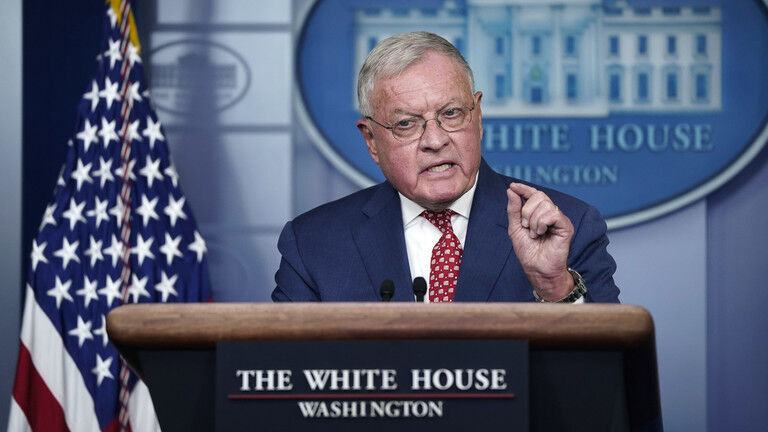
US Special Envoy for Ukraine Keith Kellogg
© Getty Images / Drew AngererUS Special Envoy for Ukraine Keith Kellogg at the White House, Washington, DC. September 22, 2020.
Keith Kellogg has echoed Moscow's characterization of the hostilities.

Russian President Vladimir Putin is right in considering the Ukraine conflict a proxy war against Russia, US President Donald Trump's special envoy Keith Kellogg told Fox News in an interview on Sunday.

He said that while he believes the peace process will ultimately succeed, "escalatory issues" remain. Kellogg referred to comments by German Chancellor Friedrich Merz, who last month indicated that Berlin would be open to supplying Kiev with Taurus cruise missiles.

Kellogg addressed Russian President Vladimir Putin's perspective, saying "he considers this a proxy war by NATO. And frankly... in a way it is."
"The escalatory issues are still there," Kellogg said. "Chancellor Merz has said: well, I'm going to give the Ukrainians the Taurus missile system."

Bizarro Earth

How American intelligence sees the new global order

DIa building
© Maj. Angel Jackson/ Unknown/KJNDIA Headquarters
If the DIA is publishing this report, it is because it wants the countries mentioned in it to receive a specific message. Let us therefore look at the content step by step.

A message to adversaries

A report by the U.S. Defence Intelligence Agency (DIA) was released a few days ago outlining a new geopolitical configuration in which Russia, China, Iran and North Korea do not form a formal alliance, but rather a system based on a flexible network with a functional distribution of roles. It is an interesting point of view that deserves further consideration.

Let us consider, first of all, that if the DIA is publishing this report, it is because it wants the countries mentioned in it to receive a specific message. Let us therefore look at the content step by step.

China confers diplomatic and visual legitimacy on the group, while openly avoiding supplying weapons. Iran, on the other hand, contributes drones and is preparing for a technology exchange. North Korea asserts itself as the main source of artillery and manpower. Moscow is not aiming to create a union centered on itself, but is developing a heterogeneous logistical and technological network. Beijing is moving on two tracks: on the one hand, it is intensifying military cooperation with Russia, including in the Arctic; on the other, it is avoiding sending lethal weapons directly in order to avoid sanctions and protect its international image. This highlights China's strategic line of maintaining a "deep partnership without a real alliance".

Comment: Insightful analysis predicts: The USA to have its reckoning.


Arrow Down

US terms for nuclear deal 'out of touch with reality' - Iranian source to RT

US delegates
© Baris Seckin/Anadolu/Getty ImagesUS delegates arrive at the Omani Embassy in Rome for nuclear talks with Iran • May 23, 2025
The White House's letter to Tehran was far from a compromise, a person familiar with the matter has said.

The US proposal for a new nuclear agreement with Iran is unacceptable, an Iranian source familiar with the matter told RT. Washington recently outlined its terms in a letter to Iran after five rounds of talks mediated by Oman.
"Iran views the US written elements as extremely far from what could possibly be regarded as a fair and realistic basis for a likely compromise. Iranians were dismayed to see such a fanciful, one-sided text that is so out of touch with reality."
The White House said on Sunday that President Donald Trump's Middle East envoy, Steve Witkoff, sent "a detailed and acceptable proposal" to Tehran. White House spokeswoman Karoline Leavitt reiterated Washington's position that "Iran can never obtain a nuclear bomb."

Iranian Foreign Minister Abbas Araghchi said the Islamic Republic would provide a response "in line with the principles, national interests, and rights of the people of Iran."

Comment: If positions deadlock, who benefits? Israel.


Light Sabers

UK must prepare for direct conflict with Russia - defense secretary

military
© Max Mumby/Indigo/Getty ImagesJunior Non-Commissioned Officers of 5th Battalion, The Rifles • Bulford, England • October 4, 2024
London will invest $8 billion in long-range missile production, John Healey has said.

The UK plans to mobilize billions of pounds to bolster its military-industrial base in preparation for a potential conflict with Russia, Defense Secretary John Healey has said.

The statement comes ahead of the publication of the government's Strategic Defense Review on Monday. According to the BBC, the report is expected to portray Russia and China as major threats to the UK.

The review is expected to allocate £1.5 billion ($2 billion) toward building six new munitions factories. Over the next five years, London will dedicate around £6 billion to manufacturing long-range weapons, including Storm Shadow missiles, Healey told the BBC on Sunday. The missile, developed jointly with France, has reportedly been used by Ukraine to strike civilian targets in Russian territory, according to Moscow.
"This is a message to Moscow as well. This is Britain standing firm - not only strengthening our Armed Forces, but also reinforcing our industrial base. It's part of our readiness to fight, if required."
Western support for Ukraine has exposed serious weaknesses in arms production, with British military leaders warning that weapons stockpiles are dangerously low, the BBC reported.

Dollars

'One quiet early morning in Beijing, the dollar's crown slipped'

Dollar Fall
© Strategic Culture Foundation
"I believe we must start from the notion of defeat leading to revolution - to grasp the Trump revolution".

"The experience underway in the United States, even if we don't know exactly what it will be, is revolution. Is it a revolution in the strict sense? Is it a counter-revolution?"

So spoke the French historian and philosopher Emmanuel Todd in his April Moscow lecture, From Russia With Love.

"This [Trump revolution] is, in my opinion, linked to defeat. Various people have reported to me conversations between members of the Trump team, and what is striking is their awareness of defeat. People like J.D. Vance, the Vice President, and many others, are people who understood that America had lost this war".

This American awareness of defeat, however, contrasts markedly with the Europeans' surprising lack of awareness - rather it is denial - at their defeat:

"For the United States, it is fundamentally an economic defeat. The sanctions policy showed that the financial power of the West was not omnipotent. The Americans were reminded of the fragility of their military industry. The people at the Pentagon know very well that one of the limits to their action is the limited capacity of the American military-industrial complex".

"That America is in the midst of a serious revolution, right now - easily comparable to the end of the USSR - is understood by a few". Yet our preconceptions - political and intellectual - often prevent us from seeing and assimilating the import of this reality".

Todd, to his credit, admits the difficulty with perception readily:
"I must admit that when the Soviet system actually collapsed, I was unable to foresee the extent of the dislocation and the level of suffering this dislocation would cause for Russia. My experience taught me one important thing: The collapse of a system is as much mental as economic ... I didn't understand that communism was not only an economic organization but also a belief system, a quasi-religion, that structured Soviet and Russian social life. The dislocation of belief would lead to psychological disorganization far beyond economic disorganization. We are reaching a situation of this type in the West today".
The psychological dislocation caused by 'defeat' may explain (but not justify) the West's 'curious' inability to understand world events: The almost pathological dissociation from the real world that it displays in its words and actions: It's blindness - for example, to the Russian experience of history and to the long history behind Shi'a defiance in Iran. Yet, even as the political situation deteriorates ... there is no sign of the West becoming more reality-based in its understanding - and it is very likely that it will continue to live in its alternative construction of reality - until it is forcibly expelled.

Arrow Down

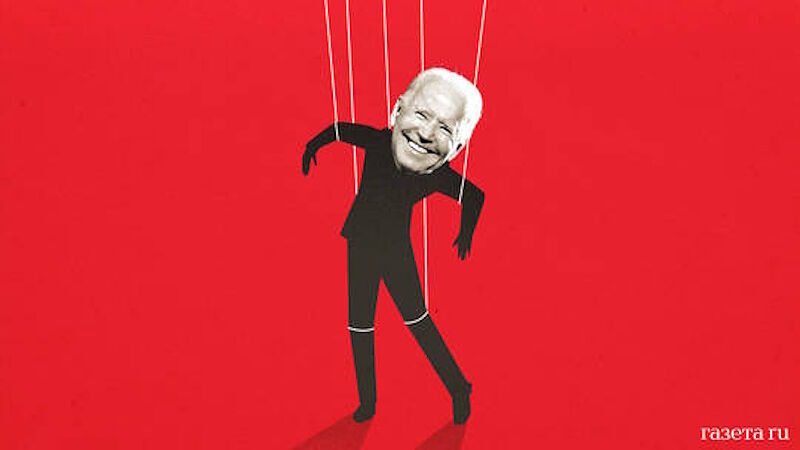
The Biden years are when America started to resemble late-stage USSR

biden puppet graphic
© Dasha Zaitseva / Gazeta.Ru
How Washington became a gerontocracy

It's been a while since we've heard much about Joe Biden, hasn't it? Yet here he is, back in the headlines - not because of some triumphant return to form, but for all the wrong reasons. The former US president has once again found himself at the center of national attention, thanks to a sequence of revealing and deeply troubling events.

It began with Axios publishing the full audio of Biden's now-infamous interview with special prosecutor Robert Hur. The same interview in which Hur concluded that the then president suffered from serious memory issues. As the recording confirmed, he wasn't wrong. Biden struggled to recall basic facts - even the date his son died.

Days later, another bombshell dropped: Biden had been diagnosed with an aggressive form of prostate cancer. The news barely had time to circulate before the release of Original Sin, a book by CNN's Jake Tapper and Axios's Alex Thompson, tore down what little remained of the White House facade.

Jet5

Ukraine conducts massive drone attack on Russian airbases

ukraine drone attack russia airbase
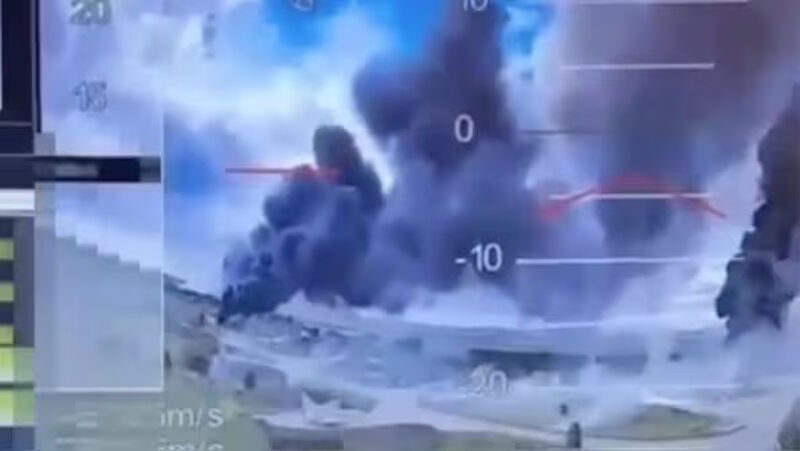
© Ukraine's Security Service via Kyiv IndependentA screenshot from a video of the alleged attack released by the SBU on June 1, 2025
International and Ukrainian media have reported a massive Ukrainian drone attack on frontline Russian bases, citing sources from Ukraine's Security Service (SBU)A screenshot from a video of the alleged attack released by the SBU on June 1, 2025 (Source: Ukraine's Security Service via Kyiv Independent)

At least 40 Russian bombers and military aircraft were reportedly hit in an operation by Ukraine's Security Service (SBU) on Sunday (June 1) in a drone attack that targeted several air bases near the frontlines, reported Reuters, citing sources in the security agency.

The Ukrainian media has also reported the development, citing sources from the SBU.

Comment: Russia's answer:
Over 30 long-range kamikaze UAVs were destroyed in the attack, the Russian Defense Ministry has said

Moscow has successfully hit a Ukrainian long-range drone launch site in Ukraine's northeastern Kharkov Region, the Russian Defense Ministry said in a statement on Sunday. It also published a video of the strike.


The strike destroyed all of the launch pads, along with some 30 long-range kamikaze drones and eight military vehicles, it added.

A short video shows a powerful blast rocking an area near the airfield where some installations were located. According to the ministry, a Russian Iskander-M ballistic missile system was used in the strike.

The news came amid reports of drone strikes across Russia. Several military airfields located in five Russian regions were targeted in attacks on Sunday, according to the Defense Ministry. The Ukrainian media claimed the strikes were part of a major operation called 'Spiderweb' that had been prepared for more than a year and a half.

According to the Russian military, three out of five attacks were successfully repelled and resulted in no damage, while two more ended up setting aircraft on fire - although the flames were promptly extinguished. No one was injured in the attacks.

Earlier in the day, the first drone attack was reported in Russia's Siberian Irkutsk Region, where unmanned aerial vehicles (UAVs) targeted a military base. The strike resulted in no casualties or major material damage, according to the authorities.

It comes less than a day after two bridges collapsed in Russian regions bordering Ukraine in what the authorities described as deliberate acts of sabotage. One of the collapses derailed a passenger train, killing seven and injuring 71 others. The Investigative Committee said in a statement on Sunday that the bridges had been "blown up" in both cases. Russian Senator Andrey Klishas has blamed Kiev for both incidents.
Lord Bebo gives a warning to the Ukrainians currently drunk on their success:


Arrow Up

What is Trump's game in Syria?

Syrian Prez DTrump
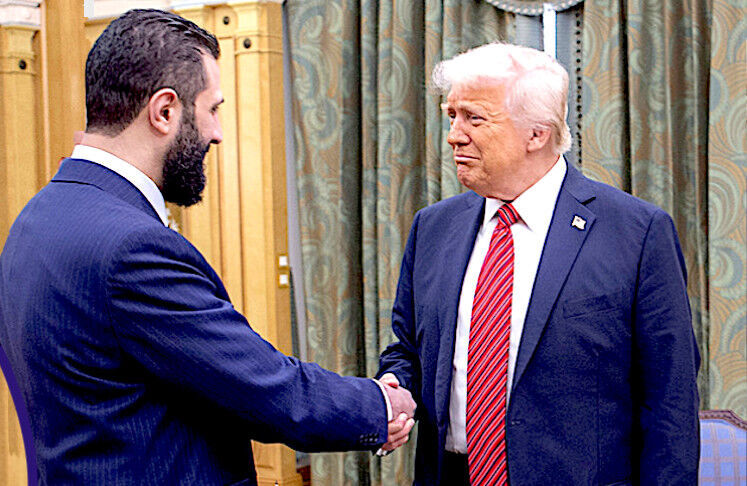
© Bandar Aljaloud/Palacio Real saudí/APSyrian Interim President Ahmad al-Sharaa • US President Donald Trump • Riyadh, Saudi Arabia • May 14, 2025
Why has the US president decided to lift all sanctions on Damascus, and how will it shape the future of the region?

US President Donald Trump's recent announcement that he intends to lift all sanctions on Syria stands as one of the most unexpected and controversial foreign policy moves Washington has made in the past decade.

Declared during Trump's Middle East tour at the US-Saudi Investment Forum in Riyadh, the decision marks a dramatic shift in America's approach to the region - one that could reshape the strategic landscape for both allies and adversaries.

The sanctions on Syria, first imposed in 1979, were progressively tightened over decades in response to accusations of sponsoring terrorism, human rights abuses, and close ties with Iran. Their full repeal is an unprecedented gesture, especially considering that Syria's current president, Ahmed Hussein al-Sharaa, was until recently regarded by the US as a senior figure in Al-Qaeda - with a $10 million bounty once placed on his capture.

In return, Damascus has made a series of strategic commitments.

Comment: Constructive revisioning, if allowed to develop, opens possibilities previously unimagined.


Mail

Letter from Israel to Tom Fletcher

Tom Fletcher
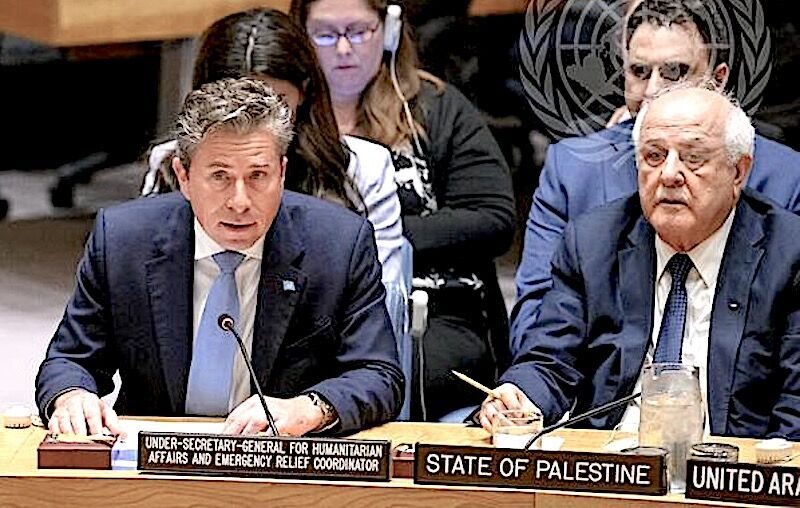
© UnknownUN Under-Secretary-General and Humanitarian Coordinator Tom Fletcher, at the Security Council on May 13, 2025
Letter from Israel to Tom Fletcher:
I was deeply shocked and disturbed by your recent remarks during the Security Council briefing on Tuesday, 13 May, in which you stated, "What more evidence do you need? Will you act now - decisively - to prevent genocide and to ensure respect for international humanitarian law? Or will you say instead, 'we did all we could.'"

You had the audacity, in your capacity as a senior United Nations official, to stand before the Security Council and invoke the charge of genocide without evidence, mandate, or restraint. It was an utterly inappropriate and deeply irresponsible statement that shattered any notion of neutrality. As a senior representative of the United Nations, you are obligated to refrain from prejudging complex international matters. Yet, this is precisely what you did before the Council. You did not brief the Council; you delivered a political sermon.

Under whose authority do you issue what could be interpreted as a legal, or quasi-legal, accusation regarding the situation in Gaza? To weaponize the word "genocide" against Israel is not just distortion, it is the desecration and subversion of a term with unique force and weight.

Comment: BBC's interview with Tom Fletcher (a reasonable guy with heart and concern) - worth a view:

Since the easing of the blockade, scenes of chaos have broken out at aid distribution centres run by the Gaza Humanitarian Foundation - a US- and Israeli-backed group.

The UN, which refuses to cooperate with the GHF, said 47 people were injured earlier this week after crowds overwhelmed one of the centres.

Mr Fletcher said: "We're seeing food set on the borders and not being allowed in when there is a population on the other side of the border that is starving, and we're hearing Israeli ministers say that is to put pressure on the population of Gaza."

He said that Israeli Prime Minister Benjamin Netanyahu should "absolutely" disavow a statement made by Finance Minister Bezalel Smotrich - who had said people in Gaza would be "totally despairing understanding that there's no hope and nothing to look for", and would be looking to relocate to begin a "new life in other places".

"We would expect governments all over the world to stand for international humanitarian law, the international community is very, very clear on that," Mr Fletcher said. He called on Netanyahu to ensure that "this language, and ultimately, this policy... of forced displacement, isn't enacted".

On 14 May, Mr Fletcher called on the UN Security Council to act to prevent genocide in Gaza. Asked why he had made that statement, he referred to reporting from colleagues on the ground in Gaza. "What they're reporting is forced displacement. They're reporting starvation, they're reporting torture, and they're reporting deaths on a massive scale."

In the cases of Rwanda, Srebrenica and Sri Lanka, "the world had told us afterwards that we didn't act in time, that we didn't sound a warning".

"And that's my call to the [UN] Security Council and the world right now, 'will you act to prevent genocide?'"
The Jerusalem Post doubles down:
Fletcher is not just wrong - he is dangerously wrong. This is a man with a global platform, overseeing one of the most sensitive humanitarian crises in the world. He cannot afford to be loose with his words or misleading with his facts. And yet, this is now a pattern. A pattern of blame without balance. A pattern of distortion. A pattern of omission where Hamas is concerned and vilification where Israel is involved.

The UN activity cannot be led by someone who treats truth as negotiable and facts as optional. The stakes are simply too high. Fletcher's continued presence damages the credibility of the world body, undermines its impartiality, and emboldens those who exploit humanitarian crises for political gain. The UN cannot afford to be represented by someone who sows confusion, inflames tensions, and selectively sees injustice. The UN cannot afford to be represented by someone who sows confusion, inflames tensions, and selectively sees injustice. Tom Fletcher must resign.
Perhaps Israel should take a long look in the mirror. It would go blind.


X

Defeating Russia impossible - German foreign minister

Wadephul
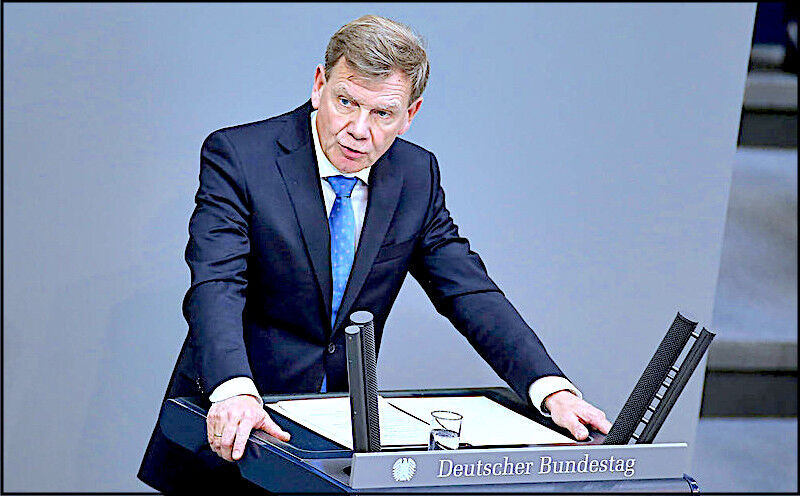
© Global Look Press/IMAGO/dts news agencyGerman Foreign Minister Johann Wadephul
The Ukraine conflict can only end at the negotiating table, Johann Wadephul has said.

It has been clear from the very beginning of the Ukraine conflict that Russia cannot be defeated, particularly due to its nuclear status, German Foreign Minister Johann Wadephul has told the SZ newspaper.

Kiev's Western backers, including top officials in Germany, France, and the UK, as well as the US under former President Joe Biden's administration, repeatedly stated the intent to inflict a "strategic defeat" on Moscow in the Ukraine conflict, or at least to ensure that it does not emerge victorious. That justification has been used to support continued military assistance to Kiev.

Wadephul admitted on Friday that it was obvious the conflict between Moscow and Kiev can only be resolved in a diplomatic way.

"It was clear from the beginning that this war would most likely end through a negotiated settlement," Germany's top diplomat told SZ in a lengthy interview.

Comment: Merz is 'trouble gaining momentum'. The force will obliterate him without mercy.