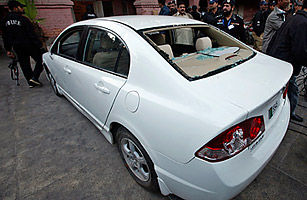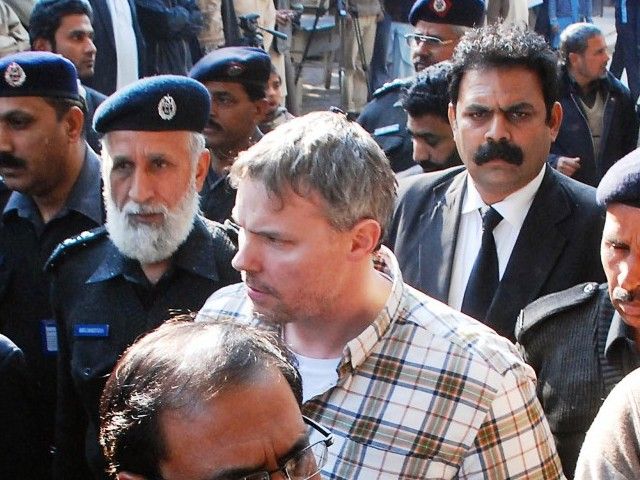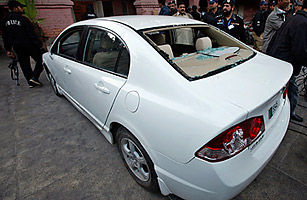
© Mohsin Raza / ReutersPolicemen stand next to a car, which police said a U.S consulate employee was travelling in when he was engaged in a shoot-out, after it was brought to a police station in Lahore January 27, 2011. The U.S. consulate employee shot and killed two gunmen in self-defence in the Pakistani city of Lahore on Thursday, police said.
The scene could have been scripted in a Hollywood action thriller: For two hours at the end of last month in Lahore, U.S. diplomat Raymond Davis was closely pursued by two visibly armed men on a motorbike. He noticed them tailing him from a restaurant to an ATM, and through the crowded streets of Pakistan's second city. They were close by when, in a crowded intersection, Davis produced his own handgun and fired seven shots. The diplomat was apparently a crack shot, and all seven bullets found their mark, killing his two pursuers. Davis then called for back-up, and a four-wheel-drive vehicle raced onto the scene, striking a Pakistani bystander who was killed by the impact. But the people in the vehicle, whose identities remain unknown, escaped from the scene having failed to retrieve Davis, who was later arrested nearby. In custody, Davis has told Pakistani authorities that he acted in self-defense, and has invoked diplomatic immunity, an international convention that protects diplomats from prosecution in the countries where they serve.
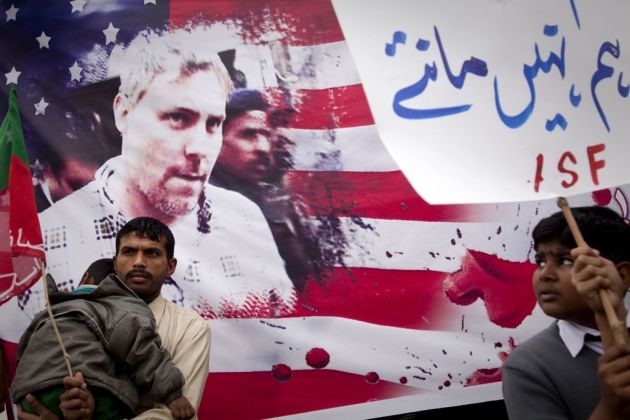
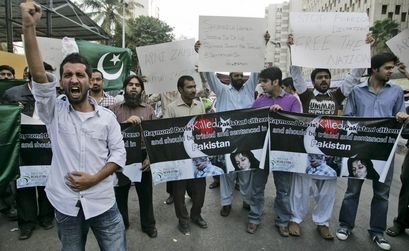
Two weeks later, Davis remains behind bars, facing murder charges. And the incident has plunged the already troubled relationship between Washington and Islamabad to a new low. Pakistani officials say Secretary of State Hillary Clinton last week canceled a meeting with her Pakistani counterpart and is considering withdrawing an invitation for President Asif Ali Zardari to a trilateral summit with Afghan President Hamid Karzai later this month. But at home, Zardari faces intense pressure to prosecute Davis. The hitherto obscure employee of the U.S. Embassy in Islamabad has now become a lightning rod for the fierce anti-American sentiments shared by an overwhelming majority of Pakistanis.