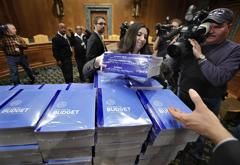
© AP/J. Scott ApplewhiteCopies of President Obama's 2012 budget are delivered to the Senate Budget Committee by staff member Dylan Morris, Monday, Feb. 14, 2011, on Capitol Hill in Washington.
The budget plan President Barack Obama sent Congress on Monday foresees a record deficit of $1.65 trillion this year. That would be just under 11 percent of the $14 trillion economy -- the largest proportion since 1945, when wartime spending swelled the deficit to 21.5 percent of U.S. gross domestic product.
The danger is that a persistently large gap in the budget could threaten the economy. Investors would see lending their money to the U.S. as riskier. So they'd demand higher returns to do it. Or they'd simply put their cash elsewhere. Interest rates on mortgages and other debt would rise as a result.
And if borrowing turned more expensive, people and businesses might scale back their spending. That would weaken an economy still struggling to lower unemployment, revive real estate prices and restore corporate and consumer confidence.
So far, it hasn't happened. It's still cheap for the government to borrow money and finance deficits. But economists fear the domino effect if all that changes.