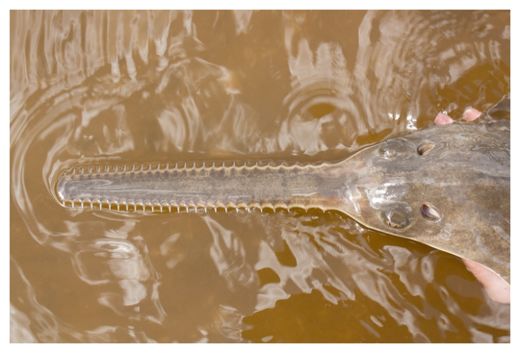
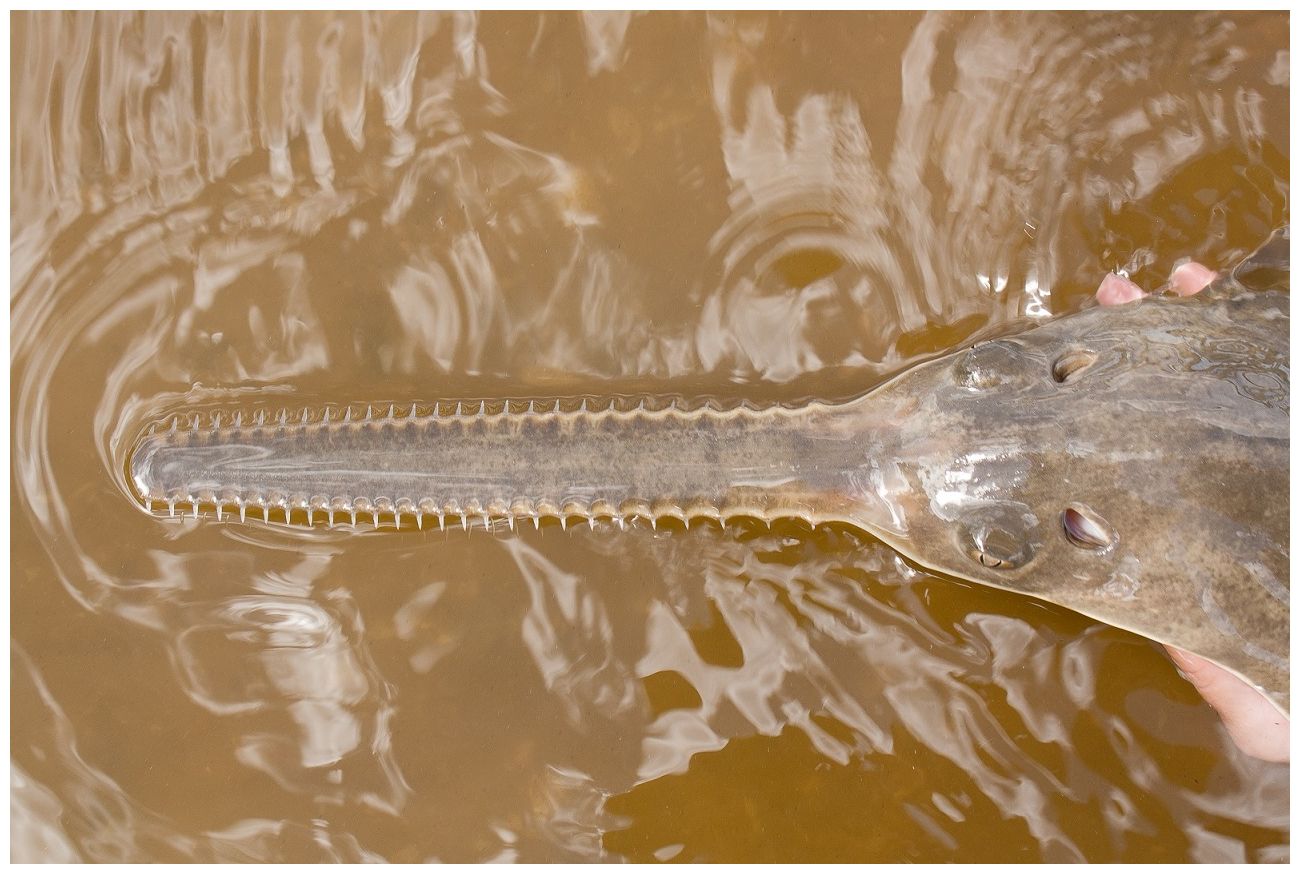
© Florida Fish and Wildlife Conservation Commission (FWC)The toothy snout of a juvenile smalltooth sawfish in Florida's Charlotte Harbor estuarine system.
To the surprise of scientists, giant endangered fish with sawlike snouts in Florida are experiencing virgin births, reproducing without sex. This is the
first solid evidence of such asexual reproduction in the wild for any animal with a backbone, scientists added.Asexual reproduction is often seen among invertebrates — that is, animals without backbones. It happens rarely in vertebrates, but instances are increasingly being discovered — only observed to survive in captivity previously. For example,
the Komodo dragon, the world's largest living lizard, has given birth via parthenogenesis, in which an unfertilized egg develops to maturity. Such
virgin births have also been seen in sharks, in birds such as chickens and turkeys, and in snakes such as
pit vipers and
boa constrictors. Such virgin-born offspring are known as parthenogens.
Until now, evidence of parthenogenesis in vertebrates came nearly entirely from captive animals, usually surprising their keepers by giving birth despite the fact that they had not had any mates. Scientists had recently found two female snakes in the wild that were each pregnant with progeny that developed via parthenogenesis, but it was not known if these parthenogens would have survived. As such, it remained uncertain whether virgin births happened to any significant extent in nature.
Now scientists find that among smalltooth sawfish, progeny of virgin births do regularly live in the wild. These fish are critically endangered relatives of sharks. [
Watch the 'Virgin Birth' Baby Sawfish (Video)]
"Vertebrate animals that we always thought were restricted to reproducing via sex in the wild actually have another option that does not involve sex," study co-author Demian Chapman, a marine biologist at Stony Brook University in New York, told Live Science. "Rare species, like those that are endangered or colonizing a new habitat, may be the ones that are doing it most often. Life finds a way."



















Comment: Also see: Human sheep: Study reveals flock mentality, how 5% can influence the crowd