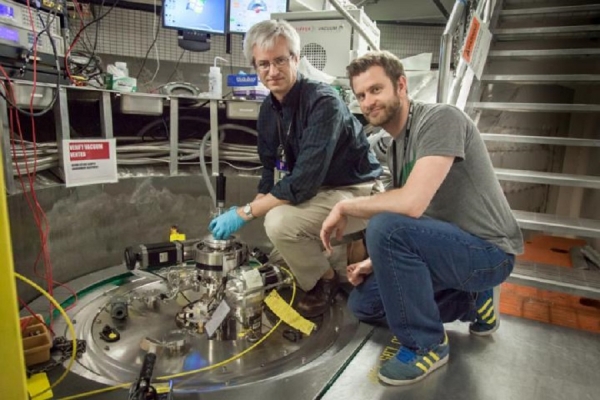
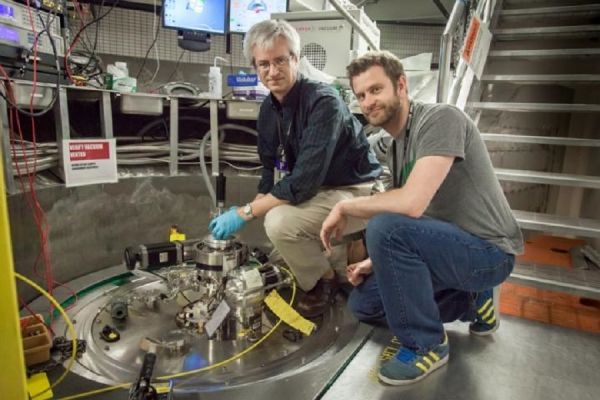
© celebcafe.orgDoug Abernathy, left, ARCS instrument scientist at Oak Ridge National Laboratory, and Marc Janoschek, Los Alamos National Laboratory, prepare their sample for experiments at the Spallation Neutron Source.
Groundbreaking work at two Department of Energy national laboratories has
confirmed plutonium's magnetism, which scientists have long theorized but have never been able to experimentally observe. The advances that enabled the discovery hold great promise for materials, energy and computing applications.
Plutonium was first produced in 1940 and its unstable nucleus allows it to undergo fission, making it useful for nuclear fuels as well as for nuclear weapons. Much less known, however, is that
the electronic cloud surrounding the plutonium nucleus is equally unstable and makes plutonium the most electronically complex element in the periodic table, with intriguingly intricate properties for a simple elemental metal.
While conventional theories have successfully explained plutonium's complex structural properties,
they also predict that plutonium should order magnetically. This is in stark contrast with experiments, which had found no evidence for magnetic order in plutonium.
Finally, after seven decades, this scientific mystery on plutonium's "missing" magnetism has been resolved.
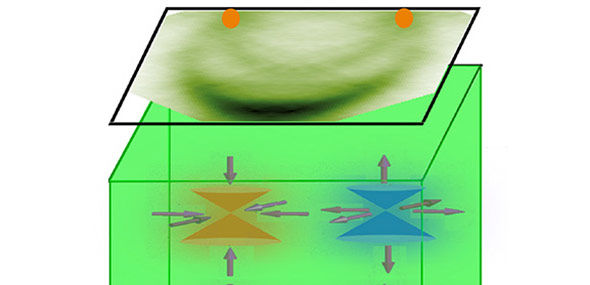
Using neutron scattering, researchers from the Department of Energy's Los Alamos and Oak Ridge (ORNL) national laboratories have made the first direct measurements of a unique characteristic of plutonium's fluctuating magnetism. In a recent paper in the journal
Science Advances, Marc Janoschek from Los Alamos, the paper's lead scientist, explains that plutonium is not devoid of magnetism, but in fact
its magnetism is just in a constant state of flux, making it nearly impossible to detect.
Comment: Finding the "missing" properties of plutonium is one thing...what they do with it may be something else. Pardon the skepticism, but didn't we "invent" this fueler of nuclear disasters?
Plutonium was first made in December 1940 at Berkeley, California, by Glenn Seaborg, Arthur Wahl, Joseph Kennedy, and Edwin McMillan. They produced it by bombarding uranium-238 with deuterium nuclei (alpha particles). This first produced neptunium-238 with a half-life of two days, and this decayed by beta emission to form element 94 (plutonium). Within a couple of months element 94 had been conclusively identified and its basic chemistry shown to be like that of uranium.To begin with, the amounts of plutonium produced were invisible to the eye, but by August 1942 there was enough to see and weigh, albeit only 3 millionths of a gram. However, by 1945 the Americans had several kilograms, and enough plutonium to make three atomic bombs, one of which exploded over Nagasaki in August 1945.
Yup, looks like we did.














Comment: