© Max-Planck Institut für Bildungsforschung
Are wind farms harmful to humans? Some believe so, others refute this; this controversial topic makes emotions run high. To give the debate more objectivity, an international team of experts dealt with the fundamentals of hearing in the lower limit range of the audible frequency range (i.e. infrasound), but also in the upper limit range (i.e. ultrasound). The project, which is part of the European Metrology Research Programme (EMRP), was coordinated by the Physikalisch-Technische Bundesanstalt (PTB).
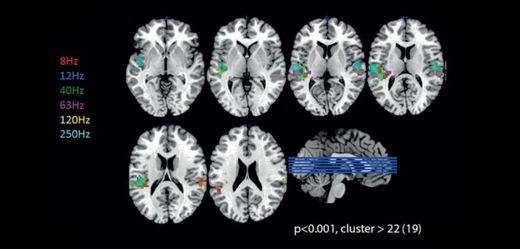
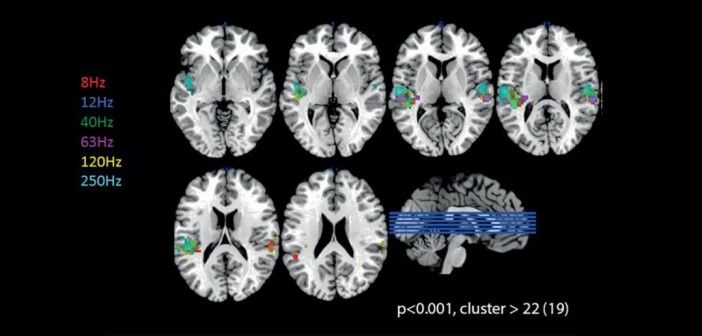
At PTB, not only acoustics experts, but also experts from the fields of biomagnetism (MEG) and functional magnetic resonance imaging (fMRI) were involved in the research activities. They have found out that
humans can hear sounds lower than had previously been assumed. And the mechanisms of sound perception are much more complex than previously thought. Another vast field of research opens up here in which psychology also has to be taken into account. And there is definitely a need for further research.
If there is a plan to erect a wind turbine in front of someone's property, many an eager supporter of the "energy transition" quickly turns into a wind energy opponent. Fear soon starts spreading: the infrasound generated by the rotor blades and by the wind flow might make someone ill.
Many people living in the vicinity of such wind farms do indeed experience sleep disturbances, a decline in performance, and other negative effects. Infrasound designates very low sounds, below the limit of hearing, which is around 16 hertz. The wind energy sector and the authorities often try to appease the situation, declaring that the sounds generated are inaudible and much too weak to be the source of health problems.
Comment: Whether or not humans can actually hear infrasound, many have reported becoming ill and have experienced severe negative emotional and behavioral impacts from both natural and man-made infrasonic activity. Increasingly, populations are reporting the persistence of ultralow pitch sounds which render them weak and fatigued. As an example, in certain locations across the Mediterranean coast some individuals suffer from "seasonal nervous exhaustion" and other "neurophysical maladies" from the Mistral. It is known that whenever the Mistral blows, there will be increased emotional tension, depression, irritability and in numerous cases, it has produced fatalities.
Infrasound: "There is geometry in the humming of the strings, there is music in the spacing of the spheres"

















Comment: