
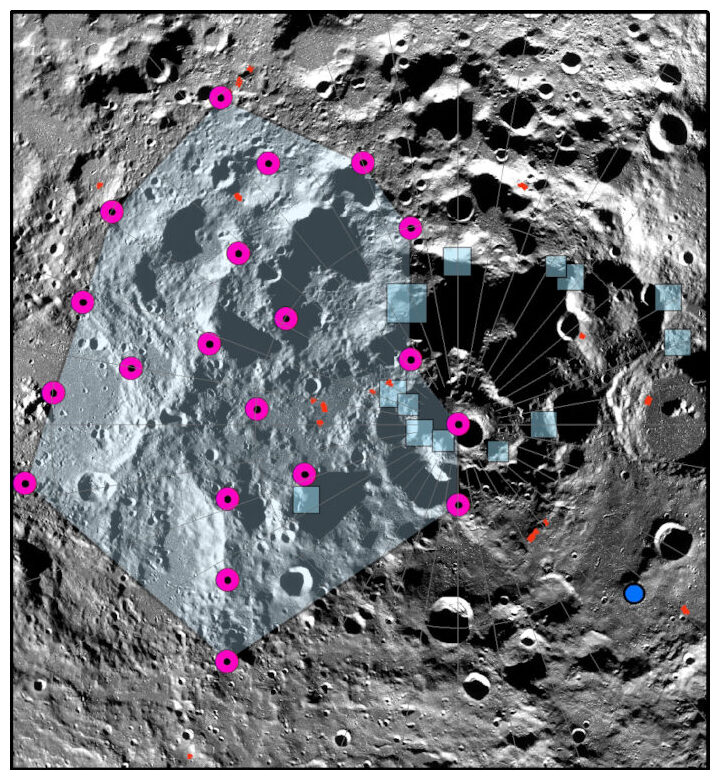
© NASA/ LRO/ LROC/ASU/ Smithsonian InstitutionThe epicenter of one of the strongest moonquakes ever recorded by the Apollo Passive Seismic Experiment could not be accurately determined. Researchers tracked multiple possible locations using a relocation algorithm specifically adapted for the sparse seismic networks near the Pole. Blue boxes show locations of proposed Artemis III landing regions, while the small red marks represent scarps.
A team of scientists discovered evidence that this continuing shrinkage of the moon led to notable surface warping in its south polar region — including areas that NASA proposed for crewed Artemis III landings. Because fault formation caused by the moon's shrinking is often accompanied by seismic activity like moonquakes, locations near or within such fault zones could pose dangers to future human exploration efforts.
In a new paper published in the Planetary Science Journal, the team linked a group of faults located in the moon's south polar region to one of the most powerful moonquakes recorded by Apollo seismometers over 50 years ago. Using models to simulate the stability of surface slopes in the region, the team found that some areas were particularly vulnerable to landslides from seismic shaking.
"Our modeling suggests that shallow moonquakes capable of producing strong ground shaking in the south polar region are possible from slip events on existing faults or the formation of new thrust faults," said the study's lead author Thomas R. Watters, a senior scientist emeritus in the National Air and Space Museum's Center for Earth and Planetary Studies. "The global distribution of young thrust faults, their potential to be active and the potential to form new thrust faults from ongoing global contraction should be considered when planning the location and stability of permanent outposts on the moon."














Comment: This might not revolutionise where we source our energy in the short term, but it might take us one step further in understanding the workings of nature, and how we can work with and harness that to our advantage: Tomato plants send electrical signals to each other through fungi