Science & TechnologyS


Comet

First interstellar asteroid recorded 'Oumuamua' is like nothing observed before

asteroid Oumuamua
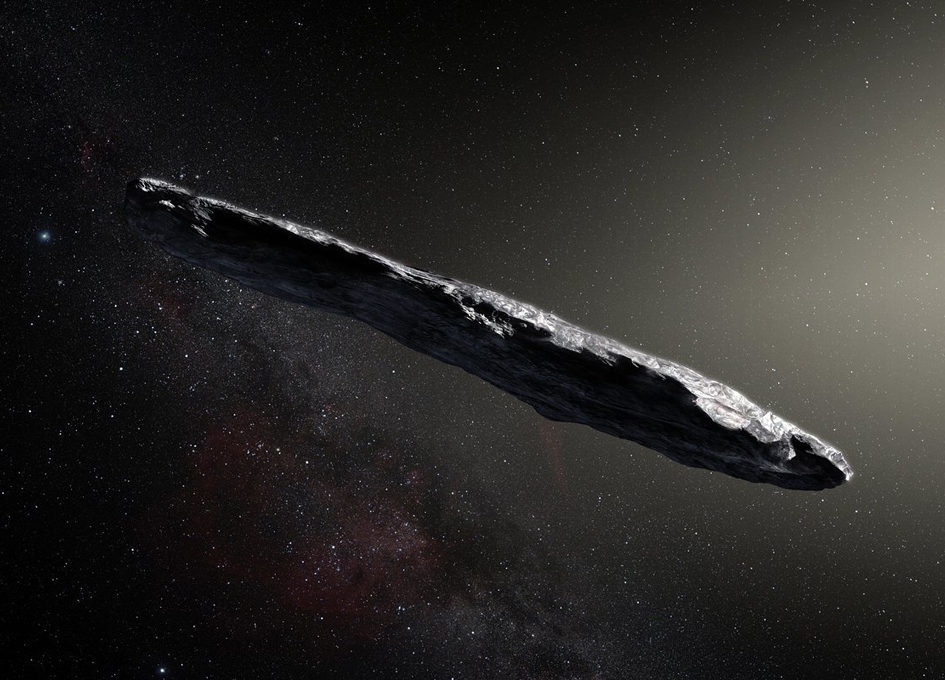
© European Southern ObservatoryArtist's depiction of asteroid Oumuamua
For the first time ever astronomers have studied an asteroid that has entered the Solar System from interstellar space. Observations from ESO's Very Large Telescope in Chile and other observatories around the world show that this unique object was traveling through space for millions of years before its chance encounter with our star system. It appears to be a dark, reddish, highly-elongated rocky or high-metal-content object.

On 19 October 2017, the Pan-STARRS 1 telescope in Hawaii picked up a faint point of light moving across the sky. It initially looked like a typical fast-moving small asteroid, but additional observations over the next couple of days allowed its orbit to be computed fairly accurately. The orbit calculations revealed beyond any doubt that this body did not originate from inside the Solar System, like all other asteroids or comets ever observed, but instead had come from interstellar space. Although originally classified as a comet, observations from ESO and elsewhere revealed no signs of cometary activity after it passed closest to the Sun in September 2017. The object was reclassified as an interstellar asteroid and named 1I/2017 U1 ('Oumuamua).
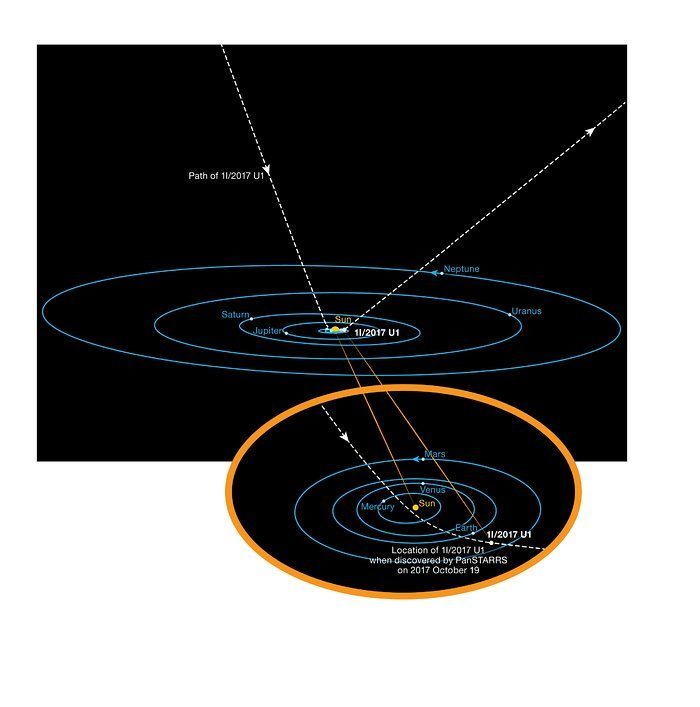
Oumuamua trajectory
© ESO/K. Meech et al.Diagram showing the orbit of the interstellar asteroid ‘Oumuamua as it passes through the Solar System.


Comment: Research paper: "A brief visit from a red and extremely elongated interstellar asteroid", by K. Meech et al., to appear in the journal Nature on 20 November 2017.


Cloud Grey

Amazon Web Services: Secret cloud region for CIA

secret cloud regions
© Daily Mail/KJN
Amazon Web Services unveiled a cloud computing region for the CIA and other intelligence community agencies developed specifically to host secret classified data.

The AWS Secret Region will allow the 17 intelligence agencies to host, analyze and run applications on government data classified at the secret level through the company's $600 million C2S contract, brokered several years ago with the CIA. AWS already provides a region for the intelligence community's top secret data.

"Today we mark an important milestone as we launch the AWS Secret Region," said Teresa Carlson, vice president of AWS Worldwide Public Sector. "AWS now provides the U.S. intelligence community a commercial cloud capability across all classification levels: unclassified, sensitive, secret and top secret. "The U.S. intelligence community can now execute their missions with a common set of tools, a constant flow of the latest technology and the flexibility to rapidly scale with the mission."

The AWS Secret Region is essentially its own commercial data center air-gapped-or shut off-from the rest of the internet. CIA Chief Information Officer John Edwards views the new region as a key step in commercial cloud computing technology that has already changed the way the IC handles data and addresses cybersecurity.

Beaker

Reckless and unregulated: Biohackers are using CRISPR to edit their own DNA

CRISPR biohacker
© The ODINZayner, a biohacker, gave a talk called “A Step-by-Step Guide to Genetically Modifying Yourself With CRISPR” at the SynBioBeta conference.
"What we've got here is some DNA, and this is a syringe," Josiah Zayner tells a room full of synthetic biologists and other researchers. He fills the needle and plunges it into his skin. "This will modify my muscle genes and give me bigger muscles."

Zayner, a biohacker-basically meaning he experiments with biology in a DIY lab rather than a traditional one-was giving a talk called "A Step-by-Step Guide to Genetically Modifying Yourself With CRISPR" at the SynBioBeta conference in San Francisco, where other presentations featured academics in suits and the young CEOs of typical biotech startups. Unlike the others, he started his workshop by handing out shots of scotch and a booklet explaining the basics of DIY genome engineering.

If you want to genetically modify yourself, it turns out, it's not necessarily complicated. As he offered samples in small baggies to the crowd, Zayner explained that it took him about five minutes to make the DNA that he brought to the presentation. The vial held Cas9, an enzyme that snips DNA at a particular location targeted by guide RNA, in the gene-editing system known as CRISPR. In this case, it was designed to knock out the myostatin gene, which produces a hormone that limits muscle growth and lets muscles atrophy. In a study in China, dogs with the edited gene had double the muscle mass of normal dogs. If anyone in the audience wanted to try it, they could take a vial home and inject it later. Even rubbing it on skin, Zayner said, would have some effect on cells, albeit limited.

Comment: Further reading:


Dig

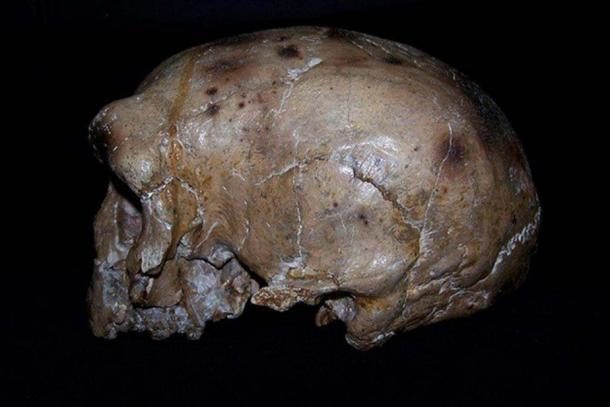
Skull unearthed in China could re-write our understanding of the 'out of Africa' theory of human evolution

Dali skull
© New Scientist/Sheela AthreyaThe Dali skull has similarities with Homo sapiens.
A skull found in China could re-write our entire understanding of human evolution.

That's according to scientists who have examined the important, ancient head and say that it proves the existing theory of how humans came to be is wrong.

Most anthropologists believe that our species came about in Africa around 200,000 years ago - and that one group left around 80,000 years later before spreading across the world. But instead of humans purely coming out of Africa, the new research suggests that important characteristics of humans actually developed in east Asia.

In fact there might have been times of intense intermingling as those early humans in Asia moved out of and back into Africa, with no single event when modern humans came into being. That means that modern humans are made up of the DNA of ancestors from both Asia and Africa, if the researchers are correct.

Comment: How China is rewriting the book on human origins


Fireball

'Oumuamua' - Definitely not your average asteroid or comet

Oumuamua
© SpaceRefOumuamua.
In October astronomers were surprised by a visitor that came racing into our Solar System from interstellar space. Now, researchers using the Gemini Observatory have determined that the first known object to graze our Solar System from beyond is similar to, but definitely not, your average asteroid or comet. "This thing is an oddball," said Karen Meech of the University of Hawaii's Institute for Astronomy who leads an international team studying this interstellar interloper.

Originally denoted A2017 U1, the body now goes by the Hawaiian name 'Oumuamua, in part because of its discovery by Meech's team using the Pan-STARRS1 survey telescope on Haleakala in Hawai'i. When discovered in mid-October 'Oumuamua was only about 85 times the Earth-Moon distance away and its discovery was announced in early November.

Since its discovery 'Oumuamua has faded from view. The object's rapidly increasing distance from the Earth and Sun now makes it too faint to be studied by even the largest telescopes.

"Needless to say, we dropped everything so we could quickly point the Gemini telescopes at this object immediately after its discovery," said Gemini Director Laura Ferrarese who coordinated the Gemini South observations for Meech's group.

Jet1

'Slaughterbots' documentary commissioned by college professors shows horrors of drones (VIDEO)

Slaughterbots drone bombs
In 'Slaughterbots,' autonomous drones use artificial intelligence to decide who to kill. The short film was commissioned by college professors and researchers to warn the public of the dangers of autonomous weapons.

The trailer:


Comment: More information on the documentary:
UC Berkeley professor Stuart Russell and the Future of Life Institute have created an eerie viral video titled "Slaughterbots" that depicts a future in which humans develop small, hand-sized drones that are programmed to identify and eliminate designated targets.

In the video above, the technology is initially developed with the intention of combating crime and terrorism, but the drones are taken over by an unknown forces who use the powerful weapons to murder a group of senators and college students. The video does contain some graphic content, and was originally uploaded to YouTube.

Russell, an expert on artificial intelligence, appears at the end of the video and warns against humanity's development of autonomous weapons.

"This short film is just more than speculation," Russell says. "It shows the results of integrating and militarizing technologies that we already have."

The Future of Life Institute released the video to put pressure on diplomats attending the United Nations Convention on Conventional Weapons in Geneva, Switzerland this week. The video was screened on the first day of the convention.


Seismograph

Fracking Earthquakes: Government sponsored scientist reveals link and cover up

Fracking Earthquakes: Government sponsored scientist reveals link and cover up
Hydraulic fracturing is a natural gas extraction method that has become extremely controversial for its environmental impacts. Fracking is the process of drilling down into the earth before a high-pressure water mixture is directed at the rock to release the gas inside. Water, sand, and chemicals are injected into the rock at high pressure, which allows the gas to flow out to the head of the well. Wastewater produced from this process is highly toxic and filled with a variety of chemicals.

In many cases, people who live near fracking sites have been able to set fire to the water and air that comes through their pipes. It has also been found to contaminate drinking water. Unfortunately, fracking is still somewhat popular publicly because people know very little about it and it is also popular politically because all of the politicians have a hand in it.

Due to an increased prevalence of seismic activity in the vicinity of fracking areas, many activists have pointed that this process may cause earthquakes as well. While environmentalists have been hoping to raise awareness about this problem for years, new testimony from one of the country's top seismologists gives us a glimpse into why the scientific community has been largely silent about this issue.

Fireball

Crater in Rajasthan proven to be caused by a meteorite

Ramgarh Crater
© Hindustan TimesThe Ramgarh Crater in Rajasthan’s Baran district.
For long the origin of the Ramgarh crater has been a subject of debate among researchers. While some believe that it was caused by 'meteorite impact', others are of the view that it evolved from 'tectonic' or 'structural' activity or 'magmatism'.

For years the crater - located near Ramgarh village, about 12 km east of Mangrol - has been considered as a 'meteorite impact' site, but the theory lacked unambiguous evidence. However, a study by geologist Satyanarayan Rana has found diagnostic evidence of 'meteorite impact' at the crater.

Rana, a research scholar at the department of geology, Mohanlal Sukhadia University (MSU), Udaipur, has found evidence in the form of shatter cones in sandstones, planar deformation features (PDFs) and planar fractures (parallel sets of multiple planar cracks) in quartz grains.

Shatter cones are rare geological features and are only known to form in the bedrock beneath meteorite impact craters or underground nuclear explosions. PDFs are also formed by extreme shock compressions on the scale of meteor impacts.

"This regional geological structure has invited the interest of various geologists throughout the world since its discovery and the past five decades have witnessed a number of theories on the origin of this structure, but the issue of origin remained debatable," the 33-year-old PhD researcher, who started his research in 2013 and he completed it in April this year.

Fireball 5

This year's annual Leonid meteor shower

Leonid Meteor
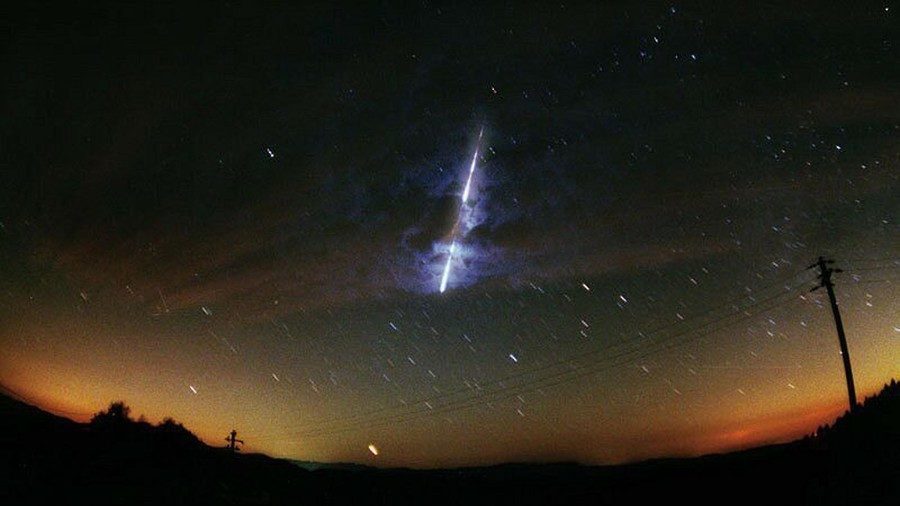
© NASA / AFPThis November 2000 NASA file image obtained 06 November, 2001 shows a meteor streaking across the sky during the Leonid meteor shower.
The annual Leonid meteor shower is expected to peak Friday night, with a second display cosmic pyrotechnics expected Saturday night.

The Leonid will peak in the early hours of the morning, between 2am and 4am when the sky is at its darkest, for star-gazers willing to sacrifice some shuteye. The moon is entering its new phase so there won't be any lunar glare in the sky to disrupt the view. We can expect to see between 10 and 15 shooting stars per hour, reports Quartz.

Leonid Meteor 2
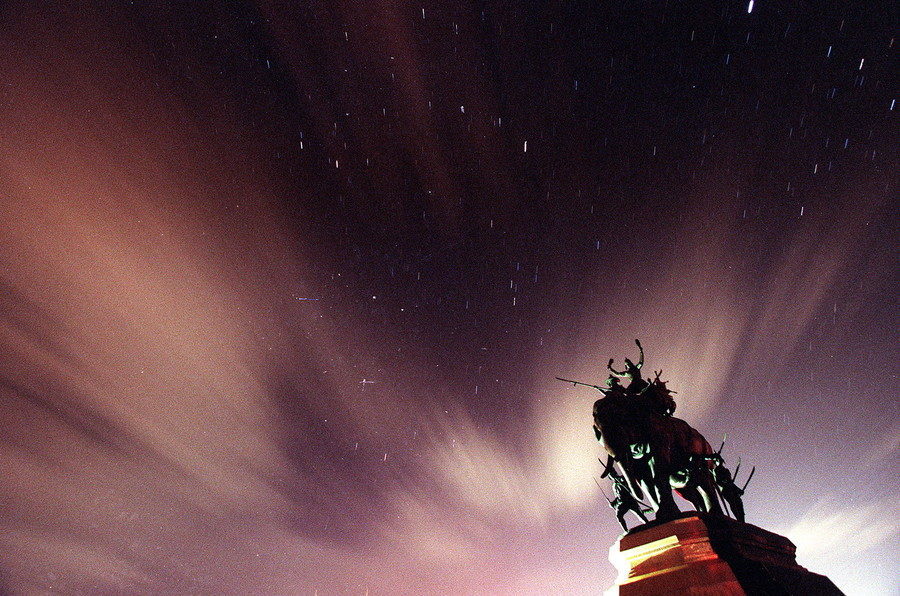
© Pornchai KITTIWONGSAKUL / AFPThe Queen Sri Suriyothai statue in Thailand's ancient capital Ayutthaya is silhouetted against the night sky as thousands of people turned out to watch the Leonid meteor shower in the early hours 18 November.

The Leonid meteor shower is named after the constellation Leo (the Lion), and takes place every year when the Earth passes through the debris field left in the wake of the Temple-Tuttle Comet creating shooting stars, streaks of light in the night sky lasting less than a second as the cosmic debris burns up in our atmosphere.

Jet4

Hypersonic missile race: China is testing weapons that can reach the US in 14 minutes

Hypersonic vehicle
Hypersonic vehicle

A secretive hypersonic wind tunnel, nicknamed 'Hyper Dragon', is helping the experts 'reveal many facts that Americans have not found out', one Chinese researcher said in a propaganda documentary...


South China Morning Post
's Stephen Chen reports
that China is building the world's fastest wind tunnel to simulate hypersonic flight at speeds of up to 12 kilometres per second.

A hypersonic vehicle flying at this speed from China could reach the west coast of the United States in less than 14 minutes.