Science & TechnologyS


Satellite

China is building a constellation of AI supercomputers in space — and just launched the first pieces

Rocket launch
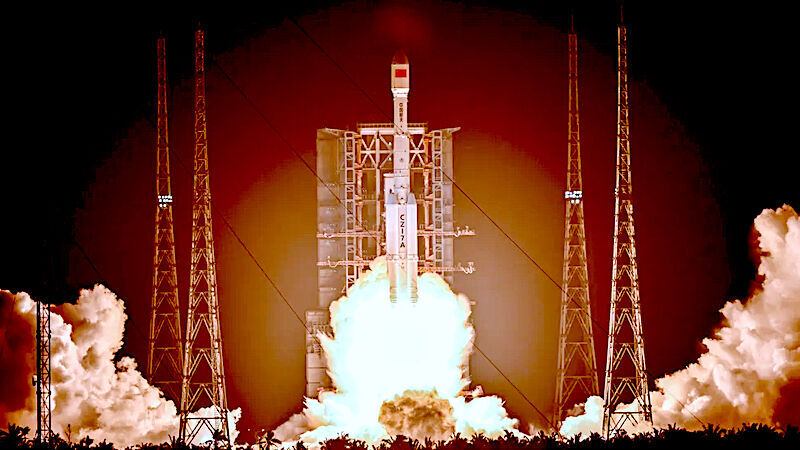
© VCG/VCG/Getty ImagesChina launches a Long March rocket carrying communication equipment from Wenchang Space Launch Site on May 20, 2025
China has launched the first cluster of satellites for a planned AI supercomputer array. The first-of-its-kind array will enable scientists to perform in-orbit data processing.

China has launched its first cluster of satellites for a planned artificial intelligence (AI) supercomputer constellation in space.

The 12 satellites are the beginnings of a proposed 2,800-satellite fleet led by the company ADA Space and Zhejiang Lab that will one day form the Three-Body Computing Constellation, a satellite network that will directly process data in space.

The satellites, which launched on board a Long March 2D rocket from China's Jiuquan Satellite Launch Center May 14, are part of a plan to lower China's dependence on ground-based computers.

Instead, the satellites will use the cold vacuum of space as a natural cooling system while they crunch data with a combined computing capacity of 1,000 peta (1 quintillion) operations per second, according to the Chinese government.

Bulb

How was the wheel invented anyway?

stone wheel
© Comstock/Getty imagesThe assumption was that the wheel evolved from wooden rollers.
Computer simulations reveal the unlikely birth of a world-changing technology nearly 6,000 years ago

Imagine you're a copper miner in southeastern Europe in the year 3900 B.C.E. Day after day you haul copper ore through the mine's sweltering tunnels.

You've resigned yourself to the grueling monotony of mining life. Then one afternoon, you witness a fellow worker doing something remarkable.

With an odd-looking contraption, he casually transports the equivalent of three times his body weight on a single trip. As he returns to the mine to fetch another load, it suddenly dawns on you that your chosen profession is about to get far less taxing and much more lucrative.

What you don't realize: You're witnessing something that will change the course of history - not just for your tiny mining community, but for all of humanity.

Info

What if we weren't the first advanced civilization on Earth?

The Silurian Hypothesis asks whether signs of truly ancient past civilizations would even be recognisable today.
Advance Civilization
© ZME Science/SORA

In the grand sweep of Earth's four-billion-year history, 300 years is barely a blink. And yet, that blink — our industrial era — has already reshaped the atmosphere, oceans, and sediments. If civilization collapsed tomorrow, would anything of us remain 100 million years from now? Could some alien beings visiting Earth in the future ever tell that this planet was inhabited by an advanced civilization? More startling still: if another civilization once existed on Earth long before us, could we even tell?

This question lies at the heart of the Silurian Hypothesis — a playful yet serious scientific proposition by NASA climate scientist Gavin Schmidt and astrophysicist Adam Frank, detailed in a 2018 paper in the International Journal of Astrobiology. The name nods to the Silurians, a fictional species of ancient intelligent reptiles from Doctor Who, but the premise is grounded in geology, astrobiology, and climate science.

"We are not however suggesting that intelligent reptiles actually existed in the Silurian age," the authors clarify in their paper, just to be sure no one misreads them. "Nor that experimental nuclear physics is liable to wake them from hibernation."

Magnify

Engineers race to harness the dazzling magic of feathers: They haven't solved their mysteries just yet

flamingo feather
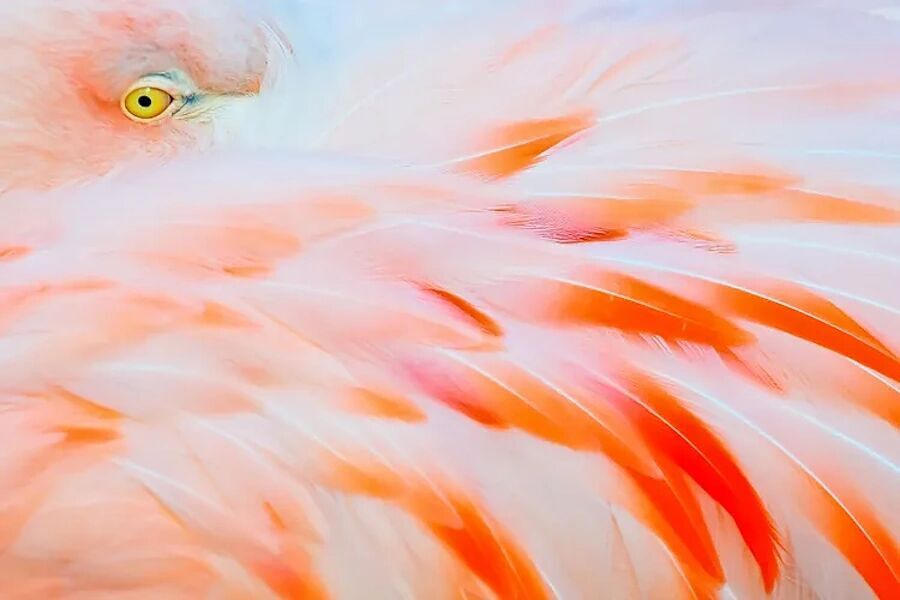
© Tom Winstead Moment via Getty ImagesA flamingo peeks from behind its feathers at the North Carolina Zoo.
The natural marvels, which do everything from enabling acrobatic flight to insulating against Antarctic cold, continue to inspire new designs and technologies

At the end of just about every commercial airliner's wings is an important piece of technology that can be easy to miss. The small upturned tips of each wing are called winglets, and although they weren't added to the big airliners until the late 1980s, they were invented more than a century earlier. Years before the Wright brothers' historic first flight, a British engineer named Frederick Lanchester patented the idea of more efficient wings for his model gliders, tipped with the very first human-made winglets. His design took inspiration from one that evolved millions of years ago: the wings of eagles that flex their tips upward as they soar.

Birds have inspired human inventions for millennia. Japanese bullet trains have long noses designed to copy the beaks of kingfishers, and woodpeckers' natural shock absorption could be borrowed for applications including protection of airplane black boxes. The more that designers, engineers and inventors study birds, and particularly their feathers, the deeper their appreciation becomes for these marvels of evolutionary engineering. Bird feathers can move or repel water, make or mask sound, create wondrous displays of color or impressive camouflage, all while maintaining a light weight, softness and warmth. This natural covering that birds have grown and used for millions of years is still, in many ways, superior to anything that humans can produce.

Comment: Other interesting research on bird feathers:


Cassiopaea

Supernovae may have kicked off abrupt climate shifts in the past, and they could again

Supernova & Climate Change
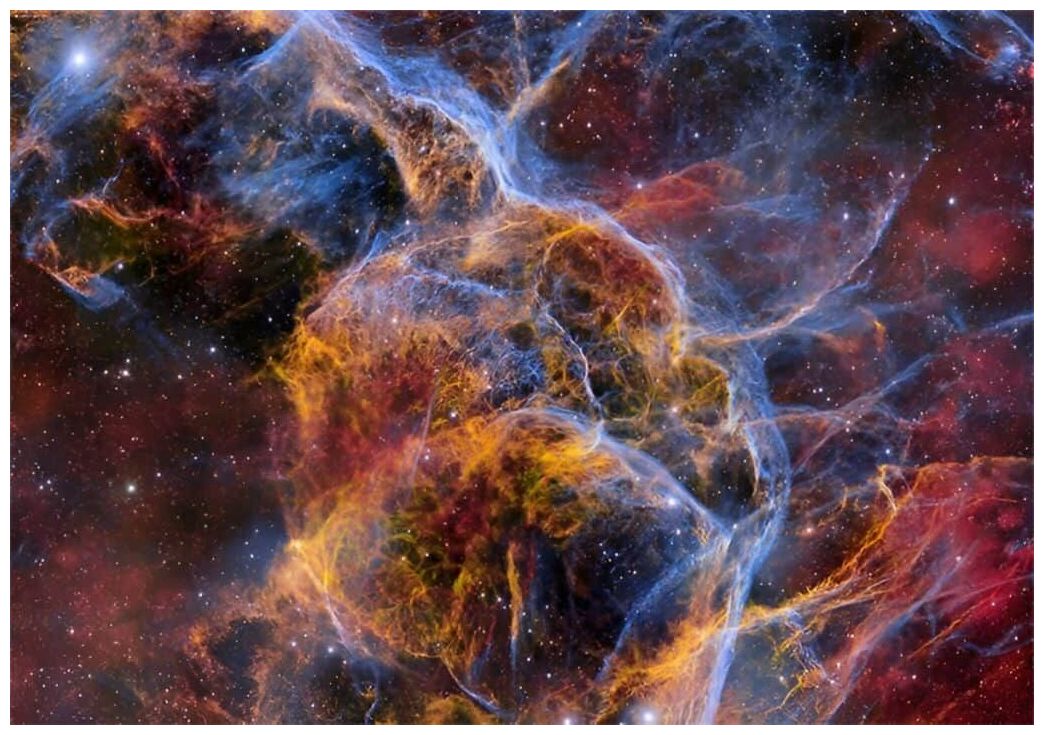
© University of Colorado BoulderThe Vela supernova remnant, the remains of a supernova explosion 800 light-years from Earth in the southern constellation Vela, as seen from the Dark Energy Camera on the Víctor M. Blanco Telescope at Cerro Tololo Inter-American Observatory.
When a star explodes, it sends high-energy particles out in all directions. This burst of energy can travel through space
Robert Brak.enridge
© University of Colorado BoulderRobert Brakenridge.
for thousands of light-years, traversing solar systems and even galaxies.

In a recent paper, published in the Monthly Notices of the Royal Astronomical Society, INSTAAR senior research associate Robert Brakenridge argues that supernovae may be the key to understanding a series of abrupt climate shifts in recent geologic history. The analysis models how such radiation could collide with Earth's atmosphere, changing its composition. Brakenridge also matches a number of known supernovae to climate shifts preserved in geologic records.

"We have abrupt environmental changes in Earth's history. That's solid, we see these changes," Brakenridge said. "So, what caused them?"

Brakenridge says that, if nearby supernovae caused such changes, further research could help scientists predict similar events in the future and prepare accordingly.

"When nearby supernovae occur in the future, the radiation could have a pretty dramatic effect on human society," he said. "We have to find out if indeed they caused environmental changes in the past."

Brakenridge's recent paper is actually one of many he and others have published on the topic since the 1980s. But, in the past, the idea has rested mainly in the realm of theoretical physics. Brakenridge's new publication is an effort to link the theory to empirical observations, both in space and here on Earth.

Moon

NASA plans to build a giant radio telescope on the 'dark side' of the moon

Lunar telescope site
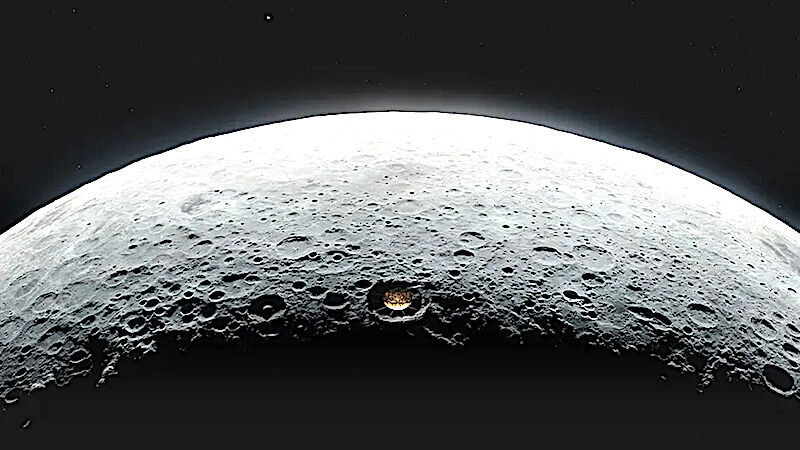
© Vladimir Vustyansky/NASAThe Lunar Crater Radio Telescope (LCRT) is currently in the planning phase but could soon become a reality if it passes the final checks and receives full funding.
A NASA-funded plan to build a large radio telescope on the moon's far side is nearing final approval and could become a reality by the 2030s, researchers say. The ambitious project will help safeguard astronomy from satellite "megaconstellations" — and help scientists unravel more of the radio spectrum.

NASA scientists are currently working on plans to build a giant radio telescope in a nearly mile-wide crater on the "dark side" of the moon. If approved, it could be constructed as early as the 2030s and cost more than $2 billion, project scientists told Live Science.

Astronomers want to build the first-of-its-kind dish, known as the Lunar Crater Radio Telescope (LCRT), to help unravel some of the universe's biggest mysteries — but also because they are concerned about growing levels of invisible radiation leaking from private satellite "megaconstellations," which could soon disrupt Earth-based radio astronomy.

No Entry

Hurricanes never cross the equator. Here's why:

global hurricanes
© NASA/National Hurricane Center/Nilfanion/public domainA world map of tropical cyclones shows how these storms stay away from the Equator, and from both the Southeast Pacific and (with one exception) the South Atlantic.
Here are four things about hurricanes that you may not know:

One: They're the local name of a global phenomenon. Large tropical storms in the western part of the Pacific Ocean are called typhoons. In the Indian Ocean, they're called cyclones. In the North Atlantic or the eastern part of the Pacific, they're hurricanes. The term "tropical cyclones" is often used as a catch-all term. Occasionally, a storm will "cross over" and get two labels, as happened in 2006 with Ioke. Arising in the Central North Pacific as hurricane Ioke, the storm wandered into the Northwest Pacific, where it was known as typhoon Ioke.
Hurricane path
© NASA/National Hurricane Center/Reub2000/public domainPath of Ioke, from its birth southeast of Hawaii to its demise near Alaska. In the eastern half of this map, Ioke was a hurricane, in the western half a typhoon.

Galaxy

Accidental discovery at a planetarium leads to revelation about structure of the Oort Cloud

new pattern discover oort cloud
© Associated PressThis image from the American Museum of Natural History shows a new planetarium show, showing a backwards S-shaped spiral in what’s known as the Oort Cloud far beyond Pluto
Scientists have unlocked one of the solar system's many secrets from an unexpected source: a planetarium show opening to the public on Monday.

At the American Museum of Natural History last fall, experts were hard at work preparing "Encounters in the Milky Way," a deep dive into our home galaxy shaped by the movements of stars and other celestial objects.

They were fine-tuning a scene featuring what's known as the Oort Cloud, a region far beyond Pluto filled with icy relics from the solar system's formation. Comets can hurtle toward Earth from the cloud, but scientists have never glimpsed their true shape.

Blue Planet

Clever Australian 'trash parrots' have now developed a local 'drinking tradition'

cockatoos use water fountain australia park
© Klump et al., Biology LettersThe cockatoos were successful in around half of their attempts to drink from the fountains.
Wild cockatoos in Western Sydney have learned to drink from water fountains — choosing to drink from them even if they have to queue.

Wild cockatoos in Sydney, Australia have learned to drink from twist-handle water fountains, turning the knob with their feet and using their body weight to keep it open. They even queue to have a drink, waiting to take turns on the fountain, footage shows.

The behavior qualifies as a new local tradition, according to a study published Wednesday (June 4) in the journal Biology Letters that analyzed videos of these cockatoos showing off their fountain-manipulating skills.

City animals are remarkably flexible. Fast-changing urban environments can push animals to solve new problems. Some urban birds adapt their songs to be audible over noise pollution, or use human-made structures as substitutes for their natural nesting habitats. Studies have linked bigger brain size and more innovativeness to bird species that live in cities, meaning species that innovate and problem solve tend to adapt better in cities.

Telescope

James Webb telescope spots weird changes on Jupiter's icy moon Europa

Europa
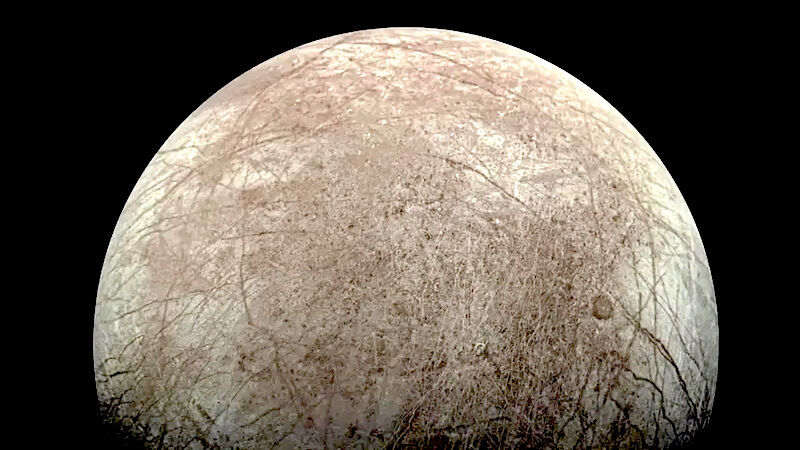
© NASA/JPL-Caltech/SwRI/MSSS; Image processing: Kevin M. Gill CC BY 3.0Europa's surface ices are changing constantly, according to new surface spectra taken by the James Webb Space Telescope.
The ice on the surface of Jupiter's massive moon Europa is constantly changing, hinting at the presence of a subsurface ocean, new James Webb telescope observations reveal.

You'd think that icy worlds are frozen in time and space because they're — well — icy. However, planetary scientists know that all worlds can and do change, no matter how long it takes. That's true for Europa, one of Jupiter's four largest moons. Recent observations made by the James Webb Space Telescope (JWST) zero in on the Europan surface ices and show they're constantly changing.

Dr. Ujjwal Raut of the Southwest Research Institute (SWRI) reported on the changes reflected in the JWST studies. Not only does Europa's surface have amorphous ice, but there's evidence of crystalline ice scattered around there. That indicates the presence of an active water source, such as the subsurface ocean. It also points toward geologic processes that affect the surface.

Comment: There are 97 moons of Jupiter with confirmed orbits as of 30 April 2025.