
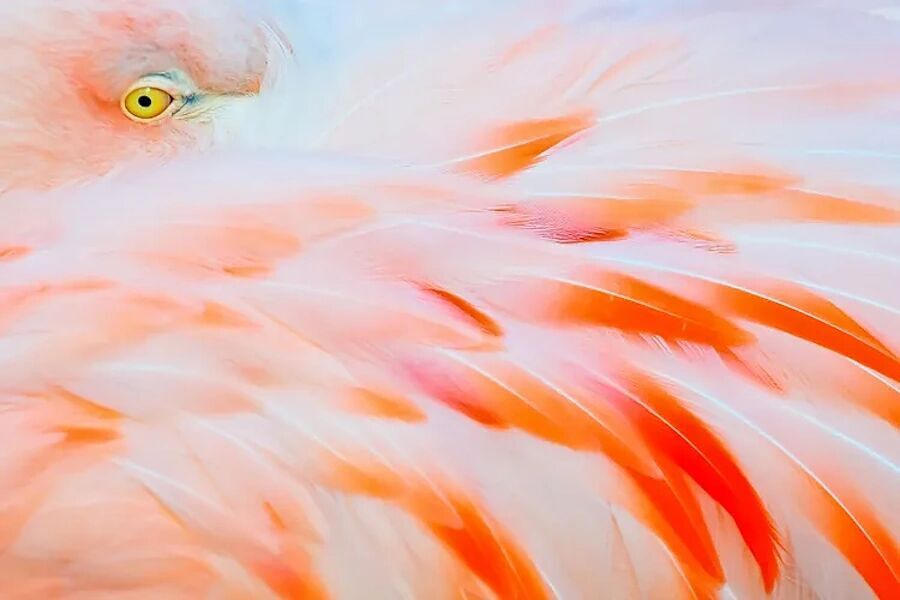
© Tom Winstead Moment via Getty ImagesA flamingo peeks from behind its feathers at the North Carolina Zoo.
At the end of just about every commercial airliner's wings is an important piece of technology that can be easy to miss. The small upturned tips of each wing are called winglets, and although they weren't added to the big airliners until the late 1980s, they were invented more than a century earlier. Years before the Wright brothers' historic first flight, a British engineer named Frederick Lanchester patented the idea of more efficient wings for his model gliders, tipped with the very first human-made winglets. His design took inspiration from one that evolved millions of years ago: the wings of eagles that flex their tips upward as they soar.
Birds have inspired human inventions for millennia. Japanese bullet trains have long noses designed to copy the beaks of kingfishers, and woodpeckers' natural shock absorption could be borrowed for applications including protection of airplane black boxes. The more that designers, engineers and inventors study birds, and particularly their feathers, the deeper their appreciation becomes for these marvels of evolutionary engineering. Bird feathers can move or repel water, make or mask sound, create wondrous displays of color or impressive camouflage, all while maintaining a light weight, softness and warmth. This natural covering that birds have grown and used for millions of years is still, in many ways, superior to anything that humans can produce.
"There is no manufacturing technology that comes close to a feather," says David Lentink, an engineer and biomimetics expert at the University of Groningen in the Netherlands, and co-author of an April paper on the function and structure of feathers in Journal of the Royal Society Interface.
Part of the gap between natural feathers and engineered materials comes down to scale. The best industrial 3D printers in the world can reliably sculpt at precisions down to about one hundredth of a millimeter. That sounds impressively small, and in the context of human engineering, it absolutely is. But a feather's smallest functional structures, called keratin filaments, go down to the nanometer scale. That's 10,000 times more intricate than our best modern manufacturing technology.
But the aspect of feathers that most impresses and inspires modern engineers is their ability to serve multiple functions at the same time.
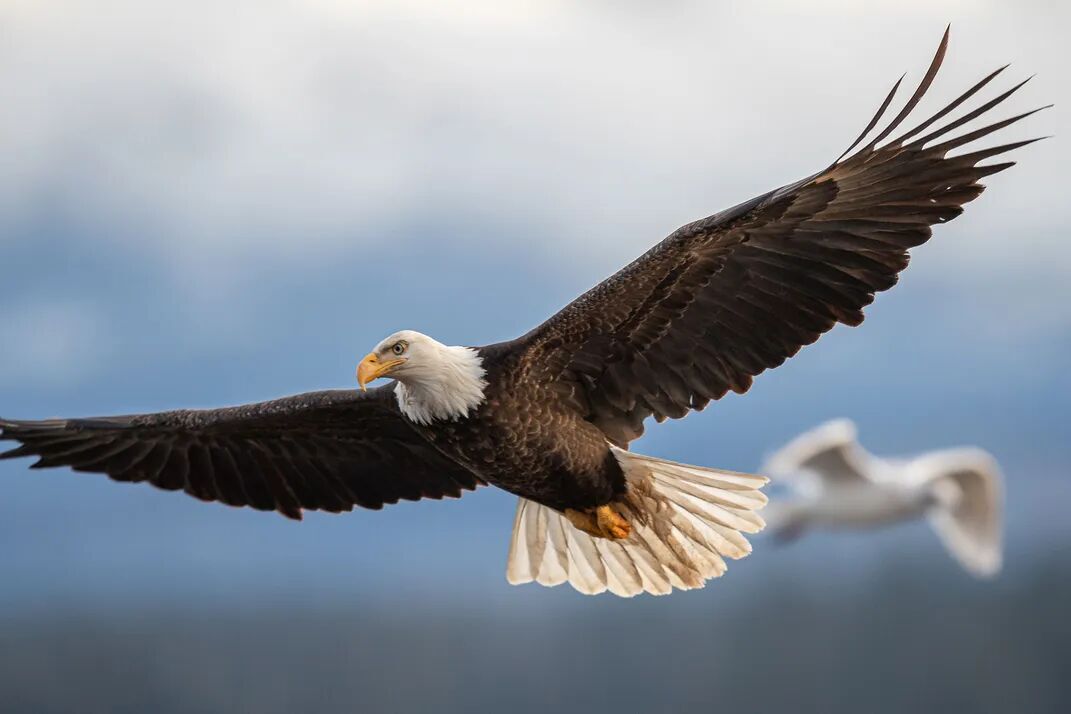
© viktor davare / 500px via Getty ImagesBritish engineer Frederick Lanchester patented the idea of winglets based on the wing tips of eagles.
The ancient Greeks told the story of Daedalus and Icarus, a tragedy about the dangers of ambition. The inventor Daedalus makes wings of bird feathers for himself and his son, but when Icarus flies too close to the sun, the glue holding his wings together fails, and he falls to his death. Today, Daedalus' wings would be classified under a category of design called biohybrids. Rather than trying to recreate feathers from scratch, biohybrid designs incorporate actual feathers into otherwise synthetic machines. Lentink and other researchers use biohybrid drones to recreate bird flight more closely than ever before, and they have recently created a flying robot that can land on a branch like a songbird.
After flight, another obvious function of feathers is color. Every bird, whether it flies or not, uses this function. Some use color to stick out and attract mates, like peacocks and bright-red cardinals. Others want to hide rather than show off, as with the mottled brown plumage of many female ducks that lets them blend into their marshy nesting habitat or the song sparrow that uses its streaked camouflage to disappear into a twiggy shrub. Hummingbirds and many other species create dazzling iridescence thanks to layers of pigments in their feathers.
Those layers use a phenomenon called constructive interference, where two light waves reflecting off different layers create an effect that neither could achieve on its own. "That helps birds create these colorful, iridescent displays that can change color as you look at them from different angles," says Sebastian Hendrickx-Rodriguez, lead author of the new paper.
Feather color is inspiring more than just beauty. Researchers are developing a new generation of more efficient solar panels, using another structural trick that causes the reflecting of infrared and ultraviolet light — based off the feathers of birds like arctic redpolls and snowy owls.
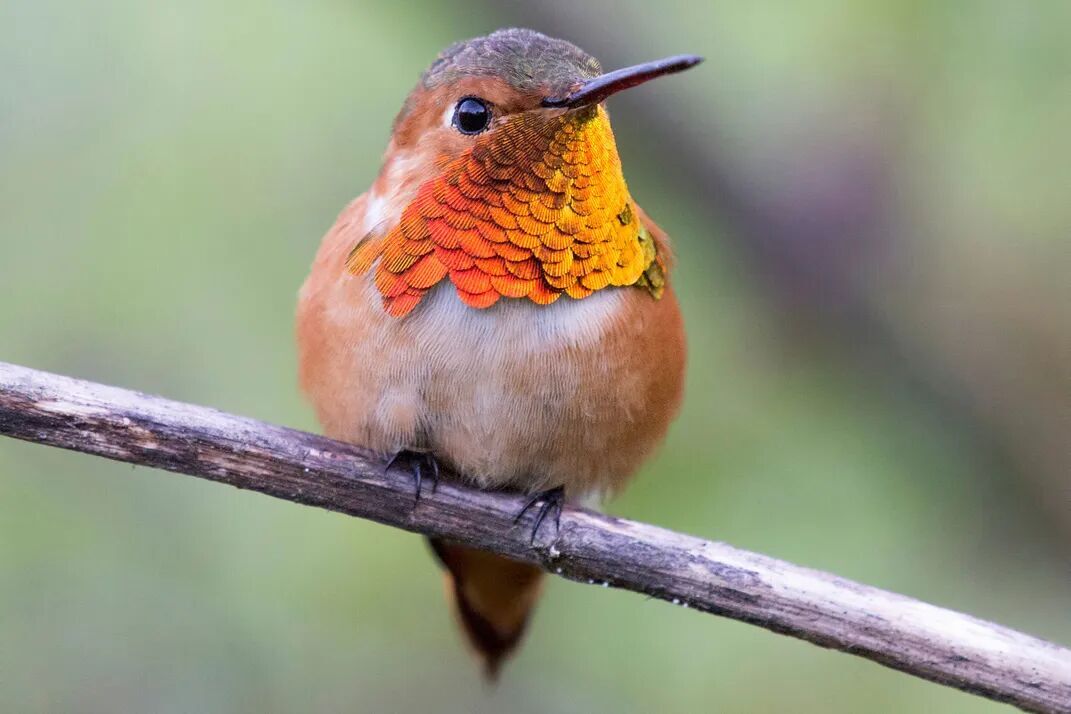
© Connect Images/Jouko van der Kruijssen via Getty ImagesAn Allen's hummingbird shows off its iridescent feathers.
Feathers also play a role in generating or eliminating sound. Hummingbird tails produce a bell-like trill when they dive, helping impress potential mates. The silent wings of an owl allow it to sneak up on mice and other prey undetected at night, which has inspired new methods for quieting aircraft, especially helicopters and rotor-powered drones.
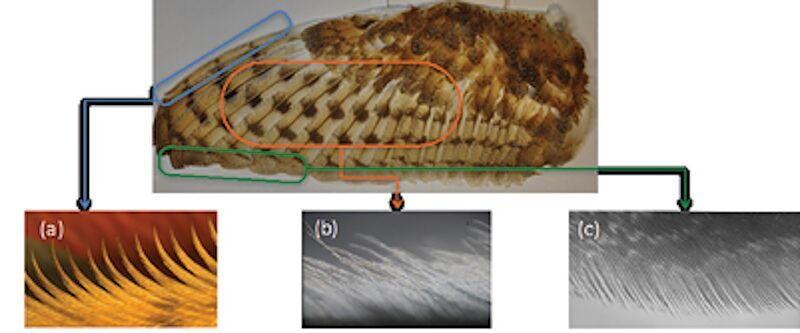
Microscopic views of a barn owl wing show (a) leading edge comb, (b) downy coat on flight feathers, and (c) trailing edge fringe.
"We all know that water rolls off a duck's back," says biologist Frank Muzio. "But all birds need to stay dry." None of the other functions work right — the colors are muted, flight becomes impossible — if the birds get too waterlogged. Muzio was lead author of a 2024 study published in the Journal of Avian Biology, based on his PhD research, that reviewed water repellency in bird feathers.
The duck feather has received a lot of attention in waterproofing technology, recently inspiring a new type of gelatin film for food packaging that could be both more sustainable and keep food fresh longer than plastic. But to Muzio's point, terrestrial birds use water repellency, too. Scientists have cited the iconic birds of paradise of Indonesia, Papua New Guinea and Australia as inspiration for a new evaporation technology that may improve desalination of seawater. Traditional evaporators don't work well in wet weather, but this new material stands up much better to wetting and drying, just like the rainforest birds that inspired it.
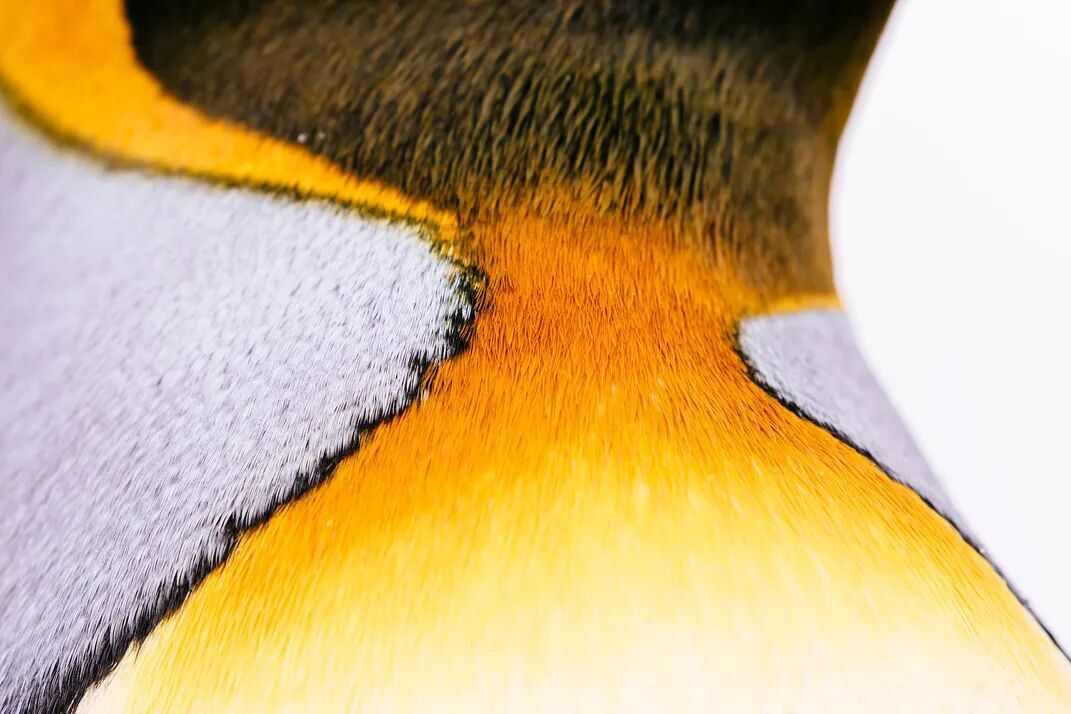
© Andrew Peacock via Getty ImagesThe many shades of a king penguin's feathers can be seen in this close-up. Penguin feathers have inspired a host of varied inventions.
"This is very unusual," says Lentink. "Think of an airplane rustling its wings a little bit and being fine again, after some critical failure in the surface."
This self-repair mechanism is inspiring new designs of so-called soft electronics, like insulators and semiconductor parts. They may someday be able to reorganize themselves back into a working pattern after damage, just as pigeon feathers have done for millions of years.
One of the most remarkable aspects of all these functions is how they arise from a chemically simple material. Feathers are made of keratin, the same compound as our hair and fingernails. Across over 10,000 bird species, in forms as small as the bristles on a hummingbird's forehead and as large as condor flight feathers, every feather in the world is made of this one substance.
"Our first instinct as engineers is often to change the material chemistry," says Hendrickx-Rodriguez. "If we want to make a stronger iron, let's add some carbon to make steel. If we want to color our plastic, add a chemical dye." With a much more limited range of materials available to it, evolution works with what it has — keratin — and solves the problems facing the bird with new structures, rather than new materials.
"It's really mind-boggling, if you look at the whole list of the things that feathers can do," says Lentink. After thousands of years of marveling at feathers, humans still cannot recreate one. But as researchers understand more about feathers and all their functions, they will continue to take inspiration from this simple but ingenious evolutionary design.







Comment: Other interesting research on bird feathers: