Science & TechnologyS


Telescope

Flashback Global Warming Detected on Neptune's Largest Moon

There may not be much industrial pollution on Neptune's largest moon, but things are hotting up nonetheless...

The Earth is not alone in suffering global warming. According to observations made by NASA's Hubble Space Telescope and several ground-based instruments, temperatures on Neptune's largest moon have increased dramatically since the Voyager space probe swung by in 1989. So much so, in fact, that Triton's surface of frozen nitrogen is turning into gas, making its thin atmosphere denser by the day.

"At least since 1989, Triton has been undergoing a period of global warming," confirms astronomer James Elliot, professor of Earth, Atmospheric and Planetary Sciences at Massachusetts Institute of Technology. "Percentage-wise, it's a very large increase."

Display

$100m supercomputer will boost life science research

A $100 million supercomputer capable of processing 400 trillion pieces of information a second to help scientists accelerate their research into diseases such as cancer and Alzheimer's will be built in Melbourne.

The powerful machine will be able to generate, manage and manipulate enormous amounts of information - such as extensive patient records or genetic databases - and make it easier to map the spread and treatment of viruses.

Meteor

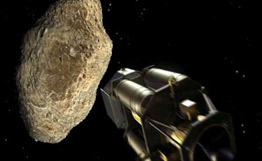
Too little, too late: Russian space probe may save Earth from asteroid

Russian experts have said a space mission should be sent in 2012 to the Apophis asteroid to establish whether it will collide with Earth, adding that the Russian Phobos-Grunt spacecraft could be used for that purpose.

A report at a Moscow scientific conference said 99942 Apophis, or Asteroid 2004 MN4, with a diameter of 350m, is the biggest space threat to Earth.

In 2029, this near-Earth object will be at a distance of only 36,000 km (22,400 miles) - closer than satellites in geostationary orbit. Earth's gravity could change the orbit of Apophis in such a way that it would collide with Earth on its next approach in 2036.

Image
©Unknown

Hourglass

Archaeologists find 5,000-year-old jewellery workshop in Cyprus

Nicosia: Archaeologists have uncovered what appears to have been a jewellery workshop during excavations at a 5,000-year old settlement in Cyprus.

Umbrella

Stock up on Long Underwear!

Sun Cycles, Always have, always been. Like clockwork. Of course it will get warmer, and of course it will get cooler. It has nothing to do with what the likes of Al Gore and the media spew forth, other than bilking you out of billions of dollars to enrich others.

Something May be Wrong with the Sun--and the Weather Could Get colder!

The disappearance of sun spots was the hot topic at a recent international solar conference held at Montana State University. For the past two years, the sun has undergone a phase of relative inactivity, meaning usual solar phenomena such as sun flares, sun spots, and solar eruptions have all but disappeared.

Laptop

Is Personal Blogging Fast-Fading?


Blogging
©Unknown

Remember when people used to blog for fun? When you could type in a friend's clever web address and be instantly delighted with the goings-on of their daily lives?

I recall a not-too-distant blogging golden age when just about everyone's dog kept an online journal. The daily musings of friends and neighbours seemed to be a big part of the common online diet.

Lately, however, I'm hard (word) pressed to find a (live) journaler to save my iBook (sorry). Gone are the days when "I already read that on your blog" was a common conversation killer. So what's happened?

Magnify

Nanotech: The Unknown Risks

Nanotechnology, now used in everything from computers to toothpaste, is booming. But concern is growing that its development is outpacing our understanding of how to use it safely.

"It's green, it's clean, it's never seen - that's nanotechnology!"

That exuberant motto, used by an executive at a trade group for nanotech entrepreneurs, reflects the buoyant enthusiasm for nanotechnology in some business and scientific circles.

Robot

Robots to engage in 'loving relations' and sex with humans by 2050

Maastricht, Netherlands - Romantic human-robot relationships are no longer the stuff of science fiction - researchers expect them to become reality within four decades.

Star

SOHO discovers its 1,500th comet

The ESA/NASA SOHO spacecraft has just discovered its 1500th comet, making it more successful than all other comet discoverers throughout history put together. Not bad for a spacecraft that was designed as a solar physics mission.

SOHO's record-breaking discovery was made late on 25 June. When it comes to comet catching, the SOlar and Heliospheric Observatory has one big advantage over everybody else: its location. Situated between the Sun and Earth, it has a privileged view of a region of space that can rarely be seen from Earth. From the surface, we can see regions close to the Sun clearly only during an eclipse.

Image
©SOHO
SOHO

Telescope

Stephen Hawking's explosive new theory

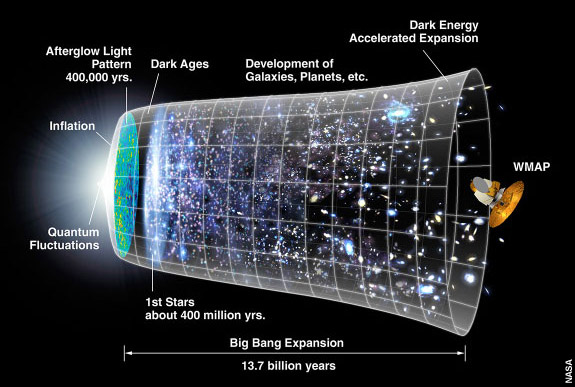
Prof Stephen Hawking has come up with a new idea to explain why the Big Bang of creation led to the vast cosmos that we can see today.

Astronomers can deduce that the early universe expanded at a mind-boggling rate because regions separated by vast distances have similar background temperatures.

They have proposed a process of rapid expansion of neighbouring regions, with similar cosmic properties, to explain this growth spurt which they call inflation.

But that left a deeper mystery: why did inflation occur in the first place?

Now New Scientist reports that an answer has been proposed by Prof Stephen Hawking of Cambridge University, working with Prof Thomas Hertog of the Astroparticle and Cosmology Laboratory in Paris.
Hawkings
©NASA
The new theory believes original estimates of Big Bang expansion are wrong

Comment: The article says:
"In this theory, the early universe can be described by a mathematical object called a wave function and, in a similar way to the light particle, the team proposed two years ago that this means that there was no unique origin to the cosmos: instead the wave function of the universe embraced a multitude of means to develop."
But why would this "object called a wave function" want to develop at all? Was there a developer not taken into account in the equations? Pulling the strings? And what is the exact relation of this mathematical object to the objective reality?

Then we have these two funny pieces:

Piece A:
"Their idea is therefore to start with the conditions we observe today - like the fact that at large scales one does not need to adopt quantum lore to explain how the universe (it behaves classically, as scientists say) - and work backwards in time to determine what the initial conditions might have looked like."
Piece B:
"The next step is to find specific predictions that can be put to the test, to validate this new view of how the cosmos came into being."
Piece B seems to contradict piece A since, if we find something new tomorrow, we will simply go backward and change our initial conditions. If necessary, we will replace our wave function by a pair or a triple of wave functions. Hawking and Hartle will have fun while the audience will take it seriously and adore these great scientists. Creationists, on the other hand, will have one more enemy and one more target to shoot at!