Science & TechnologyS


Magnify

Flashback Indian Caste Origins: Genomic Insights and Future Outlook

The main feature of Indian society, seen at its strongest in the rural areas, is caste. A caste is a collection of people who share similar cultural and religious values and practices. Members within a caste generally marry among themselves; intercaste marriages are a cultural taboo. These social regulations governing the institution of marriage have resulted in a substructuring of the Indian gene pool. There are also elaborate social regulations of avoidance of marriages within castes, and thus there is genomic substructuring even within a caste.

Attention

Flashback Genetic evidence suggests European migrants may have influenced the origins of India's caste system


Old India map
©Unknown
A new study has revealed that Indians belonging to higher castes are genetically closer to Europeans than are individuals from lower castes, whose genetic profiles are closer to those of Asians.

The study compared genetic markers - located on the Y chromosome and the mitochondrial DNA - between 265 Indian men of various castes and 750 African, Asian, European and other Indian men. To broaden the study, 40 markers from chromosomes 1 to 22 were analyzed from more than 600 individuals from different castes and continents. The comparison of the markers among these groups confirmed that genetic similarities to Europeans increased as caste rank increased.

Snowman

Flashback Ice Ages in Detail

In a previous post, I discussed the textbook theory of the causes of glacial advance and retreat for the last few million years. I'd like to take a close look at one of the best available records of past climate, the "LR04 stack."

Comment: For additional analysis on shorter period cycles of the last 100,000 years and their causes see The Younger Dryas Impact Event and the Cycles of Cosmic Catastrophes - Climate Scientists Awakening.


Ark

Researchers make noises of pre-Columbian society

MEXICO CITY - Scientists were fascinated by the ghostly find: a human skeleton buried in an Aztec temple with a clay, skull-shaped whistle in each bony hand.

People

Scholars make finds in Nazi archive

BAD AROLSEN, Germany - From prison brothels to slave labor camps, 15 scholars concluded a two-week probe Thursday of an untapped repository of millions of Nazi records, and hailed it as a rich vein of raw material that will deepen the study of the Holocaust.

Better Earth

Best of the Web: Cosmic Winter - A Lecture by Victor Clube


Image

Moderator: In introduction, I just should say that Victor is the author of two extremely intriguing books. The first is The Cosmic Serpent which was published in 1982, and the second is The Cosmic Winter, published in 1990 in collaboration with astronomer Bill Napier. And I think that today Victor is going to present a talk illustrated by slides which will continue along the lines that he developed in The Cosmic Winter, which is a book that I urge all of you to read if you can.

Better Earth

Best of the Web: The Nature of Punctuational Crises and the Spenglerian Model of Civilization


Image

Abstract: Mankind's essentially untroubled state of mind in the presence of comets during the last two centuries has been fortified by the overall relative brevity of cometary apparitions and the calculated infrequency of cometary encounters with planets.

During the course of the Space Age, however, the fact of cometary splitting has also become increasingly secure and there is growing appreciation of the fact that mankind's state of mind can never be altogether relaxed. Indeed a watershed in the modern perception of cometary facts has evidently been reached with the most recent and devastating example of cometary splitting, that of the fragmen­tation of Comet P/Shoemaker-Levy 9 and its subsequent bombardment of planet Jupiter.

Thus there is a recognized tendency now amongst comets, especially those in short-period orbits, due to the occasionally excessive effects of solar irradia­tion, planetary tides and small body impacts, which gives rise to individual swarms of cometary debris, and it is the resulting repeated penetration of such dispersed swarms by our planet which apparently increases the danger to mankind from time to time.

The danger comprises global coolings, atmospheric pollution and super-Tunguska events, the cometary debris being responsible for both high-level dust insertions and low-level multimegaton explosions in the Earth's atmosphere along with a generally enhanced fireball flux.


Telescope

Best of the Web: The Sky Is Falling

The odds that a potentially devastating space rock will hit Earth this century may be as high as one in 10. So why isn't NASA trying harder to prevent catastrophe?

Comet
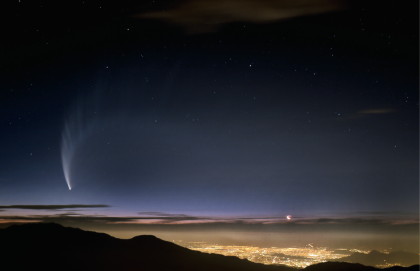
©Stéphane Guisard, www.astrosurf.com/sguisard

Breakthrough ideas have a way of seeming obvious in retro­spect, and about a decade ago, a Columbia University geophysicist named Dallas Abbott had a breakthrough idea. She had been pondering the craters left by comets and asteroids that smashed into Earth. Geologists had counted them and concluded that space strikes are rare events and had occurred mainly during the era of primordial mists. But, Abbott realized, this deduction was based on the number of craters found on land - and because 70 percent of Earth's surface is water, wouldn't most space objects hit the sea? So she began searching for underwater craters caused by impacts rather than by other forces, such as volcanoes. What she has found is spine-chilling: evidence that several enormous asteroids or comets have slammed into our planet quite recently, in geologic terms. If Abbott is right, then you may be here today, reading this magazine, only because by sheer chance those objects struck the ocean rather than land.

Bulb

Acid rain traces support meteor theory for 1908 Tunguska blast

International researchers investigating the Tunguska Event, an explosion exactly 100 years ago in central Siberia, say acid rain traces in the region back up the theory that the blast was caused by a meteorite.

On June 30, 1908, an explosion equivalent to between 5 and 30 megatons of TNT occurred approximately 7-10 km (3-6 miles) above the Podkamennaya Tunguska River in a remote Siberian region.

"Extremely high temperatures occurred as the meteorite entered the atmosphere, during which the oxygen in the atmosphere reacted with nitrogen causing a build up of nitrogen oxides," one of the authors of the joint research, Natalia Kolesnikova, told RIA Novosti.

Kolesnikova said a similar impact 66 million years ago wiped out a significant portion of life on Earth, including the dinosaurs.

Meteor

Fire in the sky: Tunguska at 100


Image
©Unknown
The Tunguska event was caused by a space rock tens of metres across

At 7:17am on 30 June 1908, an immense explosion tore through the forest of central Siberia.

Some 80 million trees were flattened over an area of 2,000 square km (800 square miles) near the Tunguska River.

The blast was 1,000 times more powerful than the atomic bombs dropped on Hiroshima and Nagasaki and generated a shock wave that knocked people to the ground 60km from the epicentre.

The cause was an asteroid or comet just a few tens of metres across which detonated 5-10km above the ground, 100 years ago today.

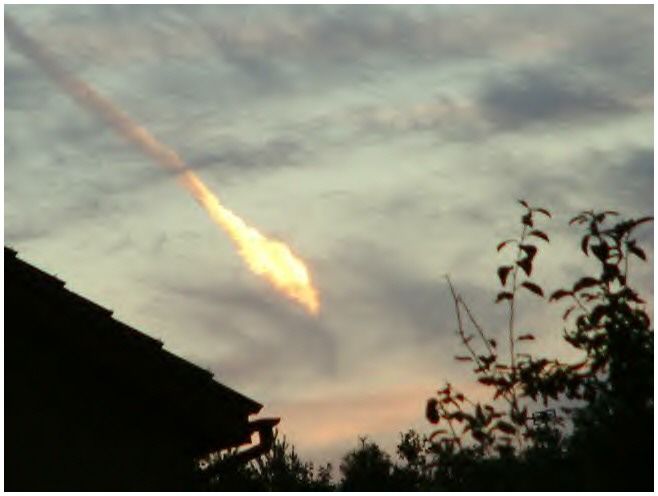
Eyewitnesses recalled a brilliant fireball resembling a "flying star" ploughing across the cloudless June sky at an oblique angle.