Science & TechnologyS


Meteor

Ancient impact may have created deep niche for life

Hollywood directors, take note - geologists have pieced together a cinematic account of a violent impact that gouged out a 90-kilometre-wide crater in the US state of Virginia 35 million years ago. Surprisingly, the impact may have created a new niche for life deep underground.

Hidden by younger sediments, the Chesapeake Bay Impact Structure is among the world's largest and best-preserved craters. Now, Gregory Gohn of the US Geological Survey in Reston, Virginia, and colleagues have drilled nearly 2 km into the basin to reveal its formation.

Comment: It should be noted that the impact was extremely harmful for all of the life that was there previously!!!


Meteor

In 1807, a comet appeared in the Natchez night sky

On Tuesday, March 1, 1808, Judge Thomas Rodney wrote a letter to his son -- U.S. Attorney General Ceasar Rodney -- with news of the sighting of a comet in the Natchez sky.

Telescope

Ancient bacterial fossils may exist on moon

Some scientists believe that at least one meteorite found in Antarctica preserves evidence of ancient life on Mars.

Now, work by a team of English scientists reinforces an earlier suggestion that evidence of life on the early Earth might be found in meteorites on the moon.

The original idea was presented in a 2002 paper by University of Washington astronomer John Armstrong, who suggested that material ejected from Earth during the Late Heavy Bombardment (a period about four billion years ago when the Earth was subjected to a rain of asteroids and comets) might be found on the moon.

Sheeple

Preparing the sheeple! Martian soil appears able to support life

LOS ANGELES - "Flabbergasted" NASA scientists said on Thursday that Martian soil appeared to contain the requirements to support life, although more work would be needed to prove it.

Display

Website domain names: any suffixes could be possible after landmark vote

Icann, the organisation that regulates the internet domain name system, has passed a landmark vote to relax rules limiting web addresses to "top-level" suffixes, such as .com and .uk, a move that could see people and companies register almost anything they want.

The unanimous vote, held in Paris today, also approved a second proposal to allow domain names written in languages other than English, such as Arabic.

Meteor

Tunguska Event still a mystery 100 years on

Scientists will gather in Siberia to mark the 100th anniversary of the Tunguska Event June 26-28, one of the world's most mysterious explosions which flattened 80 million trees but largely went unnoticed at the time.

The massive blast, equivalent to around 15 megatons of TNT, occurred approximately 7-10 km (3-6 miles) above the Stony Tunguska River in a remote area of central Siberia early on June 30, 1908. The explosion, which was estimated to measure up to 5 on the Richter scale, knocked people off their feet 70 km away and destroyed an area of around 2,150 sq km (830 sq miles).

And if the explosion had occurred some 4 hours and 47 minutes later, due to the Earth's rotation it would have completely destroyed the then Russian capital of St. Petersburg.

Image
©Unknown

Robot

Flashback Killer Machines Are Coming: iRobot to Create Revolutionary New Robot for DARPA

iRobot Corp. today announced the Defense Advanced Research Projects Agency (DARPA) and the U.S. Army Research Office have awarded the company a new multi-year, multi-million dollar R&D project to develop Chemical Robots (ChemBots). The goal of this program is to develop a soft, flexible, mobile robot that can identify and maneuver through openings smaller than its actual structural dimensions to perform Department of Defense (DoD) tasks within complex and highly cluttered environments.

As the established leader in innovative robotics research and development, iRobot will lead a team composed of leading technical experts from Harvard University and the Massachusetts Institute of Technology (MIT) to incorporate advances in chemistry, materials science, actuator technologies, electronics, sensors and fabrication techniques into ChemBots engineering. The resulting revolutionary new robot platform designs will expand the capabilities of robots in urban search and rescue, as well as reconnaissance missions.

Bulb

Scientists find how neural activity spurs blood flow in the brain

New research from Harvard University neuroscientists has pinpointed exactly how neural activity boosts blood flow to the brain. The finding has important implications for our understanding of common brain imaging techniques such as fMRI, which uses blood flow in the brain as a proxy for neural activity.

The research is described in the June 26 issue of the journal Neuron.

"When you see a brain image from fMRI studies, you are actually looking at changes in blood flow and oxygenation," says Venkatesh N. Murthy, professor of molecular and cellular biology in Harvard's Faculty of Arts and Sciences. "But because of the tight coupling between neural activity and blood flow, we are able to use the blood flow changes as a surrogate for brain activity. A better understanding of exactly how brain activity boosts blood flow should help us better read this process in reverse, which is what we do when interpreting fMRI images."

While it represents only about 5 percent of the human body's mass, the brain consumes 20 percent of the oxygen carried in its blood. Unlike muscle and other types of tissue, the brain has no internal energy stores, so all its metabolic needs must be met through the continuous flow of blood.

Meteor

Asteroid-hunting satellite a world first

Canada is building the world's first space telescope designed to detect and track asteroids as well as satellites. Called NEOSSat (Near Earth Object Surveillance Satellite), this spacecraft will provide a significant improvement in surveillance of asteroids that pose a collision hazard with Earth and innovative technologies for tracking satellites in orbit high above our planet.

Weighing in at a mere 65-kilograms, this dual-use $12-million mission builds upon Canada's expertise in compact "microsatellite" design. NEOSSat will be the size of a large suitcase, and is cost-effective because of its small size and ability to "piggyback" on the launch of other spacecraft. The mission is funded by Defence Research Development Canada(DRDC) and the Canadian Space Agency(CSA). Together CSA and DRDC formed a Joint Project Office to manage the NEOSSat design, construction and launch phases. NEOSSat is expected to be launched into space in 2010. The two projects that will use NEOSSat are HEOSS (High Earth Orbit Space Surveillance) and the NESS (Near Earth Space Surveillance) asteroid search program.

Meteor

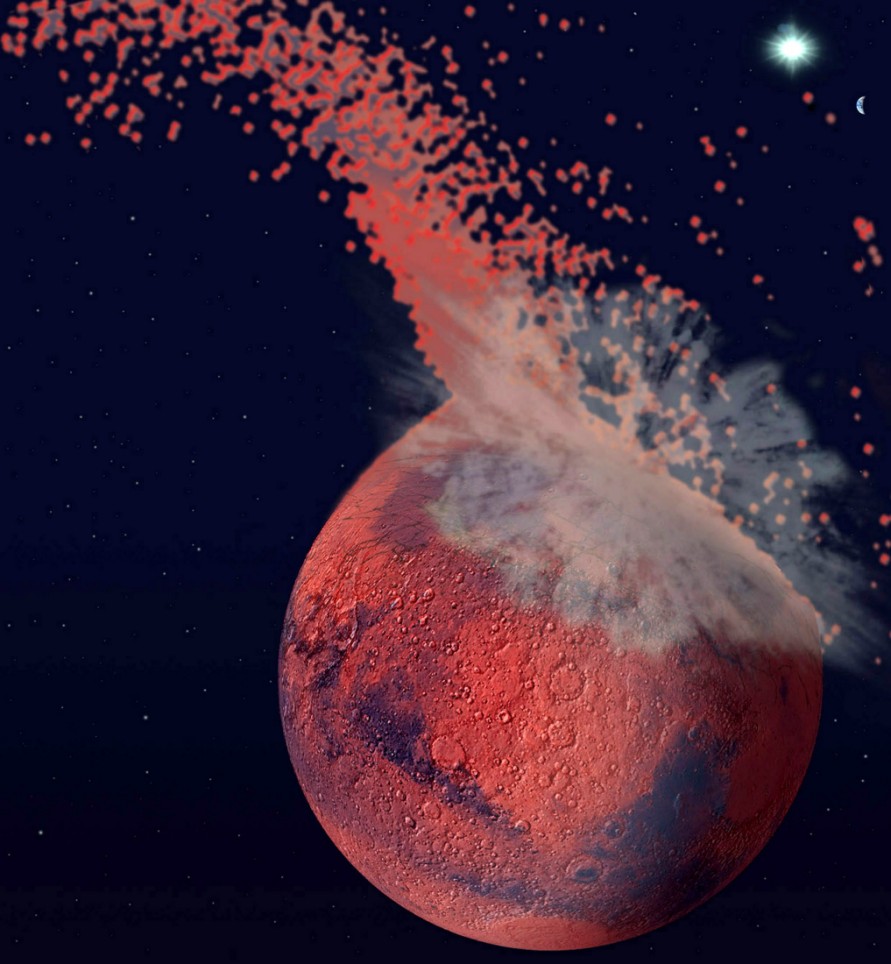
Huge crater on Mars 'solves red planet's two-faced riddle'

A giant crater made by an asteroid or comet is the reason Mars is so lopsided, scientists said today.

The impact gouged out a hole 5,200 miles across and 6,500 miles long, leaving a basin covering 40 per cent of the red planet, researchers reported in the journal Nature.

The depression is the size of the combined areas of Asia, Europe and Australia, which makes it by far the largest crater in the solar system.

In 1984 scientists proposed an impact had caused the two-faced appearance of Mars with two strikingly different kinds of terrain in its northern and southern hemispheres.

mars
©Reuters
An artist's impression of a huge asteroid impact that would explain Mars' lopsided shape