Science & TechnologyS


People

How To Tell Who Is Influencing Whom in a Group Discussion

Image
© Unknown
A computer model that detects who is influencing whom in a group discussion, can accurately predict who is likely to speak next

One fascinating question that occupies social scientists concerns groups discussions. The problem is to determine the nature of the interaction between individuals and in particular, who influences whom.

Various breakthroughs in network theory and agent-based modelling have revolutionised researchers' understanding of these processes. One approach for analysing online discussions is to look for the set of keywords that define a topic of discussion, record the various instances in which these words appear and then study the links between the sites that use them: which came first, who links to whom and so on. This data can then be used to construct a network of influence.

While this has been hugely useful, it's hard to escape the sense that it fails to capture the true dynamics of influence, the way the balance of power and influence within a group shifts from moment to moment as a discussion evolves. If you've ever participated in a face to face group discussion, you'll know what I mean. (And if you haven't, where have you been?)

Laptop

Human Unconscious is Transferred to Virtual Characters

Image
© Groenegress et alHuman unconscious is transferred to virtual characters.
Virtual characters can behave according to actions carried out unconsciously by humans. Researchers at the University of Barcelona have created a system which measures human physiological parameters, such as respiration or heart rate, and introduces them into computer designed characters in real time.

"The ultimate aim is to develop a method which allows humans to unconsciously relate with some parts of the virtual environment more intensely than with others, and that they are encouraged only by their own physiological responses to the virtual reality shown," Christoph Groenegress, co-author of the work and researcher at the University of Barcelona explained.

The system, the details of which were recently published in the journal The Visual Computer, uses sensors and wireless devices to measure three physiological parameters in real time: heart rate, respiration, and the galvanic (electric) skin response. Immediately, the data is processed with a software programme that is used to control the behavior of a virtual character who is sitting in a waiting room.

Meteor

University of Colorado students crash land a NASA satellite

Image
© Getty Images

Talk about a dream project: a group of Colorado University students were hand-picked by NASA to help them on a space mission. What was that mission? To crash the hurtling, flaming debris of an out-of-control space aircraft into the Atlantic Ocean.

The satellite was one of NASA's own and known as ICESat, or Ice, Cloud and Land Elevation Satellite. For the past seven years, it had been blooping happily above the skin of the Earth, gathering data on ice sheets that could be fed into climate change models. But then, as often happens, it just stopped working and became another bit of space junk, twinkling in the sky above.

Failing to restart the satellite, NASA scientists decided to outsource the task of crashing it into the ocean to some plucky Colorado University students, who competed on their off hours over the course of many long nights and holidays to earn the job.

Info

Physicists Solve The Mystery Behind a 1997 Soccer Miracle


Forget about bending it like Beckham -- can you curve it like Carlos?

All right, so this is a little beyond the normal health boundaries, but for more of our active, sporty, specifically soccer-loving readers, a new study in the New Journal of Physics solves the longstanding mystery of whether a dramatic goal in an international match more than a decade ago was due to athletic skill or dumb luck.

The French researchers looked at a famous free kick goal (video above) made by Brazilian player Roberto Carlos against the French team in the 1997 Tournoi de France. When observed straight on, the ball makes a dramatic zigzag, flying far to the right of the goalpost before shooting back in.

Some had attributed it to accuracy; others called it a fluke. But the physicists say that from that distance, at the speed the ball was travelling, the goal was practically inevitable.

Study coauthor Christophe Clanet, a physicist at the Ecole Polytechnique in Palaiseu, France, said at first, the study didn't pique his interest: After all, it was well known that a spinning ball will have a curved trajectory, a phenomenon known as the Magnus effect.

Magnify

Oak tracks at 10th century road site leave archaeologists puzzled

Image
© Dylan VaughanJane Whitaker of Archaeological Development Services and Charles Mount of Bord na Móna delve into the site of the late Bronze Age wooden road in the Longford Pass bog in Co Tipperary yesterday.
Archaeologists are puzzled as to the exact purpose of an ancient oak road unearthed on a Bord na Móna bog in Co Tipperary.

Operations manager and site director with Archaeological Development Services (ADS) Jane Whitaker believes the track, which runs parallel to a modern road, may have formed part of an ancient road network.

The road, discovered by ADS during a walking survey, is constructed from oak planks laid across oak beams and gravel. Mortise holes have been bored into the planks to facilitate wooden pegs. All of the materials were brought to the site from other locations.

Info

Listening to ancient colors

New technique may help restorers identify decades-old pigments.

A team of McGill chemists have discovered that a technique known as photoacoustic infrared spectroscopy could be used to identify the composition of pigments used in art work that is decades or even centuries old. Pigments give artist's materials colour, and they emit sounds when light is shone on them.

Info

Tree Stumps Old Fault Theories

Tree Stump
© Stuff.co.nzIndicator: The tree stump in question, near Inchbonnie on the West Coast.
A West Coast tree stump has revealed that the Alpine Fault is moving more quickly than thought.

Researchers working at Inchbonnie, a dairy-farming settlement about 60 kilometres from Greymouth that lies on the fault, dated wood from the dead podocarp, believed to be a matai, sitting in water at the southern end of Lake Poerua.

The dating was part of a series of investigations in the area in February 2008 to determine movement on the fault and how strain is transferred from it to the nearby Hope, Clarence and Kakapo faults at the western edge of the Marlborough Fault System.

Until now, the average annual horizontal slip rate of the Alpine Fault at Inchbonnie was believed to be about 10 millimetres a year.

The latest calculations, based on when the stump died as a result of an earthquake, show it is moving at an average 13.6mm a year, plus or minus 1.8mm. That equates to about an extra metre of movement each time the fault ruptures - about every 300 years.

The Alpine Fault is the boundary between the Australian and Pacific plates, which are moving past and pushing against each other, forcing the Southern Alps higher.

Bizarro Earth

Earth's Magnetic Field Flipped Superfast

Geomagnetic Flip
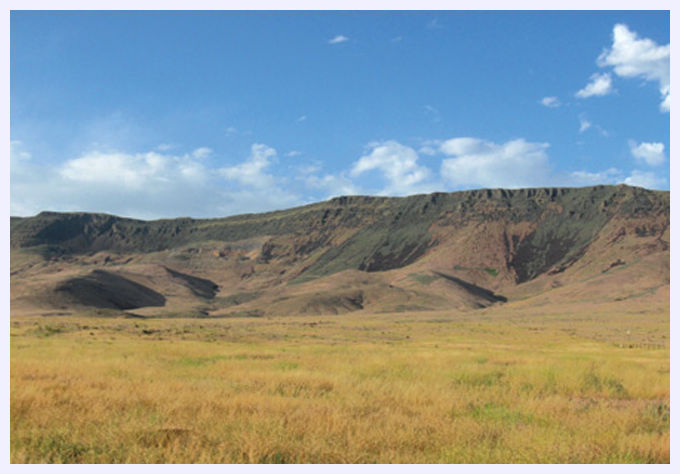
© Scott BogueFrozen Flip
Just north of a truck stop along Interstate 80 in Battle Mountain, Nevada, lies evidence that the Earth's magnetic field once went haywire.

Magnetic minerals in 15-million-year-old rocks appear to preserve a moment when the magnetic north pole was rapidly on its way to becoming the south pole, and vice versa. Such "geomagnetic field reversals" occur every couple hundred thousand years, normally taking about 4,000 years to make the change. The Nevada rocks suggest that this particular switch happened at a remarkably fast clip.

Anyone carrying a compass would have seen its measurements skew by about a degree a week - a flash in geologic time. A paper describing the discovery is slated to appear in Geophysical Research Letters.

It is only the second report of such a speedy change in geomagnetic direction. The first, described in 1995 based on rocks at Steens Mountain, Oregon, has never gained widespread acceptance in the paleomagnetism community. A second example could bolster the theory that reversals really can happen quickly, over the course of years or centuries instead of millennia.

"We're trying to make the case that [the new work] is another record of a superfast magnetic change," says lead author Scott Bogue, a geologist at Occidental College in Los Angeles.

Bizarro Earth

World 'Facing Mass Extinction'

The world is facing a mass extinction event that could be greater than that of the dinosaurs, new research shows.

Macquarie University palaeobiologist Dr John Alroy used fossils to track the fate of major groups of marine animals throughout the earth's history.

He compiled data from nearly 100,000 fossil collections worldwide, tracking the fate of marine animals during extreme extinction events some 250 million years ago.

The findings, published this week in the international journal Science, showed a major extinction event was currently under way that had the potential to be more severe than any others in history.

"Organisms that might have adapted in the past may not be able to this time," Dr Alroy said.

"You may end up with a dramatically altered sea floor because of changes in the dominance of major groups. That is, the extinction occurring now will overturn the balance of the marine groups."

The research shows a combination of human behaviour and climate change could have devastating affects on species across the planet.

"When there's mass extinction all bets are off and anything could happen," Dr Alroy said.

"So what we're basically doing as the human species collectively is we're running this gigantic experiment with nature."

Rocket

Few Asteroids Look Ripe for Astronaut Visit By 2025

Image
NASA may appear to have its pick of thousands of known asteroids for a manned mission, but only two are good targets within the next 20 years.

An asteroid mission requires a large-enough destination that astronauts could reach within a few months of launch from Earth, says Lindley Johnson, head of NASA's Near-Earth Object program in Washington. Other limits to such an ambitious undertaking include the viewing range of ground-based telescopes.

"They don't come all that close all that often," Johnson said at a NASA workshop on NEOs three weeks ago.

While NASA admits more knowledge about objects that pass within 28 million miles (45 million km) of Earth could increase the number of possible destinations, only two currently meet the guidelines set out by the space agency in its attempt to send a manned mission to an asteroid by 2025, a goal set by President Barack Obama. One of the asteroids could be reached in 2020 and the other in 2025.