Science & TechnologyS


War Whore

Air Force's Second X-37 Space Plane Nears Launch

X-37B
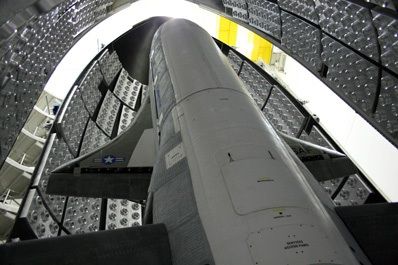
© US Air ForcePhoto of the first X-37B spacecraft being encapsulated inside the Atlas rocket's 5-meter payload fairing last year. The X-37 launches on the 501 version of the Atlas 5 rocket, which includes a 5-meter fairing, a single-engine Centaur upper stage and no solid rocket boosters.
Two months after a sister ship successfully concluded a demo flight, the U.S. military's second robotic X-37B space plane is in Florida preparing for blastoff March 4 on another secret mission, according to an Air Force official.

The 29-foot-long, 14-foot-wide space plane is being readied for flight in a processing facility near its launch site at Cape Canaveral, Fla., according to Lt. Col. Troy Giese, the X-37B program manager in the Air Force Rapid Capabilities Office.

Like its predecessor last year, the X-37B will lift off inside the nose cone of an Atlas 5 rocket. The flight is scheduled for March 4, but the Air Force has not released a time for the blastoff.

Responding to written questions, Giese said the reusable spacecraft -- also called the Orbital Test Vehicle -- is undergoing final functional tests before attachment to the Atlas 5 launcher in late February. The winged vehicle arrived in Florida in early January, according to Giese.

The United Launch Alliance Atlas 5 rocket is being readied for launch at Cape Canaveral's Complex 41. Both stages of the booster have been assembled inside a vertical integration building, and the rocket is scheduled to roll out to the pad later this week for a pre-launch practice countdown and tanking test. The wet dress rehearsal is on tap for Friday, according to an Air Force spokesperson.

Hardhat

Ozone Hole Through The Years

Ozone Hole
© NASA Ozone Hole Watch

Ozone is Earth's natural sunscreen, shielding life from excessive amounts of ultraviolet radiation. But Earth's ozone layer has been damaged by well-intentioned chemicals - chlorofluorocarbons, used for refrigerants and aerosol spray-cans - that have the unintended consequence of destroying ozone molecules.

In the late 1980s, governments around the world woke up to the destruction of the ozone layer and negotiated the Montreal Protocol, an international treaty to phase out ozone-depleting chemicals. The treaty included a requirement that scientists regularly assess and report on the health of the ozone layer, particularly the annual Antarctic ozone hole. In January 2011, the Ozone Secretariat of the United Nations Environment Programme released its latest report and noted that the Protocol has "protected the stratospheric ozone layer from much higher levels of depletion...[and] provided substantial co-benefits by reducing climate change."

This series of images above shows the Antarctic ozone hole on the day of its maximum depletion in four different years; that is, the days with the thinnest ozone layer as measured in Dobson Units (DU). The measurements were made by NASA's Total Ozone Mapping Spectrometer (TOMS) instruments from 1979 - 2003 and by the Royal Netherlands Meteorological Institute (KNMI) Ozone Monitoring Instrument (OMI) from 2004 - present. Purple and dark blue areas are part of the ozone hole.

Info

Scientists Develop Train That Can go Faster Than Airplane

China Bullet Train
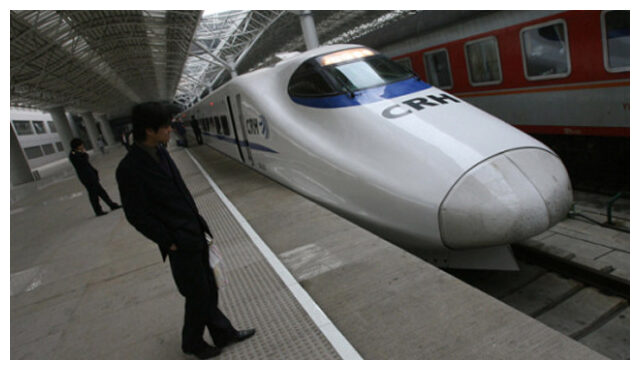
© Getty ImagesCRH2 China Railways High-speed bullet train as it arrives from Hangzhou, at the Shanghai South Railway Station.

A model Maglev train that can travel as fast as a plane has been successfully developed in a laboratory in Southwest China, but putting the technology to use is still a long way away, an official from the lab told the Global Times Sunday.

Under research conducted by the Traction Power State Key Laboratory at the Southwest Jiaotong University, the vacuum magnetic suspension train model was able to run at between 600 and 1,200 kilometers per hour, equal to the speed of a plane, according to Shuai Bin, vice dean of the university's Traffic School.

The new technology is expected to be put into operation within 10 years and promoted across the country in 2030, the Shanghai-based Science Pictorial reported Sunday.

Passengers will be able to travel from Beijing to Guangzhou in under two hours. A flight from the capital to Guangzhou takes three hours.

Telescope

New Nova Discovered

Central Bureau for Astronomical Telegrams Electronic Telegram No. 2644 (CBET 2644, Daniel W. E. Green, ed.) announces the discovery by Hideo Nishimura, Miyawaki, Kakegawa, Shizuoka-ken, Japan (reported by S. Nakano, Sumoto, Japan), of a nova in Sagittarius on 2011 Jan. 25.86 UT at unfiltered magnitude 11.2 on two 15-s CCD frames with limiting magnitude 12.5; Nakano measured magnitude 11.4 +/- 0.6 on Nishimura's frames. The object was posted on the Central Bureau's Transient Objects Confirmation Page (TOCP) with the provisional designation PNV J17474639-2335112.

Coordinates: R.A = 17:47:46.33, Decl. = -23:35:13.1 (equinox 2000.0) - Nakano measures position end figures 46.39s, 11.2" (uncertainty +/- 3")

Low-resolution spectra by Akira Arai, Koyama Astronomical Observatory, Kyoto Sangyo University, and by Kazuyoshi Imamura, Okayama University of Science, on Jan. 28.863 and Jan. 28.886 UT, respectively, indicate the object is a classical nova past maximum light, highly reddened by interstellar medium.

Phoenix

Flashback SOTT Focus: Meteorites, Asteroids, and Comets: Damages, Disasters, Injuries, Deaths, and Very Close Calls

Astronomy books and papers far too numerous to cite offer the assurance that "no one has ever been killed by a meteorite." (John S. Lewis, University of Arizona)


comet
©Julian Baum

Over the past few years, while sott.net has been tracking the increasing flux of fireballs and meteorites entering the earth's atmosphere, we have been, by turns, amused and horrified at the ignorant reactions and declarations that issue from academia and the media regarding these incursions. A few years ago, we read that "this is a 'once in a hundred years' event!" Not long after it was a "once in a lifetime" event. Still later, after a lot more incidents it became a "once in a decade" event. More recently, it has been admitted in some quarters that meteorites hit the ground (as opposed to safely burning up in the atmosphere) several times a year! And of course, we have discovered the fact that the governments of our planet are well aware that there are atmospheric explosions from such bodies numerous times a year. We have also learned in this series that the frequent reports of unusual booms and shaking of the ground is often due to such overhead explosions. Yet the media steadfastly refuses to honestly address this issue, though we have noted a plethora of recent articles presenting opposing academic arguments designed to put the populace back to sleep, to reassure them that there is nothing to worry about, that such things only happen every 100,000 years or so, and certainly, the Space Watch Program is going to find all the possible impactors and take care of things.

Info

Different Evolutionary Paths Lead Plants and Animals to the Same Crossroads

Kinase Receptor
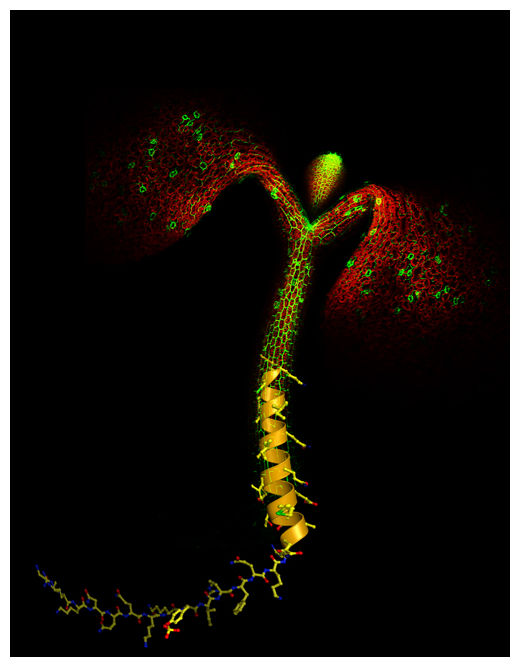
© Courtesy of Yvon Jaillard, Michael Hothorn and Jamie Simon, Salk Institute for Biological StudiesDespite their divergent evolutionary history, membrane-bound kinase receptors in animals and plants rely on similar regulatory mechanisms to control their activity.

In analyzing the molecular sensor for the plant growth hormone brassinolide, researchers at the Salk Institute for Biological Studies discovered that although plants took an evolutionary path different from their animal cousins, they arrived at similar solutions to a common problem: How to reliably receive and process incoming signals.

The team's findings, published in the February 1, 2011 issue of Genes and Development, revealed that so-called tyrosine phosphorylation - used as an "on" or "off" switch and long thought to be a feature unique to animal cells - is a mechanism conserved across the animal and plant kingdoms.

"There seem to be only so many ways to build a robust signaling system," says Howard Hughes Medical Institute investigator Joanne Chory, Ph.D., professor and director of the Plant Molecular and Cellular Biology Laboratory and holder of the Howard H. and Maryam R. Newman Chair, "and plants and animals have hit upon the same mechanisms."

As different as they may seem, both mammalian and plant cells need to be able to perceive small molecule hormones to respond to changes in the environment. While human cells draw on a wide variety of sensor molecules, including more than 800 different G-protein-coupled receptors, 48 known nuclear hormone receptors and 72 receptor kinases, plants rely mostly on the latter.

Info

Bulgarian Astronomers Discover New Binary Star - Report

Rozhen Observatory
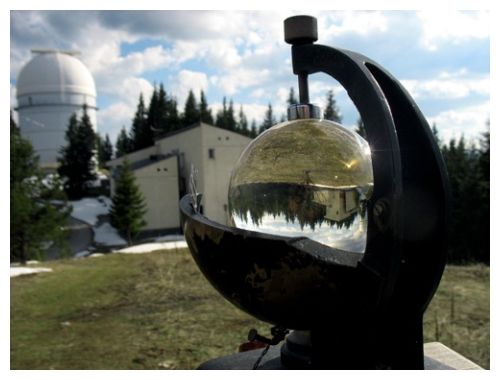
© Novinite.comFile photo of the National Astronomy Observatory on Rozhen, the Rhodope mountans.
A new object in the Andromeda galaxy has been discovered by Bulgarian scientists working at the National Astronomy Observatory.

The discovery was announced on Monday by the Observatory, which is located in the Rhodope mountains. The newly discovered object is in the central part of the Galaxy and may turn out to be a variable star similar to the Mira star.

Mira is a binary star in the constellation Cetus, consisting of the red giant Mira A along with Mira B. Mira A is also an oscillating variable star and was probably the first non-supernova variable star discovered.

A star is classified as variable if its apparent magnitude as seen from Earth changes over time, whether the changes are due to variations in the star's actual luminosity, or to variations in the amount of the star's light that is blocked from reaching Earth.

The object, discovered by the Bulgarian astronomers using a Schmidt telescope, needs additional observations in order to be classified properly.

Question

What Could Possibly Go Wrong: Deep-Drilling a Supervolcano

Supervolcano
© Jamie SneddonFire Bomb There are few good ways to deal with living atop a supervolcano, but critics worry that drilling deep into one to study its composition could, in the worst case, cause an earthquake or eruption.

When Mt. Vesuvius erupted in A.D. 79, the people around it had little warning, and more than 10,000 of them died as a result. Bad as that was, an eruption of neighbouring Campi Flegrei could be worse.

As a supervolcano, it's in the same category as Indonesia's Mt. Tambora, whose eruption in 1815 killed 92,000 people and caused the "year without a summer." Campi Flegrei's eight-mile-wide caldera is so low and unassuming that much of metro Naples was built on top, and yet a full eruption would be one of the largest in human history, the kind of geological event capable of plunging the world into a minor ice age. This time, scientists are determined to give the three million residents of greater Naples abundant warning.

That's part of the motivation behind the Campi Flegrei Deep Drilling Project. Co-sponsored by the European Union, a coalition of scientists from 18 countries plans to drill deep into the volcano and implant sensors that will measure changes in temperature, the movement of magma, and seismic activity. The first phase of the project involves drilling a 1,640-foot borehole to study the composition of the rock; phase two, drilling the narrow 2.4-mile master hole. Data collected from sensors that the scientists place at the bottom of those holes will make it possible to map the volcano's underground geometry with unprecedented precision. It could also give local authorities early warning if an eruption becomes imminent.

Either that, or the drilling itself could cause a disaster.

Bulb

The New Light Bulbs Lose a Little Shine

Image
© Getty ImagesLos Angeles Mayor Antonio Villaraigosa handed out free compact fluorescent light bulbs in 2009.
Compact Fluorescent Lamps Burn Out Faster Than Expected, Limiting Energy Savings in California's Efficiency Program

California's utilities are spending $548 million over seven years to subsidize consumer purchases of compact fluorescent lamps. But the benefits are turning out to be less than expected.

One reason is that bulbs have gotten so cheap that Californians buy more than they need and sock them away for future use. Another reason is that the bulbs are burning out faster than expected.

California's experience is notable because energy experts have placed high hopes on compact fluorescent lamps. Often spiral-shaped, they screw into existing light sockets and offer energy savings of about 75% over traditional incandescent light bulbs.

Many nations are relying on them to help cut emissions from power plants and stretch electricity supplies further. The United Nations says 8% of global greenhouse-gas emissions are linked to lighting, and that adoption of compact fluorescent lights could cut pollution.

Bulb

Man Invents Machine to Convert Plastic Into Oil