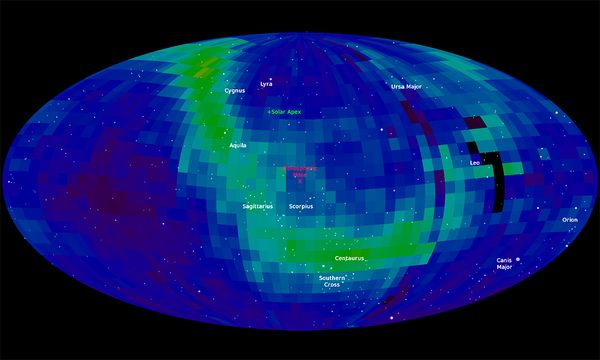
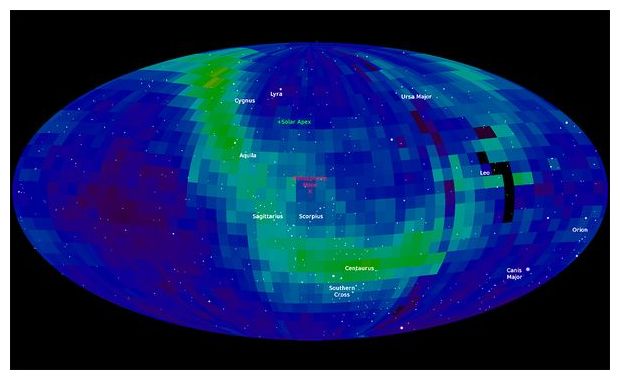
© Nathan Schwadron, University of New HampshireAn illustration based on IBEX data shows the heliopshers's "nose" (red "x") near Scorpius.
A NASA spacecraft has uncovered the solar system's "nose," which points in the direction our sun is moving through the
Milky Way galaxy, astronomers say.
The finding is based on newly released data from the
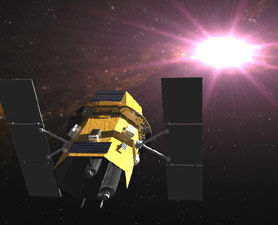
Interstellar Boundary Explorer satellite (IBEX), an Earth-orbiting probe that has been mapping the solar system's outer frontier since 2008.
As the sun travels through the galaxy, the solar wind - actually charged particles streaming from the sun - collides with interstellar gases, forming a cocoon around the solar system called the heliosphere.
The edge of this cocoon, the heliopause, lies more than 9 billion miles (14.5 billion kilometers) from the sun.
"The Voyager spacecrafts were the first to reach these outer boundaries, and [they] gave us very localized information," said study leader
Nathan Schwadron of the University of New Hampshire.
"But IBEX now allows us to pull back and finally show us its global properties. We are now overturning 40 years of theories about this gigantic bubble which surrounds and protects our solar system from harmful galactic cosmic rays," high-energy particles that zip through the universe.
Cosmic rays constantly bombard our solar system, but the heliosphere shields us from most of the radiation. Still, the small amounts that leak through and reach Earth can fry satellite electronics and pose a health hazard for astronauts.









Comment: In light of the discussions we've had here on SOTT of James McCanney's work and the electric forces that affect the Earth, Sun, planets and other less-stable bodies such as comets and asteroids, we encourage readers to check out Donald E. Scott's website, The Electric Cosmos, as well.