
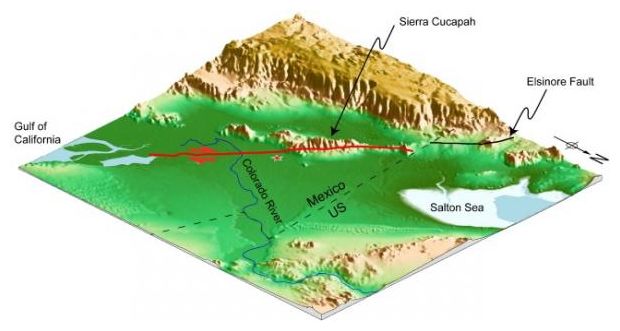
© Caltech Tectonics ObservatoryThis 3-D view of the surface rupture of the April 4, 2010, El Mayor-Cucapah earthquake (red line) reveals a new fault line connecting the Gulf of California with the Elsinore fault.
Fault lines that run across the Earth are usually more complicated at the Earth's surface than they are deeper down. But a new study of an April 2010 earthquake in Mexico reveals a reversal of this trend: While the fault involved in the event appeared to be superficially straight, the fault zone is warped and complicated at depth.
The El Mayor - Cucapah earthquake happened along a system of faults that run from Southern California into Mexico and form part of the boundary between the Pacific plate and the North American plate.
In a standard model, such faults - where two plates slide past one another - tend to be vertically oriented. However, it turns out that despite the somewhat straight line left on the Earth's surface, the portion of the fault that ruptured in the April quake is jagged and angled at depth.
"It was really surprising to see a straight fault trace that cuts through the Colorado delta and the rugged topography of the Sierra Cucapah as a result of this event," said Jean-Philippe Avouac, director of California Institute of Technology's Tectonics Observatory, in a statement.
Avouac was principal investigator on the study, which is published online in the journal Nature Geoscience.



