Science & TechnologyS


Beaker

Ionic Liquid Helps Turn Greenhouse Gas Into Fuel

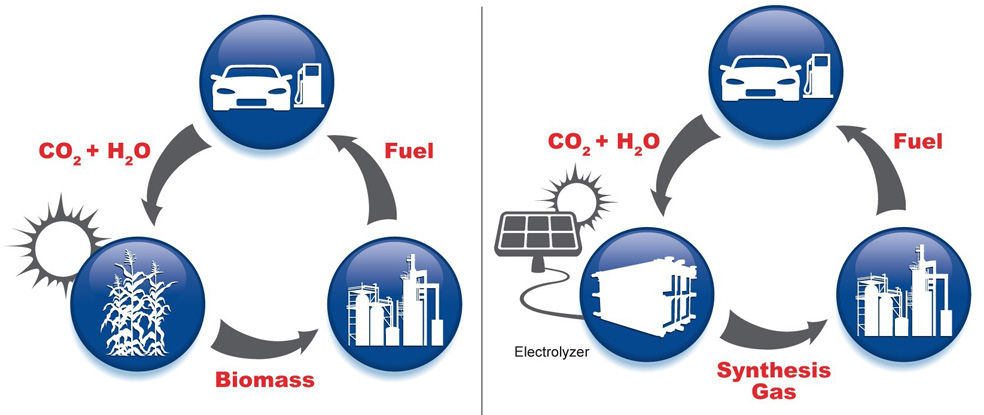
A research team at the University of Illinois claims to have developed an ionic liquid to act as a catalyst when greenhouse gas emissions are converted to fuel.
Image
© Unknown

Using the liquid, the scientists were able to dramatically reduce the energy needed to change carbon dioxide into carbon monoxide, which is the first step in turning emissions into fuels such as formic acid or methanol.

The idea isn't new and is generally knows as artificial photosynthesis, where a solar cell or wind turbine powers an electrochemical cell to convert carbon monoxide. So far, however, scientists needed more energy for the conversion from carbon dioxide into carbon monoxide than can be gained from the final product. According to the research team led by chemical and biological engineering professor and chair Paul Kenis, the ionic liquids stabilize the intermediates in the reaction, which lowers the need for electricity for the conversion. Kenis and his team did not reveal how much the need dropped, but said that they are now looking into ways to make the conversion more efficient and accelerate it so that their ionic liquid can be used in commercial applications.

"More work is needed, but this research brings us a significant step closer to reducing our dependence on fossil fuels while simultaneously reducing CO2 emissions that are linked to unwanted climate change," Kenis said.

Blackbox

Black Death Is 'Grandmother' of All Modern Plague

Black Death
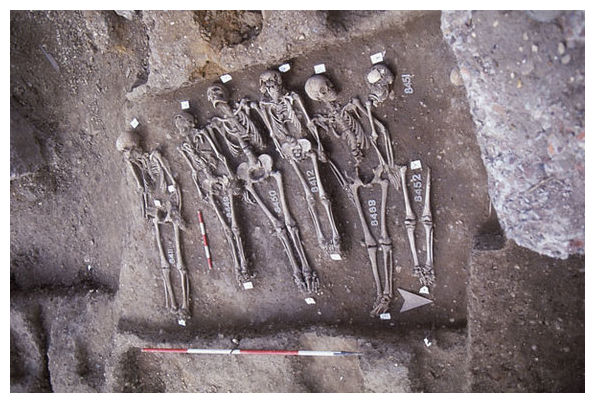
© Museum of LondonDental pulp taken from Black Death victims, like these, excavated from the East Smithfield cemetery in London, allowed scientists to sequence the genome of the bacterium that is believed to have killed them about 660 years ago.

The bacterium blamed for the Black Death that wiped out more than a third of Europe's population within about five years of the 14th century looks an awful lot like the modern versions of the plague-causing bug, new genetic research indicates.

By taking the now-powdery black pulp out of the teeth of plague victims buried in London's East Smithfield Cemetery - a cemetery established solely to handle the onslaught of the Black Death once it arrived in the city in 1348 - researchers have managed to reconstruct the entire genetic blueprint, or genome, of the bacterium blamed for the devastation.

Since science already have the same information for modern strains of plague bacteria, this gave the researchers the chance to explore perplexing questions about plague.

In fact, all modern, human-infecting strains appear to have separated from a common ancestor shortly before the Black Death, making the medieval bacterium the grandmother of modern plague, as one of the researchers said.

Still, the genetic similarity between bacteria leaves the big question: Why does modern plague, while deadly without antibiotics, pale in comparison to the devastation and wildfire-like spread of the Black Death?

Since genetic changes don't appear to explain this change in behavior, the researchers suggest an alternative: The 14th-century bug hit at a time when Europeans were already down. They were living in a cold, wet period that caused crops to fail, and they were most likely already struggling with other diseases.

Comment: The reader is encouraged to review this in-depth article that sheds more light on this subject: New Light on the Black Death: The Cosmic Connection by Laura Knight-Jadczyk.


Black Cat

UFO-Like Stealth Drone Soars in U.S. Navy Test Flight

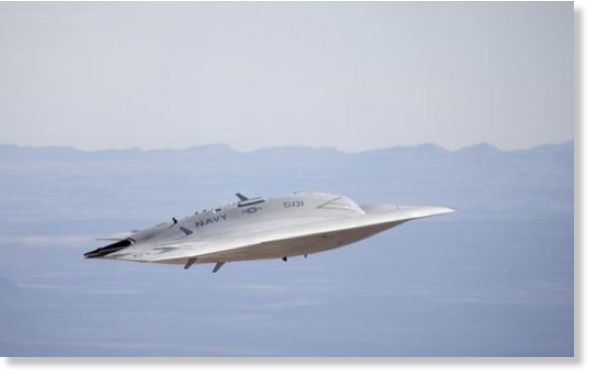
Military drones have already begun edging out manned fighter jets and bombers over the past decade, and the U.S. Navy doesn't plan on being left behind. Its vision for unmanned aerial warfare includes a tailless robotic aircraft resembling a UFO that is scheduled to begin landing on aircraft carriers in 2013. As a step toward that goal, the X-47B drone recently made its first flight in cruise mode with retracted landing gear.

The Navy has enlisted the X-47B drone - a Northrop Grumman design with a stealthy profile - as more than just its very first carrier-based drone. It also wants to use the X-47B as a test platform for autonomous aerial refueling without human assistance in 2014.

Image
© US NAVYX-47B stealth drone

Telescope

Astronomers Identify Distant Ancient Supernovas

Exploding stars called supernovas are the source of iron, essential to life on Earth. Now Tel Aviv University researchers are watching stars that exploded ten billion years ago, sharpening our understanding of these stars and their role in the formation of these elements.

Prof. Dan Maoz of TAU's Raymond and Beverly Sackler School of Physics and Astronomy is spearheading a project that has just discovered twelve of the most distant and ancient supernovas ever seen, ten of them in a part of the sky called the Subaru Deep Field. He and his colleagues say that their discovery will enhance their knowledge of the "dark energy" that is causing the universe to expand, as well as the origins of life on our own planet.

Image
© NASA, The Hubble Heritage Team and A. Riess (STScI) Intricate spiral arms contain areas of new star formation in this dusty galaxy. This galaxy, which lies about 100 million light-years away, toward the direction of the constellation Leo, was home to a supernova that appeared in 1994.

Telescope

The Milky Way Arches Over Chile

The Milky Way arches across this rare 360-degree panorama of the night sky above the Paranal observing platform in Chile, home of ESO's Very Large Telescope.

The image was made from 37 individual frames with a total exposure time of about 30 minutes, taken in the early morning hours. The Moon is just rising and the zodiacal light shines above it, while the Milky Way stretches across the sky opposite the observatory.

Image
© ESO/H.H. Heyer

Blackbox

Kraken Discovery; Science or a Whopper of a Fish Tale?

Image
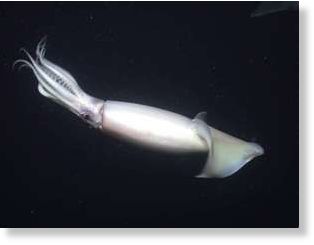
© UnknownGiant Squid
A paleontologist observing a pattern of prehistoric bones from a bus-sized ancestor of the modern sperm whale has come up with a whopper of a fish tale. Analyzing the arrangement of the bones has led to the theory that a giant mythical monster known as the Kraken dined on the whale-like creature, picked it down to the bones and methodically laid the bones in a systematic fashion.

So does this mean the Kraken lives? Well, not exactly. The existence of the Kraken has never been proven, but one scientist says he might know where it lived. More accurately, one paleontologist is speculating it lived and thinks he has stumbled upon its home. Mount Holyoke College paleontologist Mark McMenamin says he has found evidence that he says lends credibility to the mythical creature known in Norse Mythology as the Kraken.

They did not actually find Kraken remains. Giant squid do not have bones and most of their bodies are composed of soft tissue and decay quite rapidly. This makes the study of this creature so elusive. The evidence is at Berlin-Ichthyosaur State Park in Nevada, where McMenamin and his daughter conducted field studies over the past few months. It's a site where the remains of nine 45-foot ichthyosaurs have been discovered. The Ichthyosaur was known to be a whale-like creature that swam not only on the top of the water (air-breathing), but also at the top of the food chain. That theory is now being challenged by the discovery of evidence that giant Kraken feasted on the mighty leviathans, making them the king of the sea.

Saturn

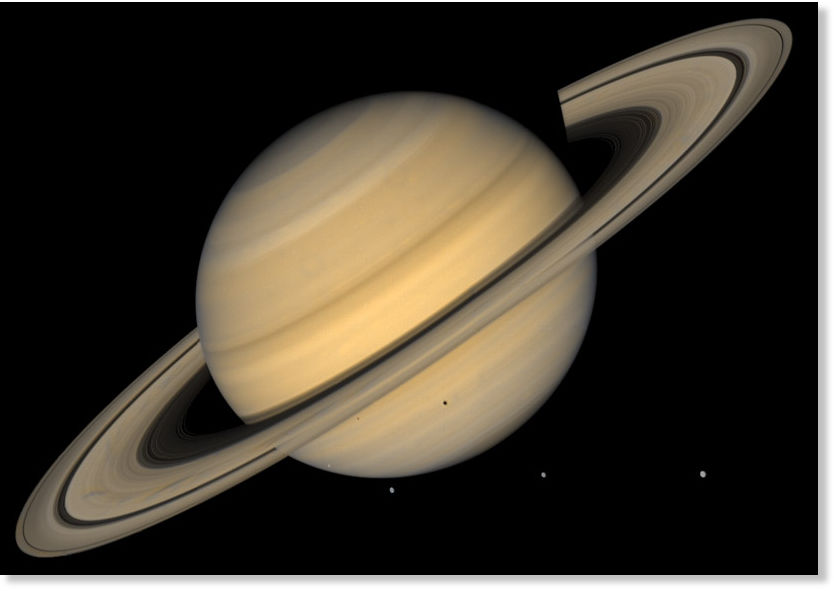
Saturn's rings tell a comet's tale

Image
© NASA
Ripples testify to 14th century collision

During the 1300s, the Black Death was savaging Europe, England and France were locked in the Hundred Years' War and Chaucer was penning his Canterbury Tales. Meanwhile, more than a billion kilometers away, a comet careened toward Saturn and disintegrated, dropping dusty clouds of debris on the giant planet's iconic rings, creating rippled cometary footprints.

The ripples from that cataclysmic event can still be detected today, electrical engineer Essam Marouf reported October 4 during the joint meeting of the European Planetary Science Congress and the American Astronomical Society's Division for Planetary Sciences.

Marouf, a professor at San Jose State University in California and a member of the Cassini science team, described how the probe beamed radio waves back to Earth through the innermost part of Saturn's C ring, a tenuous inner band in the planet's ring system. The radio waves revealed what Marouf calls a "very unusual kind of addition" to the normal ring structure. "There were highly regular little wiggles that rippled over hundreds of kilometers in a very specific pattern," Marouf says.

Info

Rocking Discovery: Boulders Rub Shoulders During Quakes

Hugh Boulders
© Jay QuadeHuge boulders in Chile's Atacama Desert appear to be rubbed very smooth about their midsections.

A strange geological process is at work in a remote corner of northern Chile's Atacama Desert, and it was discovered thanks to one scientist's upset stomach.

University of Arizona geologist Jay Quade were traveling through the area when Quade's sour stomach forced them to stop their truck at a lifeless expanse of boulders in the Atacama that they had passed before without noticing anything unusual.

While the others wandered off to see the sites, as geologists are wont to do, Quade climbed under the truck to get out of the beating sunlight. That's when Quade noticed something very unusual about the half-ton to 8-ton boulders near the truck: they appeared to be rubbed very smooth about their midsections.

The most common agent of such erosion is water - not something readily found in the bone-dry Atacama.

About the only other thing that came to Quade's mind was earthquakes, he said in a statement. Over the approximately two million years that these rocks have been sitting on their sandy plain perhaps they were jostled by seismic waves that caused them to gradually grind against each other and smooth their sides. It made sense, but Quade never thought he'd be able to prove it.

Blackbox

Gigantic virus discovery rivets scientists

Image
© DiscoverImage of Megavirus
There are many weird viruses on this planet, but none weirder-in a fundamentally important way-than a group known as the giant viruses.

For years, they were hiding in plain sight. They were so big-about a hundred times bigger than typical viruses-that scientists mistook them for bacteria. But a close look revealed that they infected amoebae and built new copies of themselves, as all viruses do. And yet, as I point out in A Planet of Viruses, giant viruses certainly straddle the boundary between viruses and cellular life. Flu viruses may only have ten genes, but giant viruses may have 1,000 or more. When giant viruses invade a host cell, they don't burst open like other viruses, so that their genes and proteins can disperse to do their different jobs. Instead, they assemble into a "virus factory" that sucks in building blocks and spits out large pieces of future giant viruses. Giant viruses even get infected with their own viruses. People often ask me if I think viruses are alive. If giant viruses aren't alive, they sure are close.

Igloo

Journey to Antarctica: Mission to Drill Into Ice-Buried Lake

Antarctica
© OurAmazingPlanet

A team of British engineers is set to begin a journey to a lake hidden beneath nearly 2 miles of Antarctic ice.

The explorers depart next week for Antarctica on the first stage of an ambitious scientific mission to collect water and sediment samples from a lake buried beneath 1.8 miles (3 kilometers) of solid ice. This mission will hopefully yield new knowledge about the evolution of life on Earth and other planets, and will provide vital clues about the Earth's past climate.

Transporting nearly 80 tons of equipment, the "advance party" will make a journey almost 10,000 miles (16,000 km) from the United Kingdom to the subglacial Lake Ellsworth on the West Antarctic Ice Sheet. It is one of the most remote and hostile environments on Earth, with temperatures that hover at minus 13 degrees Fahrenheit (minus 25 degrees Celsius). Their task is to prepare the way for the "deep-field" research mission that will take place next year, when the team of scientists and engineers will live in tents, spending around three months working above the lake.