Science & TechnologyS


Info

Slow-Mo Video Catches Light at 1 Trillion Frames a Second

Pulse of Light
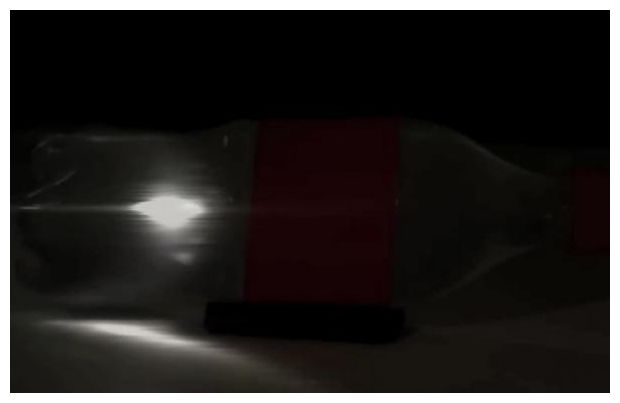
© miA still from a video shows a pulse of light traveling through a bottle; taken at one trillion frames per second.

Forget about slow-motion shots of a bullet destroying an apple or a hummingbird shaking off water. Making a slow-motion video of light beams bouncing around inside a 1-liter bottle required a new super-fast imaging system - one capable of taking 1 trillion frames a second. MIT's Media Lab has now made such a system possible by harnessing camera technology usually found in chemistry experiments.

An imaging system that makes light seem slow speaks for itself, especially when light travels 700 million miles an hour on a good day in a vacuum. But to better appreciate 1 trillion frames per second (fps), consider that the iPhone 4S camera shoots HD video at just 30 fps. Even Hollywood has relied upon a mix of digital wizardry and cameras shooting at 24 fps to capture its beloved slow-motion explosions. (Lord of the Rings director Peter Jackson just recently stepped up his game by choosing to film The Hobbit prequels at 48 fps.)

"There's nothing in the universe that looks fast to this camera," said Andreas Velten, a postdoctoral researcher at the MIT Media Lab.

Info

Bulging Brain Structures Separate Us from Neanderthals

brain

Modern humans possess brain structures larger than their Neanderthal counterparts, suggesting we are distinguished from them by different mental capacities, scientists find.

We are currently the only extant human lineage, but Neanderthals, our closest-known evolutionary relatives, still walked the Earth as recently as maybe 24,000 years ago. Neanderthals were close enough to the modern human lineage to interbreed, calling into question how different they really were from us and whether they comprise a different species.

To find out more, researchers used CT scanners to map the interiors of five Neanderthal skulls as well as four fossil and 75 contemporary human skulls to determine the shapes of their brains in 3D. Like modern humans, Neanderthals had larger brains than both our living ape relatives and other extinct human lineages.

The investigators discovered modern humans possess larger olfactory bulbs at the base of their brains. This area is linked primarily with smell, but also with other key mental functions such as memory and learning - central olfactory brain circuitry is physically very close to structures related to memory.

Airplane

New Armed Stealth Drone Heads to Afghanistan (And Maybe Iran, Too)

drone
© wired.com
The U.S. Air Force is sending a single copy of a brand-new stealth drone to Afghanistan. Only maybe not just Afghanistan.

Officially, the General Atomics-made Avenger - a sleek, jet-powered upgrade of the iconic armed Predator and Reaper - is heading to Afghanistan as a combat-capable "test asset." The Air Force said in a statement that it loves how the Avenger's "internal weapons bay and four hardpoints on each wing," will give it "greater flexibility and will accommodate a large selection of next generation sensor and weapons payloads," as reported by Zach Rosenberg at Flightglobal.

Problem is, you don't really need those things in Afghanistan. Weapons bays are for stealth: most warplanes don't have them. And it's not like the Taliban has been firing radar-guided missiles at NATO aircraft. Besides, there are already dozens of armed drones in Afghanistan. One more isn't going to make much of a difference.

Which begs the question: Is the 41-foot-long Avenger really meant for Afghanistan? Or is it destined to patrol over Afghanistan's unruly neighbors, Iran and Pakistan, both of which do have radar-guided missiles? That was a job assigned to the Lockheed Martin RQ-170 Sentinel before one of those drones crashed in Iran two weeks ago. We're sure the Air Force has a few more RQ-170s to throw at Iran and Pakistan. After all, the elusive 'bots have been spotted in Afghanistan, South Korea and Japan. But the Avenger, which debuted just two years ago, is newer and more capable than the Sentinel, which is widely believed to be a product of the early 2000s.

Comment: Caveat Lector: Wired Magazine and Wired.com is owned by a company which produces drones and is heavily invested in facilitating the widespread use of domestic drones for spying on, tracking, arresting and ultimately eliminating American citizens.

Attack of the Drones


Airplane

Trillion-Dollar Jet Has Thirteen Expensive New Flaws

jet
© wired.com
The most expensive weapons program in U.S. history is about to get a lot pricier.

The F-35 Joint Strike Fighter, meant to replace nearly every tactical warplane in the Air Force, Navy and Marine Corps, was already expected to cost $1 trillion dollars for development, production and maintenance over the next 50 years. Now that cost is expected to grow, owing to 13 different design flaws uncovered in the last two months by a hush-hush panel of five Pentagon experts. It could cost up to a billion dollars to fix the flaws on copies of the jet already in production, to say nothing of those yet to come.

In addition to costing more, the stealthy F-35 could take longer to complete testing. That could delay the stealthy jet's combat debut to sometime after 2018 - seven years later than originally planned. And all this comes as the Pentagon braces for big cuts to its budget while trying to save cherished but costly programs like the Joint Strike Fighter.

Frank Kendall, the Pentagon's top weapons-buyer, convened the so-called "Quick Look Review" panel in October. Its report - 55 pages of dense technical jargon and intricate charts - was leaked this weekend. Kendall and company found a laundry list of flaws with the F-35, including a poorly placed tail hook, lagging sensors, a buggy electrical system and structural cracks.

Comment: War is a racket, it always has been.


Beaker

Long-Sought "God Particle" Cornered, Scientists Say

News is not the final answer some were hoping for, but progress is significant step

Image
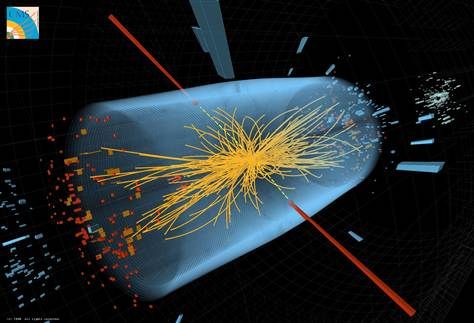
© CERN/COMSA typical candidate event at the Large Hadron Collider (LHC), including two high-energy photons whose energy (depicted by red towers) is measured in the CMS electromagnetic calorimeter. The yellow lines are the measured tracks of other particles produced in the collision. The pale blue volume shows the CMS crystal calorimeter barrel.
Physicists are closer than ever to hunting down the elusive Higgs boson particle, the missing piece of the governing theory of the universe's tiniest building blocks.

Scientists at the world's largest particle accelerator, the Large Hadron Collider at the European Organization for Nuclear Research (CERN) in Geneva, Switzerland, announced today (Dec. 13) that they'd narrowed down the list of possible hiding spots for the Higgs, (also called the God particle) and even see some indications that they're hot on its trail.

"I think we are getting very close," said Vivek Sharma, a physicist at the University of California, San Diego, and the leader of the Higgs search at LHC's CMS experiment. "We may be getting the first tantalizing hints, but it's a whiff, it's a smell, it's not quite the whole thing."

Today's announcement was highly anticipated by both the physics community and the public, with speculation running rampant in the days leading up to it that the elusive particle may have finally been found. Though the news is not the final answer some were hoping for, the progress is a significant, exciting step, physicists say. [ Top 5 Implications of Finding the Higgs Boson ]

Display

Crowdsourcing: Hidden Industry Dupes Social Media Users

crowdsourcing lego faces
© n/a
A trawl of Chinese crowdsourcing websites - where people can earn a few pennies for small jobs such as labeling images - has uncovered a multimillion-dollar industry that pays hundreds of thousands of people to distort interactions in social networks and to post spam.

The report's authors, at the University of California, Santa Barbara, also found evidence that crowdsourcing sites in the U.S. are similarly dominated by ethically questionable jobs. They conclude that the rapid growth of this way of making money will make paid shills a serious security problem for websites and those who use them around the world. A paper describing their results is available on the Arxiv pre-print server.

Ben Zhao, an associate professor of computer science at UCSB (and a TR35 winner in 2006), started looking into the largely uncharted crowdsourcing industry in China after working closely with RenRen, a social network that is sometimes called the "Facebook of China," to track malicious activity on the site. Zhao was intrigued to see a lot of relatively sophisticated attempts to send spam and promote brands by users that appeared to be working with specific agendas.

When he and colleagues investigated the source of that activity, the team was surprised by what it found, says Zhao: "Evil crowdsourcing on a very large scale." Influencing public opinion with fake "grassroots" activity is known as astroturfing, leading Zhao to coin the term "crowdturfing," since it is done via large crowdsourcing sites.

Robot

That was quick! Iran ready to clone US drone

Image
Iran is set to produce its own drones modeled on a US spy craft intercepted over its territory. Experts are at the final stages of decoding the US RQ-170 Sentinel drone and are to copy it using reverse engineering technology.

Iranian lawmaker Parviz Sorouri, a member of parliament's national security and foreign policy committee, said the country has the capability to reproduce the drone, Iranian TV reports.

If Iran successfully reverse-engineers the drone it will get access to high-tech secrets such as the chemical composition of the device's radar-deflecting paint or its sophisticated optics.

Also, if the experts are able to hack the drone's database, they might recover data the US would not want revealed. However, such drones usually do not store much data and if they do, it is encrypted.

Sorouri said that the information from the seized drone would be used to file a law suit against the US for the "invasion" by the unmanned aircraft.

Comment: Two days after writing that: "the Iranians have a short window in which to dabble in some reverse engineering", Iran have announced that they are ready to clone the captured US drone using reverse engineering. Political theatre yes but interesting to witness how quickly events are unfolding in the current geopolitical circus.


Telescope

Tiny lunar volcanoes

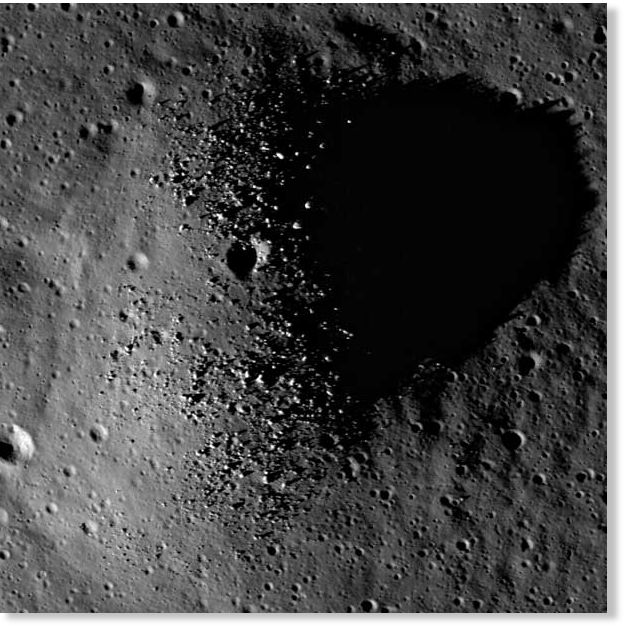
The Moon is packed with all sorts of interesting features that only come to light - literally, in some cases - when very high-resolution imaging is done. For example, the lunar far side has a bunch of small volcanoes, some only a few hundred meters across, like this one:
Image
© NASA/GSFC/Arizona State University
The image is about 500 meters across, so this is a hill you could climb pretty easily, even though the low Sun angle implies the slope is greater then 13° (remember, the Moon has 1/6th the Earth's gravity so that would be a pretty easy hike). Those boulders on the top are weird; they only appear to be on one side, and there doesn't seem to be anything in that direction that would be a source of them. There are none on the plains around it, or at the bottom of a nearby crater, either. The source must be the volcano itself, I'd wager. Note the crater at the top of the mound, too - you might think that's the volcanic vent, but in fact it's not centered on the dome, indicating it's a coincidental impact crater.

Info

WISE Images Supernova's Rose

Supernova Puppis
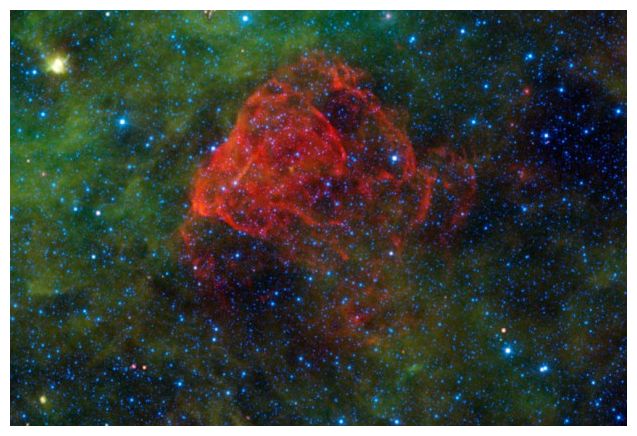
© NASA/JPLAbout 3,700 years ago people on Earth would have seen a brand-new bright star in the sky. As it slowly dimmed out of sight, it was eventually forgotten, until modern astronomers found its remains — called Puppis A.

About 3,700 years ago, people on Earth would have seen a brand-new bright star in the sky. It slowly dimmed out of sight and was eventually forgotten, until modern astronomers later found its remains, called Puppis A. In this new image from NASA's Wide-field Infrared Survey Explorer (WISE), Puppis A looks less like the remains of a supernova explosion and more like a red rose.

Puppis A (pronounced PUP-pis) was formed when a massive star ended its life in a supernova, the most brilliant and powerful form of an explosion in the known universe. The expanding shock waves from that explosion are heating up the dust and gas clouds surrounding the supernova, causing them to glow and appear red in this infrared view. While much of the material from that original star was violently thrown out into space, some of it remained in an incredibly dense object called a neutron star. This particular neutron star (too faint to be seen in this image) is moving inexplicably fast: over 3 million miles per hour! Astronomers are perplexed over its absurd speed, and have nicknamed the object the "Cosmic Cannonball."

Some of the green-colored gas and dust in the image is from yet another ancient supernova - the Vela supernova remnant. That explosion happened around 12,000 years ago and was four times closer to us than Puppis A.

Airplane

China Aims to Bypass Heaven in Securing Rain for Crops

flood/China
© Getty Images
Fresh from scoring another record grain harvest this year, China now plans to get the weather to heel as well.

Rainmaking has now become part of the government's five-year-term goals, the state-run China Daily reported Friday. Over the next four years, Beijing wants five regional weather control programs to increase artificial rain by 10 percent, it says.

The plan marks a major expansion of China's "weather modification" efforts, deployed for years in Beijing to sometimes mixed results. Cloud-seeding - accomplished by shooting shells or rockets filled with silver iodide particles into promising puffs of white - was instrumental in clearing the smog out of the skies during the 2008 Olympics and has helped relieve the capital from chronic water shortages. But the effort has occasionally gone horribly, and expensively, awry.

Existing weather modification operations in Beijing and the northeastern province of Jilin currently produce 50 billion cubic meters of artificial precipitation, the China Daily said, citing the China Meteorological Administration (CMA). The number could read 280 billion cubic meters if "more effective weather intervention measures are taken," the paper said.