Science & TechnologyS


Magnify

Scientists One More Step Closer to Realizing Invisible Technology

invisibility cloak
© Silver Pictures
A unique computer model designed by a mathematician at the University of Liverpool has shown that it is possible to make objects, such as aeroplanes and submarines, appear invisible at close range.

Scientists have already created an 'invisibility cloak' made out of 'metamaterial' which can bend electromagnetic radiation - such as visible light, radar or microwaves - around a spherical space, making an object within this region appear invisible.

Until now, scientists could only make objects appear invisible from far away. Liverpool mathematician Dr Sébastien Guenneau, together with Dr Frédéric Zolla and Professor André Nicolet from the University of Marseille, have proven - using a specially designed computer model called GETDP - that objects can also be made to appear invisible from close range when light travels in waves rather than beams.

Scientists predict that metamaterials could be of use in military technology, such as in the construction of fighter jets and submarines, but it will be some years before invisibility cloaks can be developed for human beings.


Info

Twin Births Doubled in Three Decades in U.S.

Twins
© CorbisWomen in their 30s tend to have higher rates of "spontaneous twinning," or becoming pregnant with twins without the use of fertility therapy, than younger women.
Advances in fertility treatment and a trend toward later-life childbirth are fueling a boom in twins in the United States, where one in 30 babies is a twin, according to data.

The number of twins doubled in 2009 compared to 1980, rising from 68,339 to over 137,000 births, said the National Center for Health Statistics' data brief on three decades of twin births in the United States.

The overall birth rate of twins surged 76 percent over the last 30 years, going from 1.9 percent of all births to 3.3 percent.

That means one in every 30 US babies is a twin, compared to one in 53 in 1980.

Over the last three decades, twin birth rates rose in every state, by nearly 100 percent among women aged 35-39 and more than 200 percent among women aged 40 and over, it said.

Women in their 30s tend to have higher rates of "spontaneous twinning," or becoming pregnant with twins without the use of fertility therapy, than younger women.

Chalkboard

Physicists Propose Test for Loop Quantum Gravity

loop quantum gravity signature
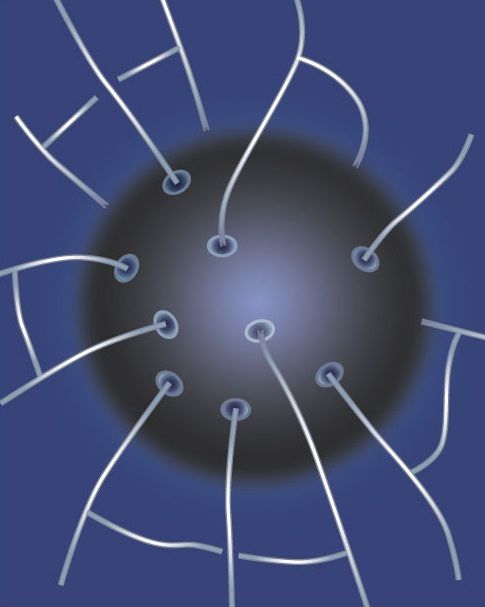
© PhysOrgArtist's illustration of loop quantum gravity.
As a quantum theory of gravity, loop quantum gravity could potentially solve one of the biggest problems in physics: reconciling general relativity and quantum mechanics. But like all tentative theories of quantum gravity, loop quantum gravity has never been experimentally tested. Now in a new study, scientists have found that, when black holes evaporate, the radiation they emit could potentially reveal "footprints" of loop quantum gravity, distinct from the usual Hawking radiation that black holes are expected to emit.

In this way, evaporating black holes could enable the first ever experimental test for any theory of quantum gravity. However, the proposed test would not be easy, since scientists have not yet been able to detect any kind of radiation from an evaporating black hole.

The scientists, from institutions in France and the US, have published their study called "Probing Loop Quantum Gravity with Evaporating Black Holes" in a recent issue of Physical Review Letters.

"For decades, Planck-scale physics has been thought to be untestable," coauthor Aurélien Barrau of the French National Institute of Nuclear and Particle Physics (IN2P3) told PhysOrg.com. "Nowadays, it seems that it might enter the realm of experimental physics! This is very exciting, especially in the appealing framework of loop quantum gravity."

HAL9000

Remembrance of things future: Long-term memory sets the stage for visual perception

Rather than being a passive state, perception is an active process fueled by predictions and expectations about our environment. In the latter case, memory must be a fundamental component in the way our brain generates these precursors to the perceptual experience - but how the brain integrates long-term memory with perception has not been determined. Recently, however, researchers in the Department of Experimental Psychology at the University of Oxford, by devising a method for integrating memory and attention, showed how LTM optimizes perception by varying brain states associated with anticipation of spatial localization in the visual field. The scientists also used fMRI to articulate a neural network involving a number of cortical areas likely to be active in the predictive use of memory in the visual cortex.
memory-guided attention 1
© PNAS
Experimental protocol for memory-guided attention. (A) In both EEG and fMRI experiments, participants first completed a learning task in which they searched for a target stimulus that was embedded within naturalistic scenes. Targets were presented on the right (Right Memory), left (Left Memory) or not at all (Neutral Memory). (B) Over repeated sessions, participants found, and learned, the location of target stimuli. The learning profile from the EEG experiment is plotted for search accuracy (left y axis, red) and search time (right y axis, blue) as a function of training session number (x axis). (C) On the following day, participants performed an attention task in which scenes from the initial learning task were used to cue the location of a subsequent target. The first scene was always presented without the target stimulus, whereas the second scene contained a target on 50% of trials. On target-present trials, previously learned locations were 100% predictive of the subsequent target location. Consequently, valid memory cue scenes could be used to predict the precise location of the subsequent target, whereas memories for neutral cues contained no task-relevant spatial information. (D) Behavioral data are shown for the EEG experiment, with sensitivity (left y axis, bars) and RT (right y axis, triangles) plotted as a function memory condition (memory vs. neutral). Detection sensitivity was higher for spatially predictive memories, and RTs were shorter. Error bars represent ±1 SEM. Copyright © PNAS, doi: 10.1073/pnas.1108555108

Info

Baby Monkeys With 6 Genomes Are Scientific First

Chimeric Primates
© OHSU PhotosRoku and Hex, two of the world's first chimeric primates.

They look like ordinary baby rhesus macaques, but Hex, Roku and Chimero are the world's first chimeric monkeys, each with cells from the genomes of as many as six rhesus monkeys.

Until now research on so-called chimeric animals, or those that have cells with different genomes, has been limited to mice; a recent procedure produced mice using cells from two dads.

The researchers turned to monkeys for more insight into the capabilities of embryonic stem cells. Most experiments on stem cell therapies are based on mice, and the researchers wanted to understand whether primate embryonic stem cells respond the same way as those of mice do.

To create the chimeric monkeys, researchers essentially glued together cells from individual rhesus monkey embryos and then implanting these mixed embryos into mama monkeys.

The key was mixing cells from very early-stage embryos, or blastocysts, that consisted of just two to four cells - each one of the cells still totipotent, capable of transforming into a whole animal as well as the placenta and other life-sustaining tissues. (This is in contrast to pluripotent stem cells, which can differentiate into any tissue type in the body, but not certain embryonic tissues or entire organisms.)

"The cells never fuse, but they stay together and work together to form tissues and organs," said Shoukhrat Mitalipov of the Oregon National Primate Research Center at Oregon Health & Science University. "The possibilities for science are enormous."

Better Earth

Why Is the New Deep-Sea Antarctic Octopus So Pale?

Image
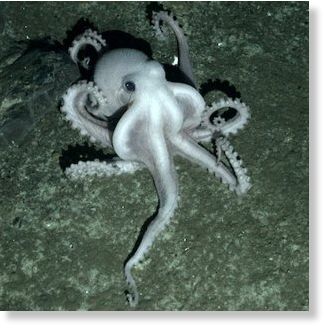
© Oxford UniversityThe deep-sea hydrothermal vent octopus discovered near Antarctica
Recent expeditions to Antarctic seafloor vents have yielded haunting new images of hairy-bellied yeti crabs, a seven-armed starfish and an eerily pale octopus its curling arms encased in almost translucent skin.

This octopus, along with the dives' other finds, were documented via ROV (remotely operated vehicle) and described earlier this week in PLoS Biology.

"The first survey of these particular vents, in the Southern Ocean near Antarctica, has revealed a hot, dark, 'lost world' in which whole communities of previously unknown marine organisms thrive," Alex Rogers, a professor in Oxford University's zoology department who led the team, said in a prepared statement.

The octopus, found at 2,394 meters below sea level (nearly a mile and a half down), of course, isn't the first deep-sea or the first vent-dwelling octopus to be discovered. But it shares the same ghostly pallor as others that have been observed at similar depths. Why would these creatures, whose shallow-water cousins are so famous for their flamboyant camouflage, be slinking along as pale as a ghost?

Info

Clever Canines: Dogs Can 'Read' Our Communication Cues

Dog
© Live Science

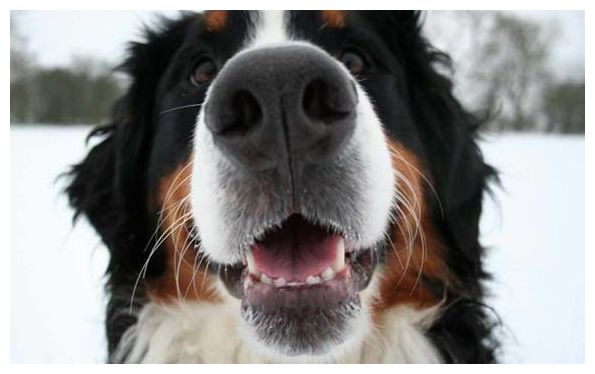
Dogs can understand our intent to communicate with them and are about as receptive to human communication as pre-verbal infants, a new study shows.

Researchers used eye-tracking technology to study how dogs observed a person looking at pots after giving the dogs communicative cues, such as eye contact and directed speech. They found that the dogs' tendency to follow the person's gaze was on par with that of 6-month-old infants.

The study suggests that dogs have evolved to be especially attuned to human communicative signals, and early humans may have selected them for domestication particularly for this reason, the researchers said.

Other scientists are excited that the eye-tracking method has been successfully adapted for dogs. "This opens many new opportunities in studying dog cognition," said Juliane Kaminski, a cognitive psychologist at the Max Planck Institute for Evolutionary Anthropology in Germany, who was not involved in the research.

Black Cat

No Surprise Here: US Pentagon-backed 'time cloak' stops the clock

Image
© AFPThe US Pentagon
Pentagon-supported physicists on Wednesday said they had devised a "time cloak" that briefly makes an event undetectable.

The laboratory device manipulates the flow of light in such a way that for the merest fraction of a second an event cannot be seen, according to a paper published in the science journal Nature.

It adds to experimental work in creating next-generation camouflage -- a so-called invisibility cloak in which specific colours cannot be perceived by the human eye.

"Our results represent a significant step towards obtaining a complete spatio-temporal cloaking device," says the study, headed by Moti Fridman of Cornell University in New York.

The breakthrough exploits the fact that frequencies of light move at fractionally different speeds.

The so-called temporal cloak starts with a beam of green light that is passed down a fibre-optic cable.

The beam goes through a two-way lens that splits it into two frequencies -- blueish light which travels relatively fast, and reddish light, which is slower.

Info

New Worms' Silk Has Spider Strength

Spider SIlk T-shrit
© InnovationNewsDaily

Think of it as softness blended with strength: One research team has genetically engineered a silkworm that spins cocoons composed of about 95 percent silkworm proteins and 5 percent spider silk proteins. The composite silk is significantly stronger than regular silkworm silk and, researchers hope, as easy to produce in large quantities as regular silk.

The research team reported on their results from two genetically engineered silkworms in this week's issue of the journal Proceedings of the National Academy of Sciences.

Spider silk's strength, lightness and flexibility make it an appealing material for sutures, artificial ligaments and tendons, bulletproof vests and more. So far, however, nobody has been able to harvest enough spider silk for practical use.

One problem is that people can't farm spiders. The animals are territorial and, if kept in close quarters, have a tendency to eat each other. To get spider silk without cannibalizing spiders, several research teams have engineered cells and even goats to produce spider silk proteins. But that leads to a problem: how to spin that protein into large quantities of silken threads.

X

Bees being turned into 'zombies' by parasite

Bees zombies by parasite
© Associated PressHoney bees
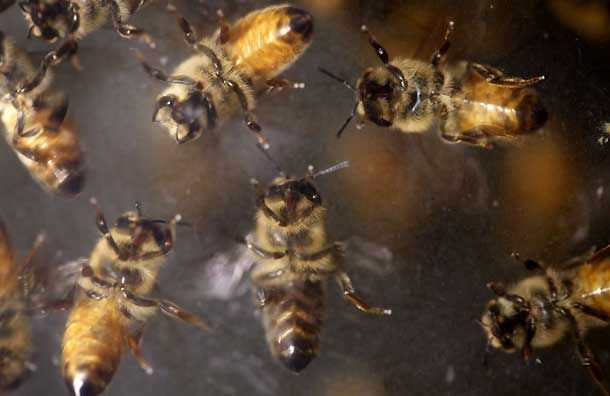
Honey bees are abandoning their hives and being turned into "zombies" by a deadly fly parasite in their stomachs.

The parasite makes the bees flee their hives and then walk round and round in circles before dying. It also makes them seek out bright lights.

The parasite lays its' eggs inside the abdomen of the honey bee. About a week after the bee dies, the pupae emerge from the throats and heads of the dead bees.

Scientists discovered the parasite by accident but they believe it may help them discover what is causing colony collapse disorder which is devastating honey bees in Europe and America cutting some populations in half.