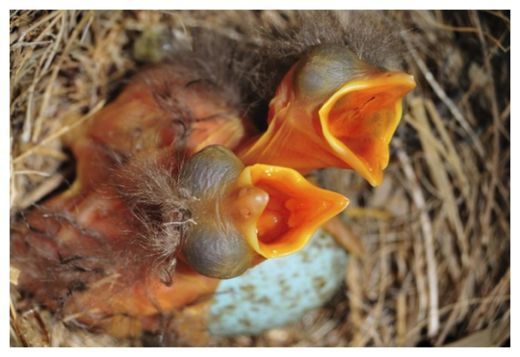
© Photos.com
Although a sparrow and a Tyrannosaurus Rex might appear to have nothing in common, evolutionary biologists see more that relates the two creatures than not. A new study, led by
Harvard scientists, has shown that modern birds are essentially living dinosaurs with skulls that are remarkably similar to those of their juvenile ancestors.
Arkhat Abzhanov, Associate Professor of Organismic and Evolutionary Biology and Bhart-Anjan Bhullar, a PhD student in Abzhanov laboratory and the first author of a paper published this week in
Nature, found evidence that the evolution of birds is the result of a drastic change in how dinosaurs developed.
Sexual maturity in many dinosaurs took many years to reach. Birds, however, sped up the clock, with some species taking as little as 12 weeks to mature, which allows them to retain the physical characteristics of baby dinosaurs.
"What is interesting about this research is the way it illustrates evolution as a developmental phenomenon," Abzhanov said. "By changing the developmental biology in early species, nature has produced the modern bird - an entirely new creature - and one that, with approximately 10,000 species, is today the most successful group of land vertebrates on the planet."
Mark Norell, chair of the Division of Paleontology at the
American Museum of Natural History and one of the paper's co-authors, said, "The evolution of the many characteristics of birds - things like feathers, flight, and wishbones - has traditionally been a difficult problem for biologists. By analyzing fossil evidence from skeletons, eggs, and soft tissue of bird-like dinosaurs and primitive birds, we've learned that birds are living theropod dinosaurs, a group of carnivorous animals that include Velociraptor."
"This new work advances our knowledge by providing a powerful example of how developmental changes played a major role in the origin and evolution of birds."