Science & TechnologyS


Blackbox

May 17 Solar Flare Creates Puzzling High-Energy Particle Pulse on Earth

A moderate solar flare on May 17 lit up ground stations all over the world with an unexpected and puzzling pulse of high-energy particles. It should not have happened, and scientists are now trying to figure out why it did.

Major solar flares, flashes of light at various wavelengths often associated with coronal mass ejections (CMEs) are known to disrupt communications and can even trip power grids on Earth. But the May 17 flare was an M-class event, moderate and relatively common and not expected to create disturbances on the surface of Earth. Yet either the flare or the CME generated a ground-level enhancement (GLE), a blast of high-energy particles that lit up ground stations called neutron monitors on Earth for the first time in nearly six years.

Scientists don't expect an M-class flare to create a GLE.


Info

Ancient Egyptian Calendar Reveals Earliest Record of 'Demon Star'

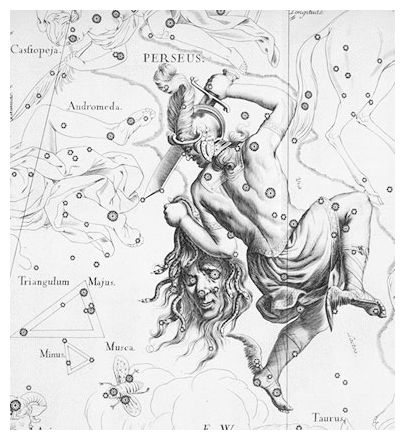
Constellation Perseus
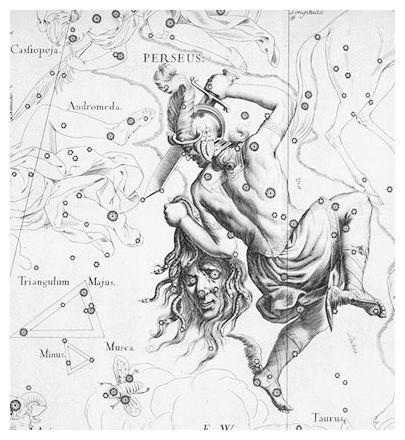
© Public DomainThe Demon Star lies some 93 light-years away in the constellation Perseus as one of the eyes of Medusa's head. (Shown here in Johannes Hevelius' Perseus from Uranographia.)
Ancient Egyptians may have chronicled the flickering of a star known as "the Demon," perhaps the earliest known record of a variable star, astronomers suggest.

The ancient Egyptians wrote calendars that marked lucky and unlucky days. These predictions were based on astronomical and mythological events thought of as influential for everyday life. The best preserved of these calendars is the Cairo Calendar, a papyrus document dating between 1163 and 1271 B.C. The entry for each day is prefaced by three hieroglyphics that indicate either good or bad luck, with the characters often derived from events of mythology.

Astronomers at the University of Helsinki in Finland had previously discovered that some of the fortunate days recurred in a pattern, every 29.6 days. This almost exactly matches the length of the lunar cycle - the time between two full moons. New moons may have been associated with bad luck.

Dimming demon star

The scientists also detected another pattern in the calendar, one that occurred every 2.85 days. Now the researchers suggest this approximately matches regular dimming of Algol, "the Demon Star," which lies approximately 93 light-years away in the constellation Perseus as one of the eyes of Medusa's head. Its name comes from the Arabic phrase, ra's al-ghul, which means "the demon's head."

Algol is the brightest known example of an eclipsing binary system - the large bright member of the system, Beta Persei A, regularly gets eclipsed by the dimmer Beta Persei B. From our point of view, Algol dims by more than a factor of three for 10 hours at a time, dwindling easily seen with the naked eye.

"It seems that the first observation of a variable star was made 3,000 years earlier than was previously thought," said researcher Lauri Jetsu, an astronomer at the University of Helsinki.

The Cairo Calendar describes how Wedjat, the Eye of Horus, regularly transformed from peaceful to raging, with good or bad influences on life. Horus was the patron god of kings in ancient Egypt.

"The eclipse seems to be linked with the lucky days, because it represents the pacification of the Eye of Horus," researcher Sebastian Porceddu, an astronomer and Egyptologist at the University of Helsinki, told LiveScience. "A bright Eye of Horus meant it is raging and a threat to mankind."

Info

Old People Do Smell, But Not That Badly

Old Smell
© Steve Heap | shutterstock People can distinguish the body odor of elderly people, but find it smells less unpleasant than that of younger people, a study indicates.
The distinctive "old person smell" you may have picked up on when visiting your grandparents most likely wasn't your imagination, a new study indicates.

When given whiffs from pieces of pads worn under the armpits of young, middle-aged and elderly people for five consecutive nights, study participants could reliably distinguish the body odor of the elderly, who were 75 and older, the researchers found.

"The results of this study support the cross-culturally popular concept of an 'old person odor,'" writes the international team in a study published today (May 30) in the journal PLoS ONE.

The notion that the elderly have a distinct smell exists in multiple cultures, and usually the odor is said to be unpleasant. But this probably has more to do with negative perceptions of old age, rather than with the odor itself, according to study researcher Johan Lundström, an assistant professor at the Monell Chemical Senses Center in Philadelphia.

In the study, participants rated the smell of the elderly people as less intense and less unpleasant than the body odor of young people (20 to 30 years old) and middle-aged people (45 to 55 years old). This effect was driven by how the participants rated the body odor from men, who appeared to smell the worst and the strongest in middle age. The odor from women of all ages was rated as less intense than men, and closer to neutral smelling for the young and middle-aged.

Bizarro Earth

Earthquakes Off Alaska Pose US Tsunami Risk

Alaska's great earthquakes
© Donna ShillingtonAlaska's great earthquakes.

The risk of a deadly tsunami ravaging the United States is now leading scientists to investigate hazards posed by giant earthquakes off the Alaskan coast.

Scientists are concentrating on the Alaskan-Aleutian subduction zone, where the tectonic plate underlying the Pacific Ocean is diving underneath the continental plate underlying North America.

Tsunamis can be caused by earthquakes, especially large ones, and the second-largest recorded earthquake in history was a magnitude 9.2 at this zone in 1964.

"It concerns us a lot that we might have deadly waves aimed at U.S. shores," said geophysicist David Scholl, an emeritus scientist at the U.S. Geological Survey at Menlo Park, Calif., who discussed the work in Eos, a publication from the American Geophysical Union.

Syringe

Method Turns Embryonic/Induced Pluripotent Stem Cells into Cardiac Muscle Cells

This finding can help researchers model diseases in the lab, and allow these diseases to be studied
Image
© thinkprogress.orgStem Cells

Researchers from the University of Wisconsin-Madison have found a way to turn both embryonic and induced pluripotent stem cells into cardiomyocytes.

Sean Palecek, study leader and professor of chemical and biological engineering at the University of Wisconsin-Madison, along with Timothy Kamp, professor of cardiology at UW School of Medicine and Public Health, and Xiaojun Lian, a UW graduate student, have developed a technique for abundant cardiomyocyte production, which will allow scientists to better understand and treat diseases.

Cardiomyocytes are important cells that make up the beating heart. These cells are extremely difficult to obtain, especially in large quantities, because they only survive for a short period of time when retrieved from the human heart.

Better Earth

Skydiver Planning World Record 120,000-Foot Jump from Space


This summer, Austrian skydiver Felix Baumgartner will attempt to break the world record for the longest jump, plummeting more than 23 miles from the Earth's stratosphere.

"I've done a lot of test jumps, so I'm good," Baumgartner confidently told Fox News before adding that he would "probably say a little prayer" before making the jump that could literally make his blood boil if something goes wrong.

Baumgartner has been preparing with retired Air Force Col. Joe Kittinger, who set the current world record back in 1960 when he made a 102,000-foot jump.

Control Panel

Stuxnet on steroids - 'Flame' Virus : How it works and who's behind it

Flame may be the most powerful computer virus in history, and a nation-state is most likely to blame for unleashing it on the World Wide Web. Kaspersky's chief malware expert Vitaly Kamlyuk shared with RT the ins and outs of Stuxnet on steroids.

Iran appears to be the primary target of the data-snatching virus that has swept through the Middle East, though other countries have also been affected.The sheer complexity of the virus and its targets has led Moscow-based Kaspersky Lab to believe a state is behind the attack.

Kaspersky first spotted the virus in 2010, though it may have been wrecking havoc on computer systems for many years.Vitaly Kamlyuk told RT how his company discovered it, just what makes Flame so significant, features of the virus that could point towards its creator, and why we all lose out in this intensifying cyber-war.

RT:So, how did you spot the malware, was it a planned investigation, or did it come by surprise?

Vitaly Kamlyuk: It was by surprise. We were initially searching for a [different form of] malware. We were aware of the malware that had spread throughout the Middle East, attacked hundreds of computers and wiped their hard drives, making the systems unbootable after that. It was actually after an inquiry from the International Telecommunications Union, which is a part of the United Nations, who actually asked us to start conducting research. When we started looking for this mysterious malware in the Middle East, we discovered this suspicious application that turned out to be even more interesting than the initial target of our search.

RT:According to one of your experts, 'Flame' does not appear to cause physical damage, so why has it been dubbed the most hazardous cyber-attacks in history?

VK: It's actually on the same level as the notoriously known Stuxnet and Duqu [attacks], because we suspect that there is a nation state behind the development of this cyber attack, and there are reasons for that. This application doesn't fit into any of the existing groups of developed cyber attack tools. There are currently three groups. There are traditional cyber criminals who are hunting users' data (like log-ins and passwords) to access bank accounts over the Internet and steal money, send spam, or conduct dubious attacks.This [Flame] doesn't fit into the group of traditional cyber criminal malware. Also, it doesn't fit into the activists' malware who are using typically free and open source tools to attack computers on the Internet. And the third known group [at this time] is nation-states.

Video

World's first 'atomic' movie is stored in vapor

Images on Vapor
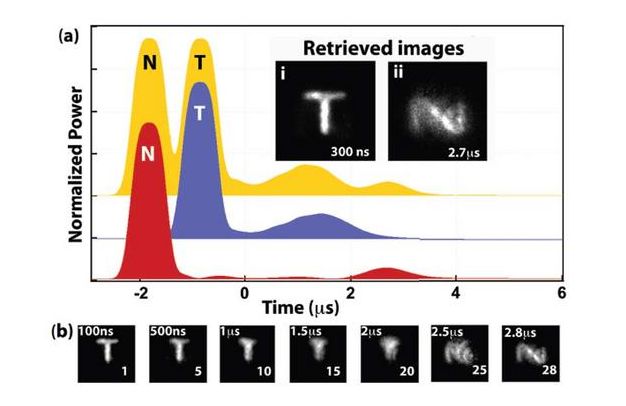
© Quentin Glorieux, Jeremy B. Clark, Alberto M. Marino, Zhifan Zhou, and Paul D. LettImages of the letters N and T were stored and replayed in atomic vapor.
Many people keep favorite Hollywood films or TV shows on solid DVDs or Blu-ray discs, but quantum physicists wanted to go beyond solid storage devices. They stored and replayed two letters of the alphabet in a gaseous atomic vapor - the first time images have ever been reliably stored in a nonsolid medium.

The physicists used lasers and a magnetic field to store the letters "N" and "T" as separate images in a small container filled with rubidium atoms. Then they hit the metaphorical replay button - reversing the magnetic field so that the atomic vapor reemitted the images of the letters as light signals. The very short movie plays with just one millionth of a second between the two images.

"It is very exciting because images and movies are familiar to everyone," said Quentin Glorieux, a physicist at the Joint Quantum Institute of the National Institute of Standards and Technology." We want to go to the quantum level."

The storage achievement goes far beyond a scientific parlor trick. Glorieux and his colleagues hope to harness the storage method for superfast quantum computers that would operate based on the strange, "spooky" behavior of particles at very small scales.

Meteor

New Comet: C/2012 K5 (LINEAR)

Cbet nr. 3127, issued on 2012, May 28, announces the discovery of a new comet (discovery magnitude 18.5) by the LINEAR survey on CCD images taken with the 1.0-m f/2.15 reflector on May 25.3. The new comet has been designated C/2012 K5 (LINEAR).

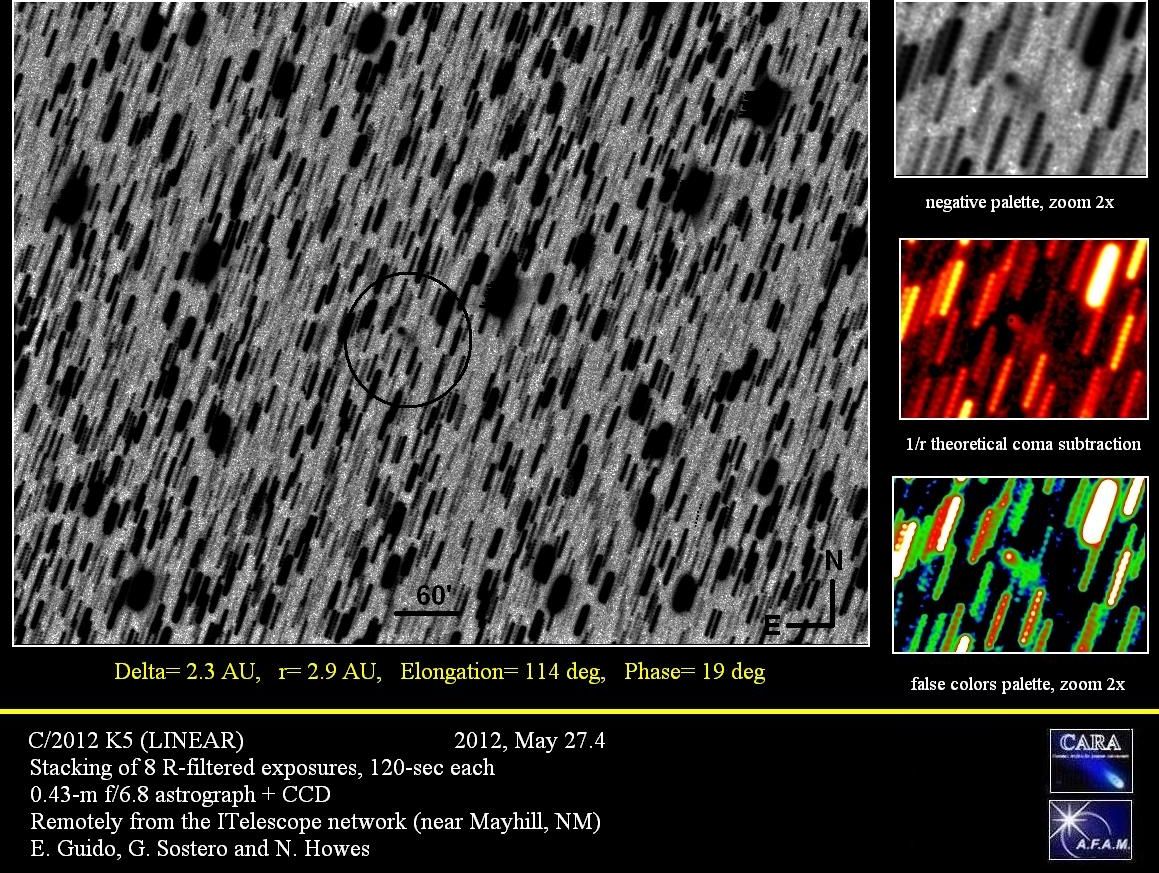
We performed some follow-up measurements of this object, while it was still on the neocp. Stacking of 8 R-filtered exposures, 120-sec each, obtained remotely, from the ITelescope network (near Mayhill, NM) on 2012, May 27.4, with a 0.43-m f/6.8 astrograph + CCD,shows that this object is a comet coma 10" in diameter and a tail nearly 20" long in PA 210 deg.

Our confirmation image (click on the image for a bigger version):
C/2012 K5 (LINEAR)
© Remanzacco Observatory
M.P.E.C. 2012-K69 assigns the following preliminary parabolic orbital elements to comet C/2012 K5: T 2012 Nov. 29.04; e= 1.0; Peri. = 138.80; q = 1.15 AU; Incl.= 92.84

Laptop

SRC and Stanford Enable Chip Pattern Etching for 14nm

Image
© Unknown
In a project sponsored by the Semiconductor Research Corporation (SRC), researchers at Stanford University claim to have solved one of the major semiconductor manufacturing problems standing in the way of further scaling.

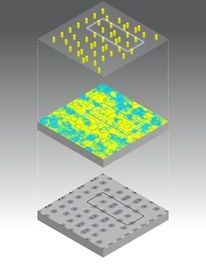
Stanford scientists were able to successfully demonstrate a new directed self-assembly (DSA) process not just for regular test patterns, but for irregular patterns that are required for the manufacture of smaller semiconductors. It was the first time that this next-generation process was used to contact hole patterns at 22 nm, but the scientists claim that the technique will enable pattern etching for next-generation chips down to 14 nm.

"This is the first time that the critical contact holes have been placed with DSA for standard cell libraries of VLSI chips. The result is a composed pattern of real circuits, not just test structures," said Philip Wong, the lead researcher at Stanford for the SRC-guided research. "This irregular solution for DSA also allows you to heal imperfections in the pattern and maintain higher resolution and finer features on the wafer than by any other viable alternative."

The research group also noted that the process is much more environmentally-friendly as a "healthier" solvent - polyethylene glycol monomethyl ether acetate (PGMEA) - is used for the coating and etching process.

Leveraging the new DSA process, the researchers manufactured chips by covering a wafer surface with a block copolymer film and using "common" lithographic techniques to carve structures into the wafer surface and create a pattern of irregularly placed "indentations." These indentations are used to as templates "to guide movement of molecules of the block copolymer into self-assembled configurations." According to the researchers, these templates can be modified in their shape and size, which enables distance between holes to be reduced more than current techniques allow.