Science & TechnologyS


Telescope

First evidence discovered of planet's destruction by its star

Penn State
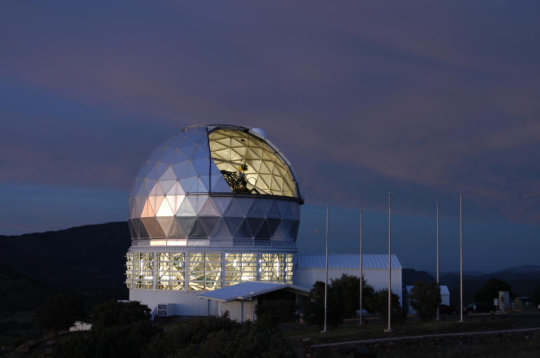
© Marty Harris/McDonald Obs./UT-AustinThe first evidence of a planet's destruction by its aging star indicates that the missing planet was devoured as the star began expanding into a "red giant" — the stellar equivalent of advanced age. "A similar fate may await the inner planets in our solar system, when the Sun becomes a red giant and expands all the way out to Earth's orbit some five-billion years from now," said Alexander Wolszczan, Evan Pugh Professor of Astronomy and Astrophysics at Penn State and the discoverer of the first planet ever found outside our solar system.
The first evidence of a planet's destruction by its aging star has been discovered by an international team of astronomers. The evidence indicates that the missing planet was devoured as the star began expanding into a "red giant" -- the stellar equivalent of advanced age.

"A similar fate may await the inner planets in our solar system, when the Sun becomes a red giant and expands all the way out to Earth's orbit some five-billion years from now," said Alex Wolszczan, an Evan Pugh Professor of Astronomy and Astrophysics at Penn State University, who is one of the members of the research team. Wolszczan also is the discoverer of the first planet ever found outside our solar system.

The astronomers also discovered a massive planet in a surprisingly elliptical orbit around the same red-giant star, named BD+48 740, which is older than the Sun with a radius about eleven times bigger. Wolszczan and the team's other members, Monika Adamow, Grzegorz Nowak, and Andrzej Niedzielski of Nicolaus Copernicus University in Torun, Poland; and Eva Villaver of the Universidad Autonoma de Madrid in Spain, detected evidence of the missing planet's destruction while they were using the Hobby-Eberly Telescope to study the aging star and to search for planets around it. The evidence includes the star's peculiar chemical composition, plus the highly unusual elliptical orbit of its surviving planet.

Info

Quakes Beneath Antarctic Glacier Linked to Ocean Tides

Antarctica
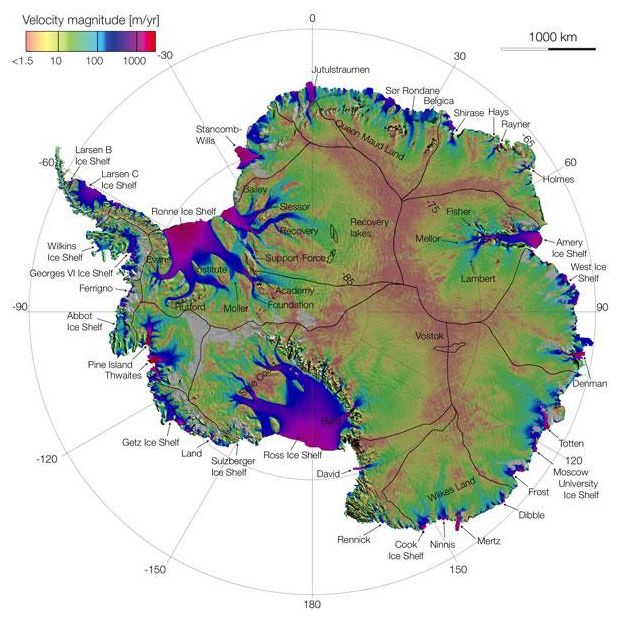
© NASA/JPL-Caltech/UCIAntarctic ice flow speeds derived from satellite data.
Thousands of earthquakes occurring in rapid succession in less than a year under an Antarctic glacier may have been linked to ocean tides, new research suggests.

Scientists investigated seismic activity under David Glacier, a large glacier in East Antarctica about 270 square miles (700 square kilometers) in size. The glacier serves as the outlet from which ice from 4 percent of that region's ice sheet drains out toward the sea.

To learn more about the foundations and behavior of this glacier, the researchers analyzed seismic data gathered from there over a nine-month period between 2002 and 2003 by the Transantarctic Mountains Seismic Experiment array of 42 seismometers. They identified about 20,000 seismic events during this period that were stronger and lasted longer than the shaking typically seen with glaciers.

"The fact these events exist is fairly surprising," researcher Lucas Zoet, a glaciologist at Pennsylvania State University, told OurAmazingPlanet. "This type of seismic behavior had not been observed before in Antarctic outlet glaciers, so one main challenge was just to categorize it initially."

The earthquakes also perplexingly occurred at regular intervals about 25 minutes apart.

Eye 1

Big Brother Airport-style screening considered for UK train and tube stations

X-ray machine
© Andy HallSuitcases going through the X-ray machine at Terminal 5 at Heathrow Airport.
Fresh consideration is to be given to the introduction of airport-style mass security screening at mainline rail stations and across London's tube network.

The Home Office has launched a search for new and emerging technologies that are capable of rapidly screening huge numbers of passengers and which could be used in major train and tube stations and across the tube network.

The new rail and tube screening technology is to be used to detect explosives, guns and knives, being carried by people and in bags, but would also need a capacity to spot chemical and biological materials. The screening equipment needs to be able to scan wheelchairs, prosthetics, crutches, pushchairs and bikes as well as people and their luggage.

Comment: Security Industrial complex in need of fresh profits after the London Olympics bonanza and the PTB to continue the encroaching levels of surveillance, control and invasion of privacy. Expect a round of bomb-on-train terror scares to get things moving...


Question

Unexplained Solar Wind Heating Possibly Caused By Magnetic Turbulence

Sun
© andrey_l / Shutterstock
Magnetic turbulence is most likely the reason that solar wind moving away from our sun and our solar system is hotter than it theoretically should be, according to new research from scientists at the University of Warwick.

As solar wind leaves the sun and expands beyond the solar system, it should begin to cool off due to the lack of particle collisions to dissipate energy, the university explained in a Friday press release. That isn't actually the case, though, as the solar wind is actually hotter than experts believe it should be, and that phenomenon has stumped researchers for years.

In a pair of papers recently published in the journal Physical Review Letters, physicist and lead author Dr. Kareem Osman believes that he has uncovered the answer to the conundrum: magnetic turbulence, which is found in stars, stellar winds, galaxies, and other cosmic entities throughout the universe. Understanding this turbulence is vital to interpreting astrophysical observations, the institute explained, and the solar wind and near-Earth environment offered them an opportunity to examine the relationship between them.

"The solar wind is much hotter than would be expected if it were just expanding outward from the Sun. Turbulence is the likely source of this heating," the university said. "For neutral fluids such as fast flowing water, energy dissipation occurs through many microscopic collisions.

As is the case for many astrophysical plasmas, the near-Earth solar wind is thin and spread out, which means collisions between particles are rare to the point that the plasma is considered collisionless. A major outstanding problem is how, in the absence of those collisions, does plasma turbulence move energy to small scales to heat the solar wind."

2 + 2 = 4

How A Unit Inside a Protein Expands the Human Brain

Microscopic molecule within protein holds the key to why our brains are so big.

A minute particle within a protein allowed humans to become the most intelligent creatures on the planet, say scientists.

It holds the key to understanding why our brains are so much bigger and more complex than any other animal, according to new research.

It may also explain how its unequalled mental capacity evolved so rapidly and dramatically, a mystery that has baffled researchers for decades.

Arrow Up

Genetically Engineered Babies Are Our Moral Obligation, Argues Professor Julian Savulescu

Unborn
© Photos.com
In a recent Reader's Digest article, an Oxford University professor, philosopher, and bioethicist reports that he believes parents have a "moral obligation" to genetically engineer their babies to make sure that they become better people.

In the article, Julian Savulescu, who is also the director of the Uehiro Centre for Practical Ethics and the editor of the Journal of Medical Ethics, said that "screening out personality flaws, such as potential alcoholism, psychopathy and disposition to violence" in fetuses would improve the quality of society, the Huffington Post reported on Thursday.

Furthermore, Savulescu argued that parents should be given the option to screen out potential personality flaws in their children in order to make them less likely to "harm themselves and others," and that screening embryos and manipulating specific genes could result in a smarter, wiser, less aggressive and less violent society, Richard Alleyne of the Telegraph added.

Alleyne said Savulescu believes that advances in science make it easier and more likely to influence an unborn child's personality, altering DNA and genetic markers in order to enhance positive traits and eliminate negative ones.

Chalkboard

Hot Solar Wind: Magnetic Turbulence Trumps Collisions to Heat Solar Wind

Image
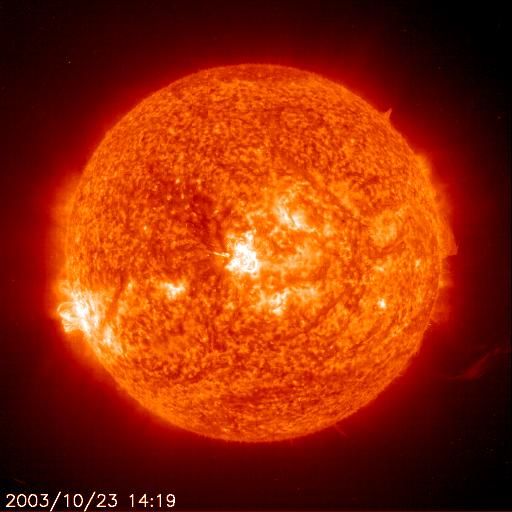
© ESA/NASA/SOHOThe sun. New research has provided significant insight into how the solar wind heats up when it should not.
New research, led by University of Warwick physicist Dr Kareem Osman, has provided significant insight into how the solar wind heats up when it should not. The solar wind rushes outwards from the raging inferno that is our Sun, but from then on the wind should only get cooler as it expands beyond our solar system since there are no particle collisions to dissipate energy. However, the solar wind is surprisingly hotter than it should be, which has puzzled scientists for decades. Two new research papers led by Dr Osman may have solved that puzzle.

Turbulence pervades the universe, being found in stars, stellar winds, accretion disks, galaxies, and even the material between galaxies. It also plays a critical role in the evolution of many laboratory plasmas, causing diminished confinement times in fusion devices. Therefore, understanding plasma turbulence is essential to the interpretation of a large body of laboratory, space, and astrophysical observations. The solar wind and near-Earth environment provide an excellent laboratory for the study of turbulence, and are the only in-situ accessible astrophysical plasmas.

Pills

Mice Mojo to Lead to Male Birth Control Pill

sperm
© perinatal-nk.ru
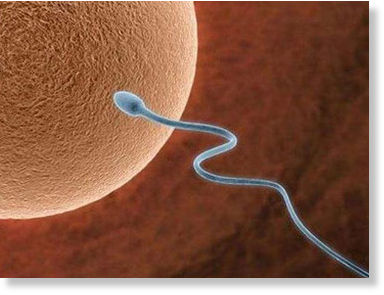
A male contraceptive pill could be on the horizon, as a new scientific study reveals a compound capable of blocking sperm production in mice which could one day be used by humans.

Scientists from the Dana-Farber Cancer Institute and Baylor College of Medicine have discovered a tiny molecule that yields a quick yet perfectly reversible decrease in sperm count in rodents.

The beacon of gender equality, the compound, known as JQ1, infiltrates male testes cells and temporarily made the mice in the experiment infertile as the dose produced fewer and less mobile sperm. The result is non-hormonal birth control; furthermore the effects of it can be reversed or stopped anytime. "Within one to two months [after discontinuing the drug], there was complete restoration in testicular size, sperm number, sperm motility and - importantly - fertility," Dr. James Bradner, an author on the study told the Huffington Post. "The litter size was normal, and there were no obvious, adverse symptoms in these animals," he added.

Dana Farber researchers originally created the JQ1 as a means to block out cancer causing genes, but the results from the initial testing made them seek advice from contraceptive specialists at Baylor to see if the mice formula could be repeated in men. In the new study, published in the Cell journal, researchers showed how JQ1 effectively penetrated the blood-testis boundary in mice, preventing sperm from maturing.

Play

Quantum Teleportation Achieved over Record Distances

Image
© ESAThe European Space Agency's Optical Ground Station on Tenerife in the Canary Islands was used as a receiver in recent quantum teleportation experiments.
Two teams of researchers have extended the reach of quantum teleportation to unprecedented lengths, roughly equivalent to the distance between New York City and Philadelphia. But don't expect teleportation stations to replace airports or train terminals - the teleportation scheme shifts only the quantum state of a single photon. And although part of the transfer happens instantaneously, the steps required to read out the teleported quantum state ensure that no information can be communicated faster than the speed of light.

Quantum teleportation relies on the phenomenon of entanglement, through which quantum particles share a fragile, invisible link across space. Two entangled photons, for instance, can have correlated, opposite polarization states - if one photon is vertically polarized, for instance, the other must be horizontally polarized. But, thanks to the intricacies of quantum mechanics, each photon's specific polarization remains undecided until one of them is measured. At that instant the other photon's polarization snaps into its opposing orientation, even if many kilometers have come between the entangled pair.

An entangled photon pair serves as the intermediary in the standard teleportation scheme. Say Alice wants to teleport the quantum state of a photon to Bob. First she takes one member of a pair of entangled photons, and Bob takes the other. Then Alice lets her entangled photon interfere with the photon to be teleported and performs a polarization measurement whose outcome depends on the quantum state of both of her particles.

Meteor

See Rare Cluster of Comets Across the Solar System This Week: How to Watch Online

A rare cluster of comets is making its way through our solar system this week, but you don't need a telescope to spot the icy celestial wanderers. An online telescope will stream live views of the comets in a webcast today (Aug. 17). The Internet-based Slooh Space Camera, which offers views of the night sky from observatories around the world, will target more than six different comets today during a free webcast at 6 p.m. EDT (2200 GGMT).

The webcast feature views from telescopes at the Canary Islands Observatory off the west coast of Africa during today's comet program, which will include commentary from Slooh officials and amateur astronomer Donald Machholz - the discoverer of no less than 11 comets. The webcast can be accessed at the Slooh website here.

Image
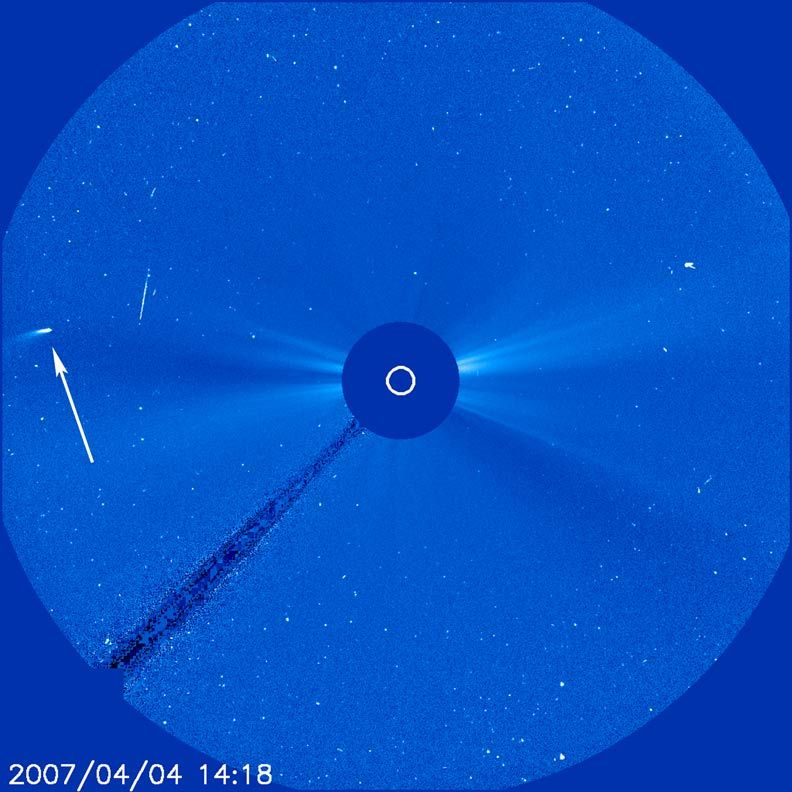
© NASA/SOHOThis view of comet Machholz was recorded by the SOHO space telescope in 2007. Comet Machholz was discovered in 1986 by amateur astronomer and comet-hunter Donald Machholz. It orbits the sun in just over five years.