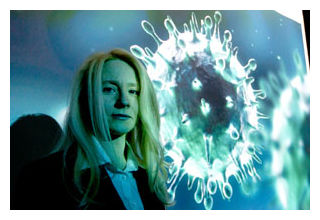
© Norbert von der GroebenMilana Trounce offers a course called Biosecurity and Bioterrorism Response, which aims to get students thinking about how to prevent bioterror and, in the event of a biological attack, what to do about it.
What if nuclear bombs could reproduce? Get your hands on one today, and in a week's time you've got a few dozen.
Of course, nukes don't double on their own. But contagious, one-celled pathogens do. Properly packaged as a bioweapon, they could kill as many people as a hydrogen bomb would, or more.
Milana Trounce, MD, a clinical associate professor of emergency medicine, wants to get people to worry about this possibility. For the fourth year in a row, she is presiding over a course called Biosecurity and Bioterrorism Response, which aims to get students thinking about how to prevent bioterror and, in the event of a biological attack, what to do about it. More than 100 Stanford undergraduate, graduate, postdoctoral and professional students, representing disciplines ranging from public policy to biological science to engineering and bioengineering, have enrolled.
The course, which Trounce considers more of a forum or workshop, brings students together with guest lecturers from Stanford and other universities, as well as with biotech-company executives, think-tank denizens and current and former public-health and other government officials.
"I'm hoping to continue to grow this forum to figure out real-world solutions," she said.
Authorities on bioterrorism and biosecurity say that more thinking about how to handle this threat is desperately needed.
Steven Block, PhD, professor of biological sciences and of applied physics at Stanford, is a member of a scientific advisory group that meets several times a year to report to the federal government on national-security issues, including bioterrorism. "The advent of modern molecular genetic technologies is making it increasingly feasible to engineer bioweapons," said Block, who is also the Stanford W. Ascherman Professor of Sciences and a guest lecturer in Trounce's class. "It's making people with even moderate skills able to create threats they couldn't before."
A natural anthrax strain mailed to public officials in a series of homegrown terrorist incidents in late 2001 - while deadly - was treatable, Block said.
But the technology for making drug-resistant anthrax - or, for that matter, creating all manner of novel "designer diseases" - is becoming increasingly available worldwide, not to mention cheaper and more sophisticated.Trounce agrees. "We are undergoing a biotechnology revolution," she said. "Even in the last 10 years, science has advanced so much that you can engineer some of the scariest organisms, for example smallpox."
In laboratory experiments, scientists have mutated H5N1 - a deadly influenza strain that so far has been transmitted to humans only by birds - to become transmissible by other humans. They have synthesized the Spanish flu virus, a naturally occurring strain that swept the globe in a 1918 pandemic, killing far more people than died in all the battles of World War I. What if any of those were to get out of the lab?
"Unfortunately, it's a real possibility, because with advances in technology it's now much easier to create these weapons than ever before," Trounce said. "
A few people with modern resources can create a bioweapon. This is something we don't typically think about."





















Comment: Crowding out other internet providers is not the only issue with internet domination by Google. The company has been accused of being highly selective in its search results, vacuuming up huge amounts of personal data from individuals, and of turning over data to the NSA.
The Disappeared: SOTT.net and Google's conspicuous omissions
Google shuts down millions of websites
Q&A: Google to Dig Deeper into Users' Lives
Google faces legal action over alleged secret iPhone tracking
Google Comes Under Fire for 'Secret' Relationship with NSA