
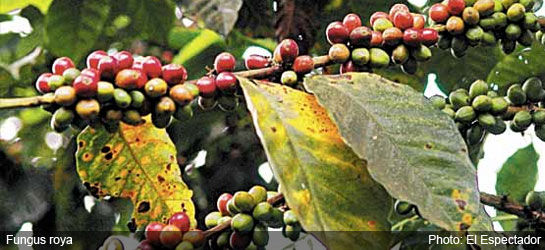
© colombiareports.coCoffee industry's foe: leaf rust
Leaf rust, or la roya in Spanish, is a yellow- and orange-colored, plant-choking fungus that has devastated coffee crops from Peru to Mexico over the past three years, costing $1 billion in damages in Central America in the late harvest season of 2012 alone. The fungus is especially ruinous to the Arabica bean, which is used in higher-end coffees, as it is said to produce better-tasting coffee than the other major commercially grown coffee species. It contains less caffeine but a more robust flavor. Arabica accounts for 75 to 80 percent of the world's coffee production, according to the Coffee Research Institute.
The effects of leaf rust have decimated local economies.
"Big farmers hire fewer workers to pick the ripe coffee cherries that enclose the beans. Smaller farmers go into debt and sell livestock or tools to make up for the lost income. Sales fall at local merchants," the New York Times reported. "Teenagers leave school to work on the farm because their parents can no longer hire outside help. At the very end of the chain are the landless migrant workers who earn just a few dollars a day."Central America has been particularly hard hit. Four million people there and in southern Mexico rely on coffee for their living, according to the Inter-American Development Bank. In Guatemala, twenty percent of the half-million jobs directly tied to growing coffee have already disappeared, estimated Nils Leporowski, the president of Anacafé, the country's coffee board.













Comment: In Colombia, unusual rainy weather in 2008 fueled an outbreak of rust that later grew into an epidemic. If roya is detected on more than half of a tree's leaves, the tree has to be cut off at the stump and will not produce beans for three years. The rust is a microorganism that must take energy and nutrients from a specific live host and thereby produces thousands of tiny spores that can travel in water, rain, or air and remain viable for long distances. Coffee rust must find a coffee host in order to complete its cycle. The rust pathogen impacts photosynthesis which provides energy to the plant for food production. Currently there are over 45 varieties of coffee rust. The shift to a high density monoculture and lagging research has aided this problem and, so far, is attempting to be cured primarily by metallic fungicides, limited in capacity and detrimental to the environment. Are we surprised?