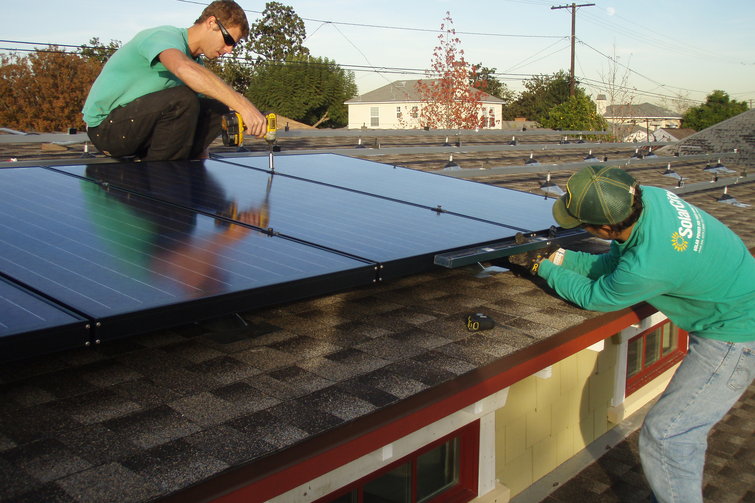
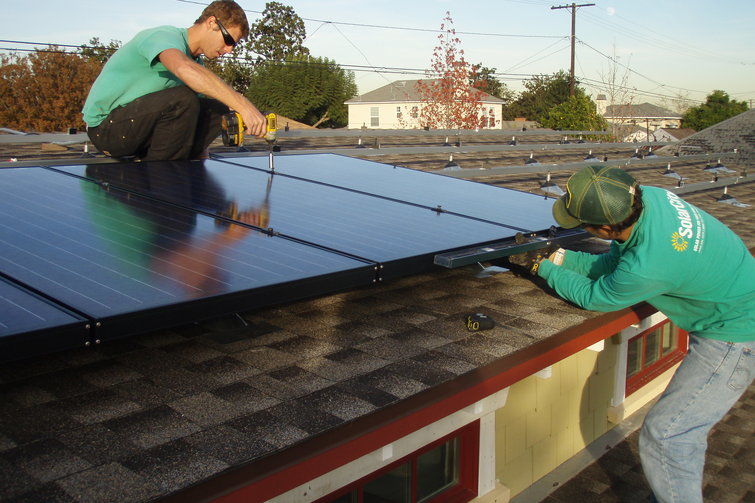
© Steve & Michelle Gerdes/FlickrWorkers with solar city install rooftop panels in California.
If you ask the people who run America's electric utilities what keeps them up at night, a surprising number will say solar power. Specifically, rooftop solar.
That seems bizarre at first. Solar power provides
just 0.4 percent of electricity in the United States - a minuscule amount. Why would anyone care?
But utilities see things differently. As solar technology gets
dramatically cheaper, tens of thousands of Americans are putting photovoltaic panels up on their roofs, generating their own power. At the same time, 43 states and Washington DC have
"net metering" laws that allow solar-powered households to sell their excess electricity
back to the grid at retail prices.
That's a genuine problem for utilities. All these solar households are now buying less and less electricity, but the utilities still have to manage the costs of connecting them to the grid. Indeed,
a new study from Lawrence Berkeley National Laboratory argues that, without policy changes, this trend could soon put utilities in dire financial straits. If rooftop solar were to grab 10 percent of the market over the next decade, utility earnings could decline as much as 41 percent.
To avoid that fate, many utilities
are now pushing for reforms that would at least slow the breakneck growth of rooftop solar - say, by scaling back those "net metering" laws. And that's opened up a war with many fronts. There are solar advocates who'd prefer not to see any changes. There are conservative groups like the American Legislative Exchange Council (ALEC) pushing to pare back solar subsidies. And there are even Tea Party groups now defending solar. Meanwhile, state regulators are struggling to find compromises that would both allow solar to expand but also ensure that there's enough money to maintain the existing grid.
Battles over solar are now raging in more than a dozen states - from
Arizona to
Utah to
Wisconsin to
Georgia. (They're also
flaring up abroad, in countries like Germany and Australia). And the debate raises some legitimately hard questions about how best to deal with a new energy technology. Here's a broad overview:



















Comment: If our society was not ruled by a group of psychopaths, the natural creative and cooperative abilities of humans would be able to progress to the point where cities could develop in ways that would facilitate society's general health and well-being. Until the problem of psychopathy is understood by more people and steps are taken to counteract their influence, things will continue to deteriorate, and nature will take balancing steps.