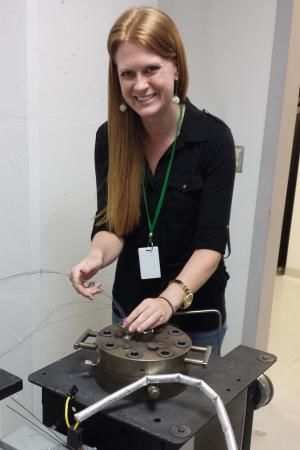
© NASAErika Kohler places thermocouples into a pressure chamber at NASA's Goddard Space Flight Center. The thermocouples measure the temperature of the chamber to ensure it reaches Venusian temperatures.
Kohler, a doctoral candidate in the Arkansas Center for Space and Planetary Sciences at the University of Arkansas, returned to campus last month after a summer-long fellowship at NASA's Goddard Space Flight Center in Maryland, where she performed experiments in the facility's pressure chamber to simulate Venusian conditions.
"My dissertation is focusing on metal condensates in planetary atmospheres," said Kohler, who is the only student in the Space and Planetary Sciences Center currently researching Venus. "I have been primarily looking at the stability of materials on Venus and determining what can exist at certain altitudes. I'm finding that there are different forms of iron compounds or mercury compounds that can exist at these conditions."
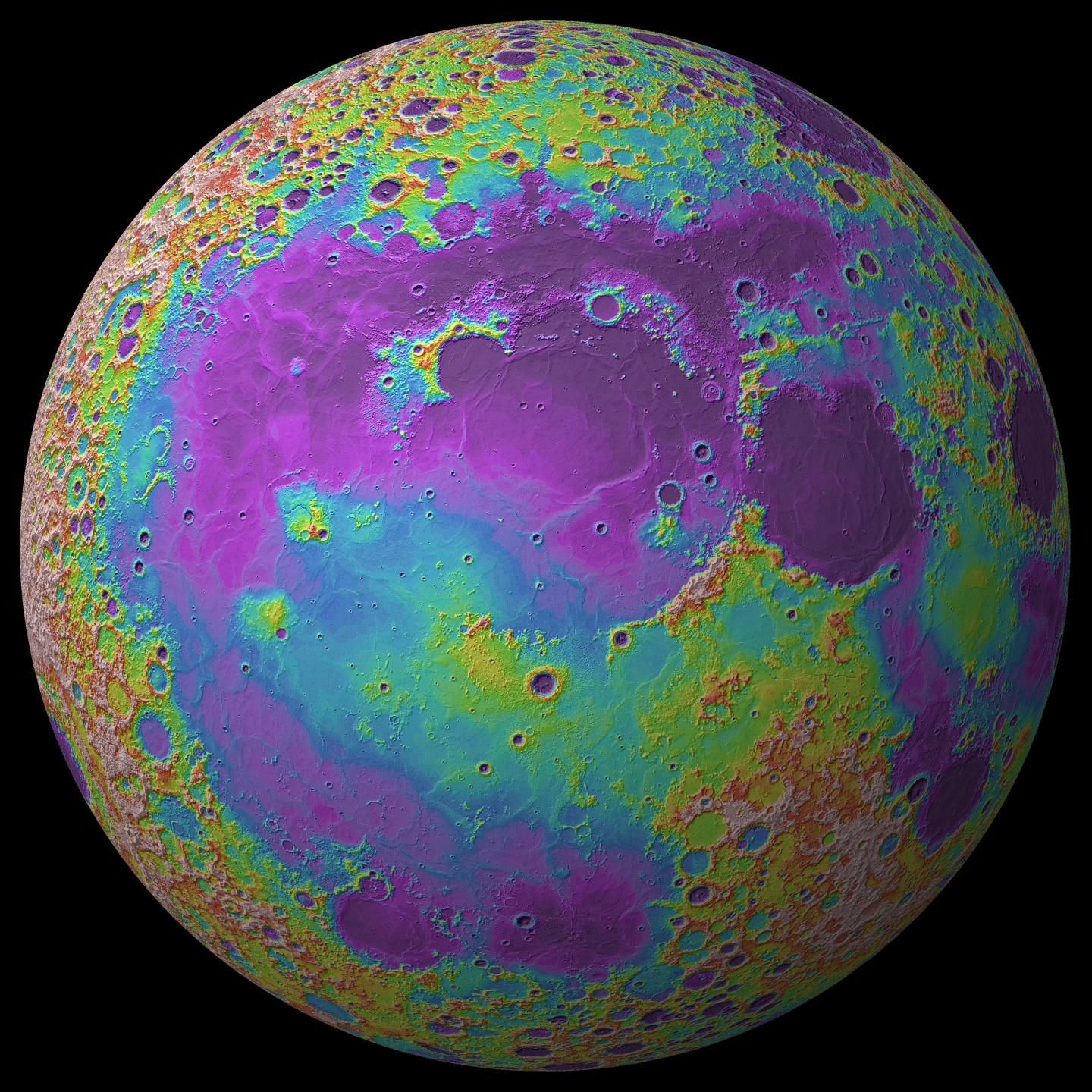
Venus, the second planet from the sun, is both the closest planet to Earth and the planet closest in size to Earth. But the conditions on the planet are radically different than ours. The average daily temperature is 860 degrees Fahrenheit, for instance. And the atmosphere is so dense that there are only a handful of actual photographs of the Venusian surface; most images of Venus are created through radar imaging.