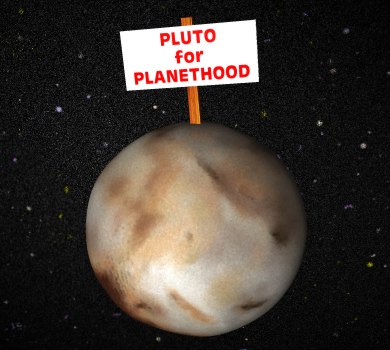
© www.fromquarkstoquasars.comUp for debate...again.
What is a planet? For generations of kids the answer was easy. A big ball of rock or gas that orbited our Sun, and there were nine of them in our solar system. But then astronomers started finding more Pluto-sized objects orbiting beyond Neptune. Then they found Jupiter-sized objects circling distant stars, first by the handful and then by the hundreds. Suddenly the answer wasn't so easy. Were all these newfound things planets?
Since the International Astronomical Union (IAU) is in charge of naming these newly discovered worlds, they tackled the question at their 2006 meeting. They tried to come up with a definition of a planet that everyone could agree on. But the astronomers couldn't agree. In the end, they voted and picked a definition that they thought would work.
The current, official definition says that a planet is a celestial body that:
- is in orbit around the Sun,
- is round or nearly round, and
- has "cleared the neighborhood" around its orbit.
But this definition baffled the public and classrooms around the country. For one thing,
it only applied to planets in our solar system. What about all those exoplanets orbiting other stars? Are they planets? And Pluto was booted from the planet club and called a
dwarf planet. Is a dwarf planet a small planet? Not according to the IAU. Even though a dwarf fruit tree is still a small fruit tree, and a dwarf hamster is still a small hamster.
Eight years later, the Harvard-Smithsonian Center for Astrophysics decided to revisit the question of "what is a planet?" On September 18th, we hosted a debate among three leading experts in planetary science, each of whom presented their case as to what a planet is or isn't. The goal: to find a definition that the eager public audience could agree on!
Comment: After the IAU decision to downgrade Pluto by four percent of its members, most of whom are not planetary scientists, it was immediately opposed in a formal petition by hundreds of professional astronomers. Part of the issue is that the term "minor planet" is a synonym for asteroids and comets, bodies too small to be rounded by gravity. Regardless of its size, Pluto still meets much of the planetary "criteria." The recent feel-good vote was not official nor binding.
As the bumpersticker says:
Honk if Pluto is still a planet...
The video of the debate and audience vote can be seen on YouTube at
https://www.youtube.com/user/ObsNights.

















Comment: After the IAU decision to downgrade Pluto by four percent of its members, most of whom are not planetary scientists, it was immediately opposed in a formal petition by hundreds of professional astronomers. Part of the issue is that the term "minor planet" is a synonym for asteroids and comets, bodies too small to be rounded by gravity. Regardless of its size, Pluto still meets much of the planetary "criteria." The recent feel-good vote was not official nor binding.
As the bumpersticker says: Honk if Pluto is still a planet...
The video of the debate and audience vote can be seen on YouTube at https://www.youtube.com/user/ObsNights.