
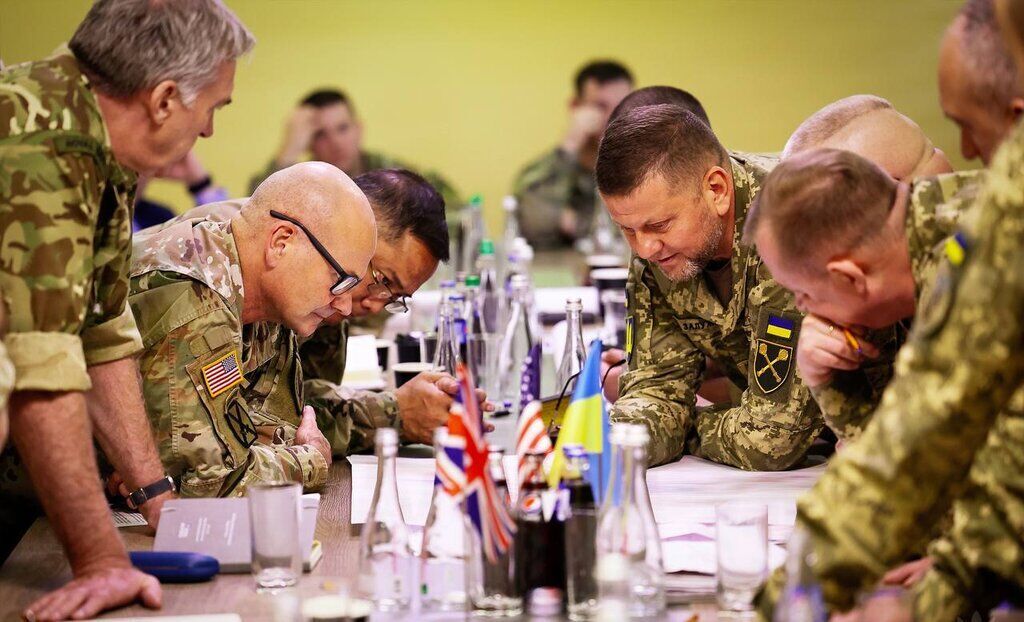
Ukrainian, American and British military leaders during a meeting in Ukraine in August 2023. Valerii Zaluzhnyi is seen on the right.
On a spring morning two months after Vladimir Putin's invading armies marched into Ukraine, a convoy of unmarked cars slid up to a Kyiv street corner and collected two middle-aged men in civilian clothes.
Leaving the city, the convoy — manned by British commandos, out of uniform but heavily armed — traveled 400 miles west to the Polish border. The crossing was seamless, on diplomatic passports. Farther on, they came to the Rzeszów-Jasionka Airport, where an idling C-130 cargo plane waited.
The passengers were top Ukrainian generals. Their destination was Clay Kaserne, the headquarters of U.S. Army Europe and Africa in Wiesbaden, Germany. Their mission was to help forge what would become one of the most closely guarded secrets of the war in Ukraine.
One of the men, Lt. Gen. Mykhaylo Zabrodskyi, remembers being led up a flight of stairs to a walkway overlooking the cavernous main hall of the garrison's Tony Bass Auditorium. Before the war, it had been a gym, used for all-hands meetings, Army band performances and Cub Scout pinewood derbies. Now General Zabrodskyi peered down on officers from coalition nations, in a warren of makeshift cubicles, organizing the first Western shipments to Ukraine of M777 artillery batteries and 155-millimeter shells.
Then he was ushered into the office of Lt. Gen. Christopher T. Donahue, commander of the 18th Airborne Corps, who proposed a partnership.
Its evolution and inner workings visible to only a small circle of American and allied officials, that partnership of intelligence, strategy, planning and technology would become the secret weapon in what the Biden administration framed as its effort to both rescue Ukraine and protect the threatened post-World War II order.
How the promise of Texas barbecue led to a meeting with a key Ukrainian general.
Today that order — along with Ukraine's defense of its land — teeters on a knife edge, as President Trump seeks rapprochement with Mr. Putin and vows to bring the war to a close. For the Ukrainians, the auguries are not encouraging. In the great-power contest for security and influence after the Soviet Union's collapse, a newly independent Ukraine became the nation in the middle, its Westward lean increasingly feared by Moscow. Now, with negotiations beginning, the American president has baselessly blamed the Ukrainians for starting the war, pressured them to forfeit much of their mineral wealth and asked the Ukrainians to agree to a cease-fire without a promise of concrete American security guarantees — a peace with no certainty of continued peace.
Mr. Trump has already begun to wind down elements of the partnership sealed in Wiesbaden that day in the spring of 2022. Yet to trace its history is to better understand how the Ukrainians were able to survive across three long years of war, in the face of a far larger, far more powerful enemy. It is also to see, through a secret keyhole, how the war came to today's precarious place.
With remarkable transparency, the Pentagon has offered a public inventory of the $66.5 billion array of weaponry supplied to Ukraine — including, at last count, more than a half-billion rounds of small-arms ammunition and grenades, 10,000 Javelin antiarmor weapons, 3,000 Stinger antiaircraft systems, 272 howitzers, 76 tanks, 40 High Mobility Artillery Rocket Systems, 20 Mi-17 helicopters and three Patriot air defense batteries.
But a New York Times investigation reveals that America was woven into the war far more intimately and broadly than previously understood. At critical moments, the partnership was the backbone of Ukrainian military operations that, by U.S. counts, have killed or wounded more than 700,000 Russian soldiers. (Ukraine has put its casualty toll at 435,000.) Side by side in Wiesbaden's mission command center, American and Ukrainian officers planned Kyiv's counteroffensives. A vast American intelligence-collection effort both guided big-picture battle strategy and funneled precise targeting information down to Ukrainian soldiers in the field.
One European intelligence chief recalled being taken aback to learn how deeply enmeshed his N.A.T.O. counterparts had become in Ukrainian operations. "They are part of the kill chain now," he said.
The partnership's guiding idea was that this close cooperation might allow the Ukrainians to accomplish the unlikeliest of feats — to deliver the invading Russians a crushing blow. And in strike after successful strike in the first chapters of the war — enabled by Ukrainian bravery and dexterity but also Russian incompetence — that underdog ambition increasingly seemed within reach.
Read the rest of this long story here

Mind you, that article was written almost two years after the much touted 2023 spring offensive, planned by "competent" Nato CENTCOM officers, that killed almost 100.000 Ukrainian soldiers while achieving nothing.
As Sun Tzu wrote "If you neither know yourself nor the enemy, you will lose every battle."