
Swaths of Siberia have slipped back toward winter.
On May 22, frost warnings stretched across a broad belt of Russia, from Omsk and Novosibirsk to Kemerovo, Altai Krai and Orenburg. Overnight lows were expected to fall to -5C (23F), cold enough to threaten early crops, gardens and spring vegetation.
In Kemerovo Oblast, the cold has been biting for days. Local stations fell to around -4C (24.8F), with daytime temperatures stuck near 4C (39.2F). Snow fell in Kemerovo. Roads in Kuzbass were covered. Visibility deteriorated.
The cold also spread into the mountains and republics farther east.
Tuva faced wet snow, thunderstorms, hail and damaging winds. Buryatia was hit by mountain wet snow and a temperature drop of at least 10C. Around Irkutsk and Lake Baikal, snow remained in the higher terrain, with more frosts expected through to May 25, at least.
Heating systems have been turned back on in Siberian communities, according to local reports.
U.S. Cold Pool Holds Into Late May
A broad cold pool has gripped much of the United States for the past week.
On May 21 into 22, it stretched from the Rockies through the Plains, Great Lakes, Appalachians and Northeast.
The cold was not confined to the mountains or the far north. Topeka reached only 66F (18.9C) on Thursday, around 12F below normal.
Michigan is under frost and freeze headlines, including parts of the northern Lower Peninsula.
Western New York joined the frost zone, with advisories for Allegany, Jefferson and Lewis counties. Across Vermont and the Adirondacks, freeze warnings were issued, with lows cold enough to damage early-season crops.
Pennsylvania carried the cold into the daytime. NWS State College described the setup as "downright dreary/raw, unseasonably chilly and pretty miserable for this time of year," with rain, cloud and easterly flow locking in the chill.
The Rockies added the wintry edge, with wet snow continuing for parts of the range May 22.
![GFS 2m Temperature Anomalies for May 22 [tropicaltidbits.com]](/image/s37/745022/full/a048a83b_9b3b_4971_a0ad_1ebf13.jpg "Click to enlarge")
GFS 2m Temperature Anomalies for May 22 [tropicaltidbits.com]
For early May 22, SMN/Conagua reported -5C (23F) in the mountains of Durango and Chihuahua, with 0C (32F) in high terrain of Baja California, Sonora, Puebla and Estado de México — stark anomalies for the time of year.
Antarctica Below -100F
It has been chilly on the Antarctic Plateau.
On May 20, the South Pole fell to -68.9C (-92F), its lowest reading of the season so far. Vostok dropped even lower, reaching -72.7C (-98.9F). A day later, Concordia dipped to -74.3C (-101.7F).
For reference, the South Pole's winter mean is listed near -60C (-76F), Vostok's May average is around -65.8C (-86.4F), putting the May 20 reading almost 7C below. Concordia's typical May minimum is around -68.7C (-91.7F).
Antarctica remains an enormous, poorly behaved, violently cold continent that refuses to fit neatly into the cartoon narrative.
The CO2 Effect Shrinks As CO2 Rises
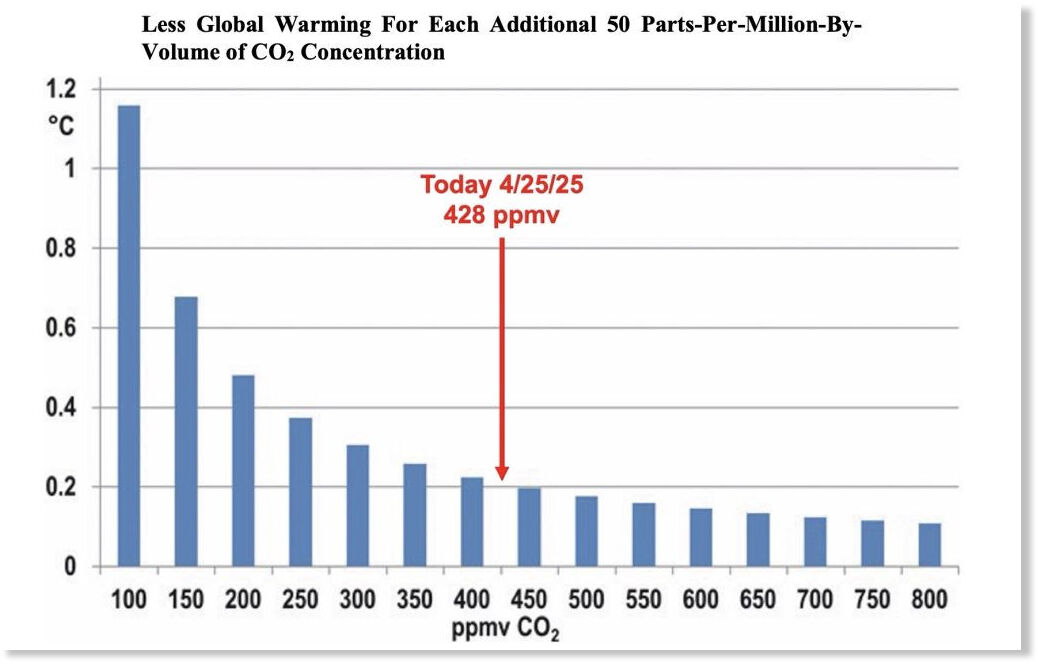
The direct warming effect of CO2 is limited and logarithmic. Each added 50 ppm has less impact than the 50 ppm before it. The early increases do the most work; later increases deliver diminishing returns.
A rise from 100 ppm to 150 ppm has a far larger direct effect than a rise from 400 ppm to 450 ppm. In fact, by the time CO2 reaches modern levels, much of its main infrared absorption band is already heavily active.
The simple physics: a 100 ppm to 150 ppm rise is a 50% increase; 400 ppm to 450 ppm is only 12.5%. The forcing response follows the ratio, not the raw ppm count.
That is why climate debate has shifted so heavily onto feedbacks. The direct CO2 effect alone does not produce the required warming. The scare depends on amplification: water vapor, clouds, models, assumptions, and long chains of projected response.
The public is sold a simple story: more CO2 means worsening warming. Physics says otherwise: more CO2 means progressively smaller direct warming increments. Diminishing returns apply.
This basic fact has been buried under decades of literature and slogans: the higher CO2 climbs, the less warming each added molecule can deliver.
Sunspot Weakens
The large sunspot group spotted on the far side of the Sun is weakening.
New Solar Orbiter data show the active region is dispersing. It has not produced an X-class flare in five days, and even M-class flares are becoming scarce. That sharply reduces the risk.
Overall, the Sun has been quiet of late:
![Today’s sunspots are quiet and pose little threat. [NASA/SDO]](/image/s37/745024/full/ced93e9f_9752_4ae6_a521_f1eff2.jpg "Click to enlarge")
Today’s sunspots are quiet and pose little threat. [NASA/SDO]
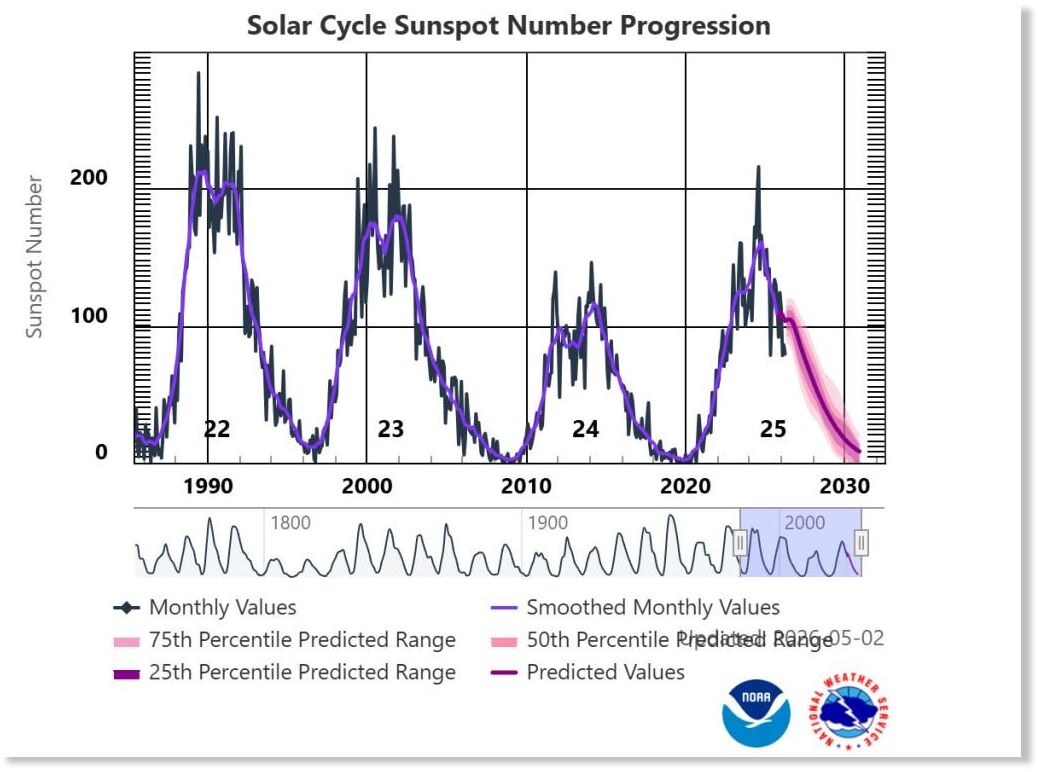
Solar Cycle 25 is moving toward its descent. The next test is how quickly activity falls, how deep the coming minimum becomes, how drawn out it becomes, and whether Solar Cycle 26 continues the weaker cycle pattern that began with SC23.
The GSM cold signal may not be theoretical for much longer.
For me, it hinges on SC26 (due to commence as early as January 2029).
The next few years will tell us whether this is a routine descent — or the start of something deeper.


Reader Comments
to our Newsletter