
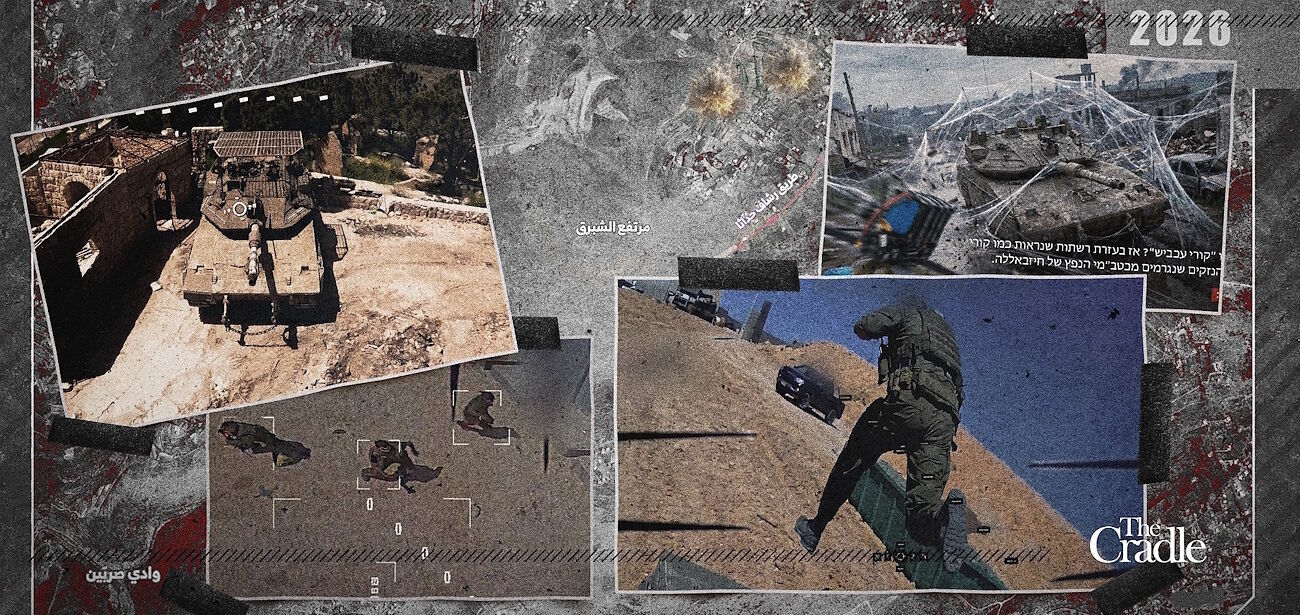
© The CradleScreenshots from videos of Hezbollah's operations against the IDF in southern Lebanon
The shock at Hezbollah's performance did not stay with military correspondents, security commentators, or analysts close to the army. It reached Northern Command itself.
On 6 April 2026, Channel 14 reported that Maj. Gen. Rafi Milo came under cabinet criticism after admitting the army had been surprised by Hezbollah's capabilities, with Israeli army Chief of Staff Eyal Zamir saying he had raised the matter with Milo during a situational assessment.
In a leaked Channel 12 recording, Milo also admitted that the first assessments after "Operation Arrows of the North" had been "too optimistic."
"There is a gap between the way we ended Arrows of the North, what we understood and believed, and the fact that we are finding Hezbollah still standing and operating," he said. The rockets worrying northern settlers, he added, were directed mostly at the army.
Hezbollah still standing
Contrary to the denials from senior officers, Haaretz reported that Hezbollah was still operating as an organized military force, with a hierarchical command-and-control structure able to transmit orders, coordinate fire, and draw lessons during the battle itself.
Citing military intelligence reports on 7 April, the paper said each combat zone was being managed by a resistance sector commander responsible for coordinating attacks and activating weapons against Israeli forces.
A reserve officer quoted by Haaretz on 6 April said he was surprised by Hezbollah's readiness south of the Litani River. Even in villages struck during Arrows of the North at the end of 2024, he said, the movement had quickly rebuilt infrastructure, redeployed weapons, and resupplied itself for combat. Northern Command had already been told internally after that operation that the resistance was ready for a long confrontation.
Maariv, in a parallel report on 6 April, admitted that Israel and its army were not ready for this war. It pointed to gaps in intelligence, aircraft availability, Northern Command performance, Home Front Command, and even the army spokesperson's unit. More strikingly, the paper reported that the original plan had been to strike Lebanon in winter before turning to Iran in summer. Events inside Iran pushed the army to freeze the Lebanon attack and move first against Tehran.
Israel then began building explanations for the shock. One blamed the air force and Military Intelligence for concentrating on Iran as the main front and misreading how and when Hezbollah would enter the war.
Another pointed to exhausted soldiers, weak protection, and the absence of a plan to secure the north, the army, and its bases. A third recast the Lebanon campaign as a continuation of Arrows of the North rather than a planned war.
That explanation did not hold for long. Fighting in the south continued even after Israel was expected to have restored its air and intelligence capacity, while losses in personnel and equipment persisted until the truce.
The pressure soon moved from the battlefield to the home front. On 2 April, parents of Nahal Brigade soldiers warned Israeli Prime Minister Benjamin Netanyahu and his Defense Minister Israel Katz that their sons were being exposed to unjustified danger without sufficient military support.
Explaining away the shock
Nahal Brigade commander Col. Arik Moyal defended the army's performance in a Walla interview from south Lebanon on 19 April. Arrows of the North, he argued, had created the conditions for the current operation by destroying large parts of Hezbollah's infrastructure, although troops were still finding large weapons caches in areas not reached in 2024.
Moyal claimed Hamas fighters were bolder in direct confrontation, while Hezbollah usually withdrew, waited for Israeli troops to enter houses or rooms, then engaged at close range while relying on longer-range fire and advanced weapons.
Lt. Col. "A," commander of Battalion 75, gave Ynet a more careful version on 15 April: Gaza combat is centered on close ranges, he said, while "In Lebanon the fighting is much more spatial. The anti-tank positions are located at far ranges, and the commander's main challenge is to understand that every meter is a potential arena."
Other Israeli accounts cut through the excuses. Amos Harel wrote in Haaretz on 10 April that the northern campaign had exposed gaps in Tel Aviv's intelligence assessment, especially after larger-than-expected quantities of Hezbollah weapons were found. He also described a limited five-division maneuver and an army strained by nearly 30 months of war, with manpower and resource shortages limiting its ability to sustain long or multi-front operations.
Walla went further in a 10 April report, saying Military Intelligence had detected Hezbollah's intention to join the war and the southward movement of Radwan fighters, but no preemptive strike was approved.
The report said Hezbollah Secretary-General Naim Qassem had instructed Radwan commanders to send about 1,000 fighters from Beirut to south Lebanon, raising questions inside Israel over why the force was not hit before reaching the battlefield.
A separate Walla report on 12 April described an Israeli campaign built around attrition and systematic clearing rather than a quick decision. It said Hezbollah had forced the army to split forces and maneuver deeper, while the movement's Almas anti-tank missiles, with ranges up to 10 kilometers, meant that Israeli positions several kilometers from the border were still exposed.
Comment: Funny how the 'systematic clearing' seems to always be of civilians . . .
Maariv, in a report cited by the original account, quoted the commander of Battalion 77 in the 7th Armored Brigade describing a battlefield shaped by dense mountainous terrain and rain that turned the ground into mud, obstructing heavy vehicles and infantry.
The commander said Hezbollah combined close friction with light weapons and shells with long-range attrition through anti-tank missiles - an admission that undercut the easier claim that Hezbollah fighters simply avoid direct combat.
Comment: And drones. Hezbollah has become quite skilled in drone warfare:
When deterrence is misread
Behind the contradictions was a deeper Israeli admission: the failure began with the reading of Hezbollah's intentions and capabilities.
Walla reported on 10 April that Military Intelligence had warned in advance that Hezbollah intended to enter the war. According to the report, the assessment reached the General Staff and political leadership, where officials discussed the possibility of an unusually broad preemptive strike. By then, Hezbollah had already begun firing rockets.
Shira Barbivay-Shaham wrote in Yedioth Ahronoth on 6 April that Milo's admission pointed to a deeper weakness in Israeli intelligence. The problem lay in assessing deterrence, how it shapes enemy decision-making, and how quickly adversaries recover after a round of fighting. She noted that Israel had warned Hezbollah not to open a second front during the Iran war, yet the movement joined the fight anyway.
Raviv Drucker offered the harshest criticism in Haaretz on 6 April: "The IDF did not come prepared for the campaign in the north. It had objectives, but no strategic plan for how the use of force would improve security."
He then pressed the central contradiction in Israel's position: officials spoke of holding territory up to the Litani, while the army denied plans for permanent bases, leaving unanswered how Israel would control the area, how many forces it would require, and whether those forces were even available.
The arsenal that remained
The battlefield shock forced Israel's security establishment to revise its picture of Hezbollah's remaining capabilities. By early April, Israeli assessments were already treating the resistance as prepared for a long fight.
N12 reported on 4 April that the army believed Hezbollah could sustain fire of around 200 rockets a day for another five months, through what Israeli officials described as an "economy of munitions." A separate N12 update said Hezbollah still held around 10,000 rockets and hundreds of active launchers, most of them north of the Litani.
Later assessments said the movement had increased drone launches while slightly reducing rocket fire. I24News reported that damage to launchers and command centers had not translated directly into a collapse in the rate of fire, because Hezbollah's missile systems were decentralized enough to preserve launch capacity despite broad attacks on infrastructure.
The buffer zone trap
By the time US President Donald Trump announced a three-week extension of the Lebanon truce, Hezbollah had resumed limited military activity against Israeli forces that were still carrying out demolitions and raids. The occupation state was already debating how to hold the ground it had tried to carve out.
Israeli reports said the army was preparing a new "Yellow Line" inside south Lebanon, extending up to 10 kilometers from the border in some areas, and presented as a forward defensive line to prevent a direct threat to northern settlements.
Israel had already turned that model into practice during the ceasefire, using the Yellow Line to continue attacks and demolitions under the cover of stabilization.
The plan immediately revived old anxieties over Israel's former security belt in Lebanon. Israeli commentators warned that a fixed presence inside sovereign Lebanese territory would leave troops exposed to Hezbollah attacks, strain reserves and logistics, and fail to stop rockets launched from depth rather than from border villages alone.
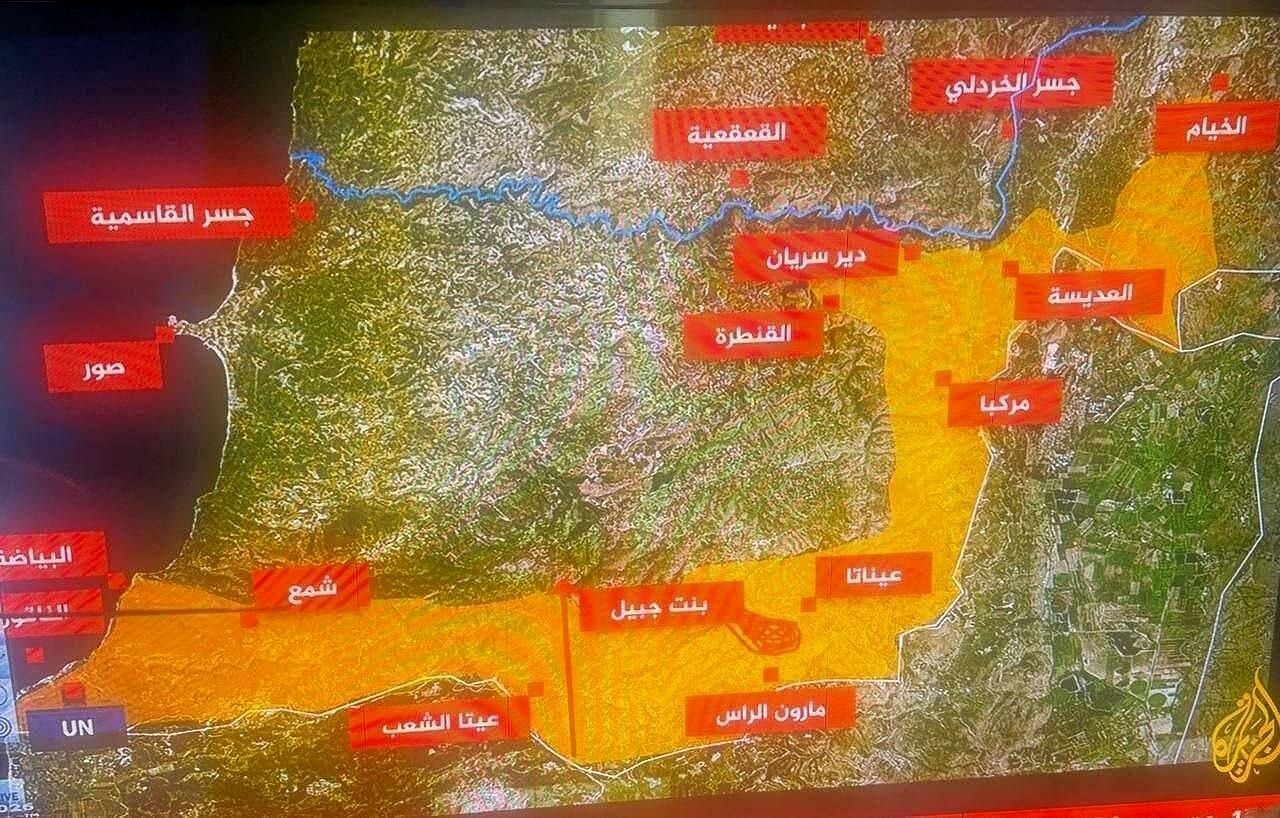
Israel is attempting to take a chunk of southern Lebanon, a "yellow line" which will also give them control of the main water source for the region
Asher Ben Lulu, a former brigade commander on the Lebanon border and former Northern Command chief of staff, wrote in Yedioth Ahronoth that the new buffer zone could reduce the danger of ground infiltration and anti-tank fire, improve defenses for northern settlements, allow the army to operate deeper inside Lebanon, and give Israel leverage in future negotiations.
But he warned that Israel must "be careful not to fall in love with it or call it a 'security belt,'" because "it will not bring full security." Drones, rockets, and fire from north of the Litani, he added, would continue to reach northern Israeli settlements.
Ben Lulu's conclusion returned Israel to the unresolved strategic question. "The real debate is not whether to hold another hill or another village," he wrote. "The central question is what Israel's strategic objective is."
For him, that objective was "dismantling Hezbollah's military wing" through a years-long campaign combining military pressure, political action against Hezbollah's structures in Beirut and deep Lebanon, strikes on Iranian supply lines through Syria, political isolation, economic sanctions, and efforts to sever the movement from Lebanese state interests.
For now, Israel remains caught in the contradiction exposed by the confrontation itself. Every fixed position creates another target. More destroyed terrain has not produced control. Hezbollah's fire has already forced the occupation state to admit that the movement it declared weakened still knows how to fight.

Reader Comments
With the Iranian strikes on long-range radar systems and factual expulsion of the US military from neighboring Gulf countries, the US support and huge military supremacy is gone. Now they have to fight at the same level, and expose their amateurishness.
Recent exposure of heinous crimes such as anal rapes using iron bars and dogs and killings in Israeli prisons have revealed the perversity of Zionist ideology as Bronze age barbarity.
In my opinion, this rogue State does not have "a right to protect itself", it has forfeited the right to exist.
One State, majority rule. Nothing less. Let the settlers go back to Crown Heights - they deserve each other.