
For May, that ranks as the fourth-coldest such setup in 30 years of record-keeping. The benchmark remains May 2012, with ERA5 reanalysis coming up with -33C (-27F).
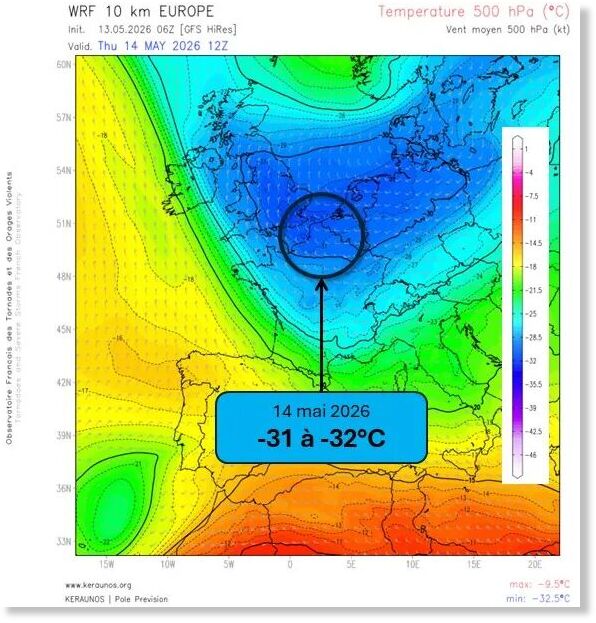
© [Keraunos]
The cold is already showing up.
In Croatia, Puntijarka on Zagreb's Medvednica has recorded May snow for only the sixth time since observations began in 1981.
In the Alps, accumulations of 1 m (39 inches) are forecast on the peaks.
Fresh snow is also expected across the Pyrenees.
The likes of France and Belgium have seen the convective side of the pattern, with snow levels in parts of France forecast to fall to around 1,000 m (3,280 ft) across the Vosges, northern Alps and Massif Central.
The Mediterranean is next.
Italy, the Adriatic and the western Balkans face several days of unstable conditions and anomalous chills.
Looking east, swaths of Russia are also shivering.
Tatarsk logged -5C (23F) on May 13, breaking its previous minimum of -4.3C (24.3F) set in 1951, according to Pogoda i Klimat's records monitor.
Likewise in neighboring Kazakhstan, Kazhydromet warned of "negative night temperatures" and snow across northern, eastern and central regions, down to -6C (21.2F), with frost also expected in the southeast.
Blocking to the west, polar air driven south, a deep cold pool aloft, and unstable weather underneath.
It doesn't feel much like mid-May in Europe right now.
ENSO Swamps The Attribution Machine
World Weather Attribution is already setting the line. At a recent press briefing, alarmist Friederike Otto said "climate change will likely play a larger role in this year's extreme weather than El Nino."
That is the takeaway for the media.
But it isn't factual.
Hurricanes expose the problem.
ENSO is a major natural Pacific cycle that reshapes weather patterns far beyond the tropics. In the Atlantic hurricane basin, the link is clear: El Nino tends to increase wind shear, which can tear storms apart; La Nina tends to reduce that shear, giving storms more room to form and strengthen.
Looking to US hurricane losses, ENSO is shown to be the main driver.
Roger Pielke Jr.'s comparison of normalized US hurricane losses puts the annual ENSO effect at about $541 million. The projected annual climate-change effect is about $8.7 million. That is a 62-fold gap.
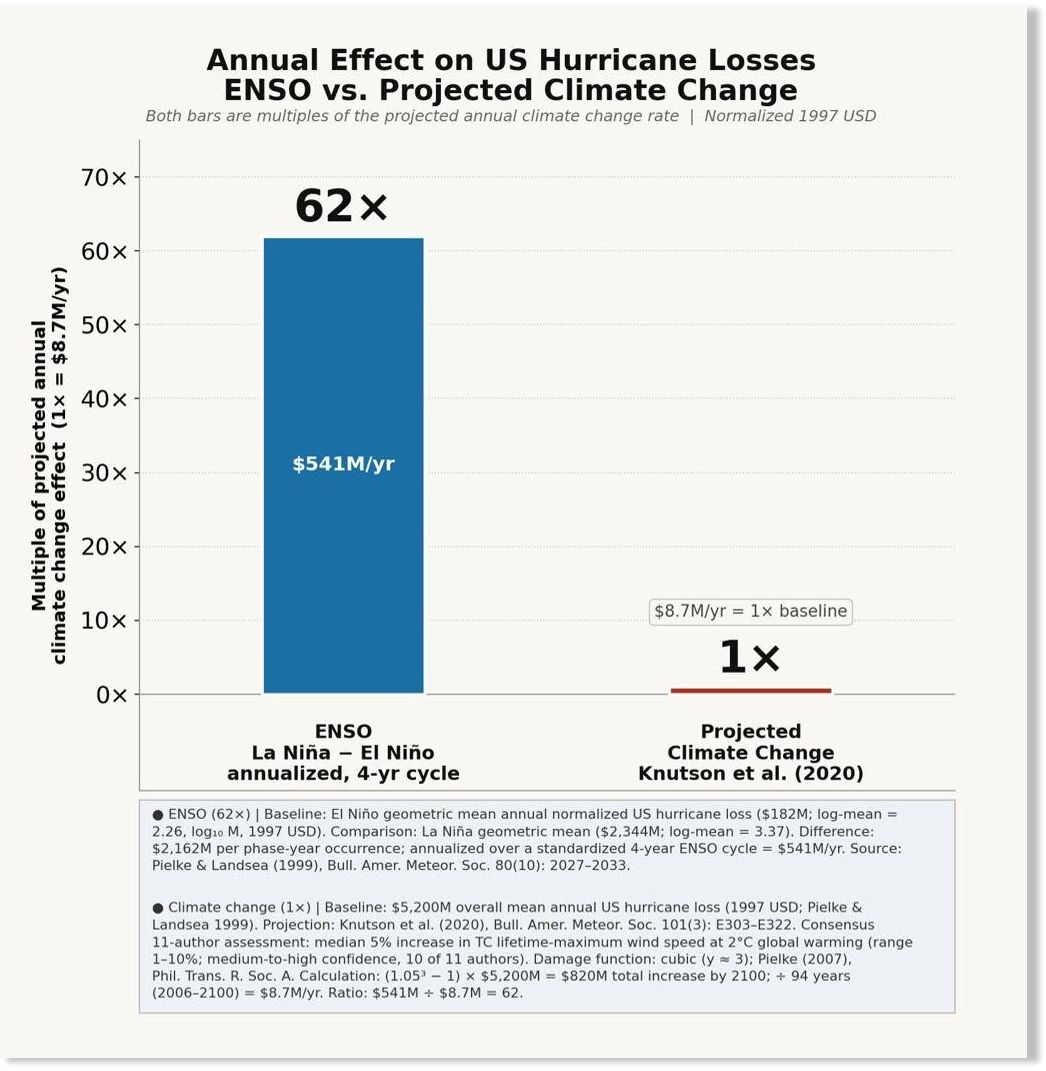
This is where attribution politics runs into reality. The public is told to view extreme weather through climate change first, while one of the planet's strongest natural climate drivers is largely ignored.
That is why WWA exists: to turn weather disasters into media-ready emissions stories. A flood, storm, drought or heatwave happens, and WWA supplies the institutional stamp. The link can be paper thin, model-heavy, caveated and riddled with ignored natural variability, but the headline survives: "climate change made it worse, scientists say." That is the function. It gives journalists, activists and politicians a clean causal line they could never prove on their own.
Weather goes in. Propaganda comes out.

Reader Comments
to our Newsletter