
Comment: Great story from CNN here...
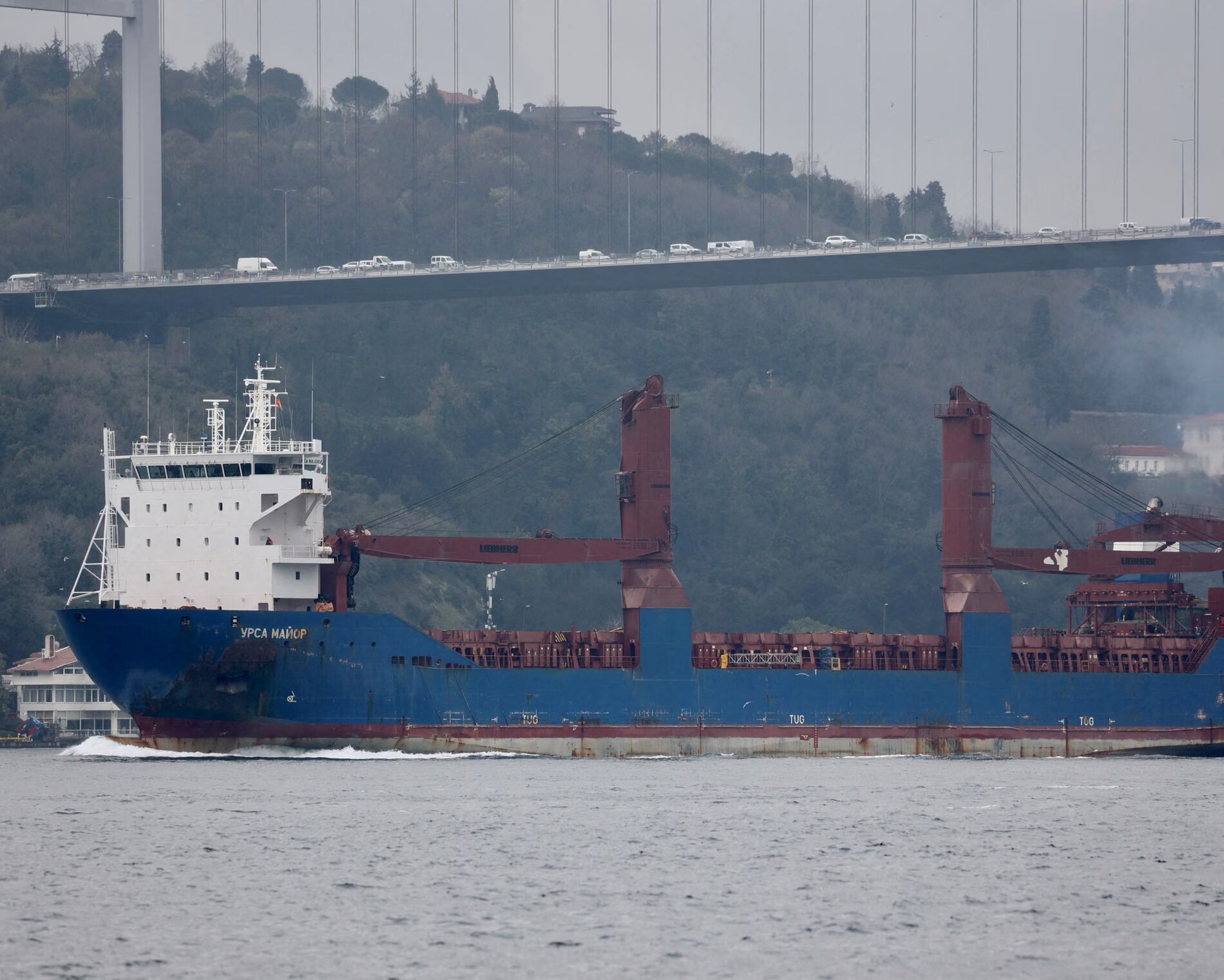
© Yoruk Isik/ReutersThe Ursa Major in the Bosphorus in Istanbul. The Russian cargo ship was purportedly sailing from St Petersburg to Vladivostok when it sank off the coast of Spain in 23 December 2024.
The extraordinary fate of the Ursa Major has been shrouded in secrecy since it sank on December 23, 2024. But it may mark a rare and high-stakes intervention by a Western military to prevent Russia from sending an upgrade in nuclear technology to a key ally, North Korea, CNN reporting suggests. The ship set sail just two months after Kim Jong Un had sent troops to assist with Moscow's invasion of Ukraine.
A flurry of recent military activity around its remains has deepened the mystery around its cargo and destination. US nuclear "sniffer" aircraft have flown over the sunken ship twice in the past year, according to public flight data. And its wreckage was also visited a week after it sank by a suspected Russian spy ship which set off four further explosions, according to a source familiar with the Spanish investigation into the incident.
The Spanish government has said little, only releasing a statement on February 23 after pressure from opposition lawmakers. It confirmed that the ship's Russian captain had told Spanish investigators the Ursa Major was carrying "components for two nuclear reactors similar to those used in submarines," and that he was unsure if they were loaded with nuclear fuel.
The series of events which led the Ursa Major to sink to the bottom of the Mediterranean Sea remains unclear. It may have involved the use of a rare type of torpedo to breach the ship's hull, according to the Spanish investigation, as described by the source familiar with its contents. The incident occurred in the closing days weeks of Joe Biden's presidency, when the war in Ukraine was peaking in Moscow's favor, and there was a strong US desire not to directly escalate with Moscow.
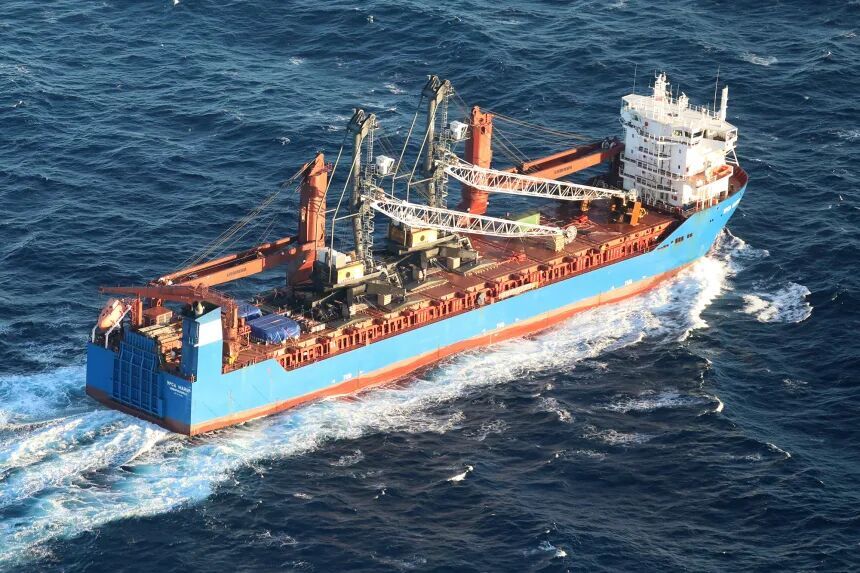
© Portuguese Air ForceThe Ursa Major is seen in a photo taken by the Portuguese Air Force as the Russian vessel sailed through Portuguese waters in December 2024.
In October that year, its owner, the state-linked Oboronlogistics, said in a statement that their ships had been licensed to carry nuclear material. Time-lapse video footage of the Ursa Major's loading at Ust-Luga, analyzed by CNN, shows containers being put inside the hull, with a gap left below where the "manhole covers" would later sit.
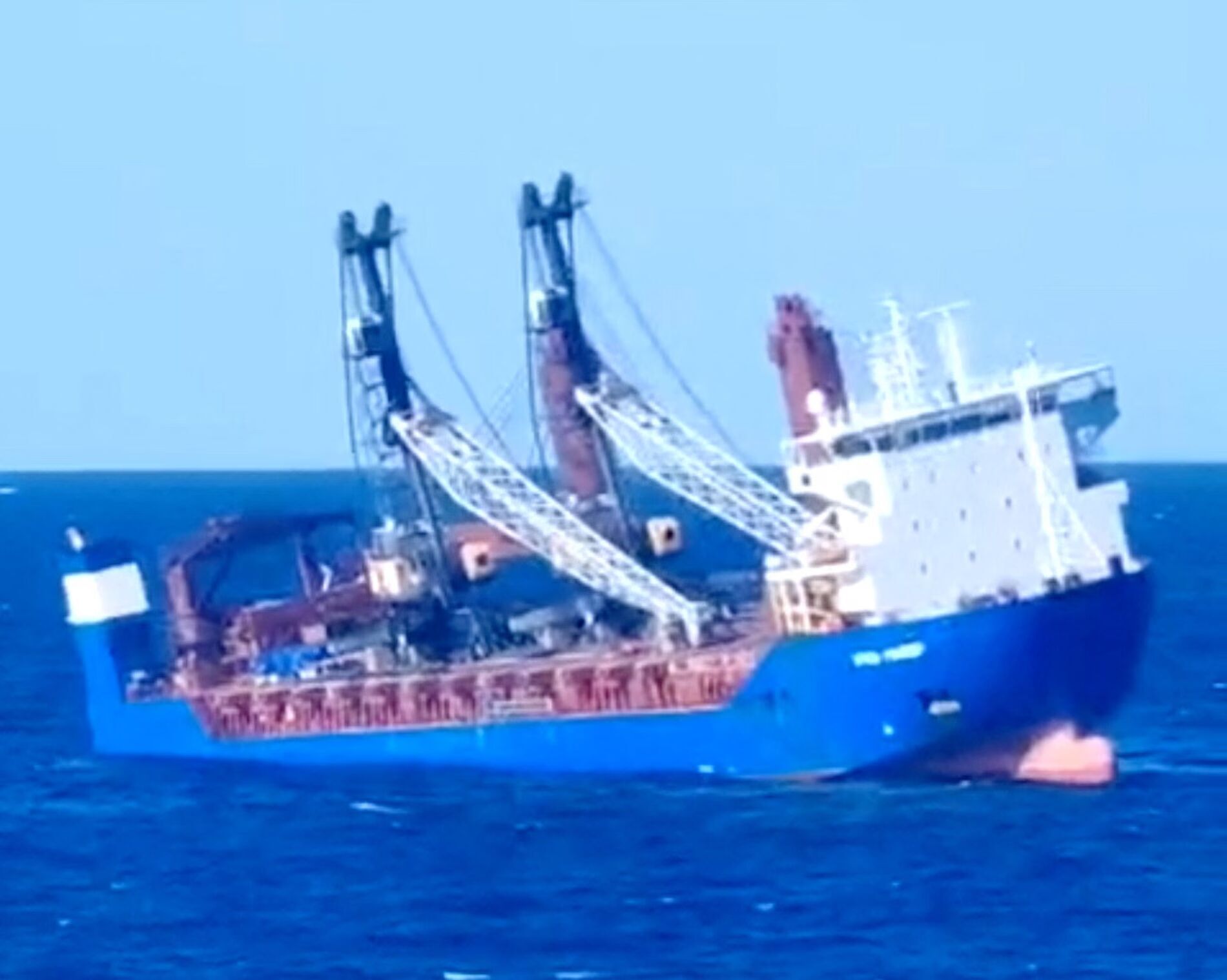
© Social media/ReuterThe Ursa Major pictured listing before it sank 62 nautical miles off the coast of Murcia.
About four hours later, in Spanish waters, the ship slowed dramatically, prompting Spanish rescuers to radio and check if it was in distress, according to the Spanish government investigation, carried out by the local maritime authorities in the southern port of Cartagena. The ship's crew replied that it was fine.
But about 24 hours later, the ship deviated sharply from its course and, at 11:53 a.m. UTC on December 23, issued an urgent call for help, the investigation said. It had suffered three explosions on its starboard side, likely near its engine room, that killed two crew members. This left the vessel listing and immobile, as social media video of the boat shows.
The 14 surviving crew members evacuated on a lifeboat, and were later picked up by the Salvamar Draco, a Spanish rescue boat. At 7:27 p.m., a Spanish military vessel arrived to assist. But half an hour later, one of the Russian military ships that had escorted the Ursa Major, the Ivan Gren, ordered nearby vessels to keep two nautical miles away, and later asked they return the rescued crew immediately.
The Spanish maritime rescue authorities insisted they must conduct a rescue operation, and sent a helicopter to the ship to check for survivors. Footage seen by CNN shows a rescuer trying to enter the ship's engine room, but finding it sealed. The Spanish rescuer checks the living quarters for survivors, and peers inside the ships' containers to see two filled with trash, fishing nets and other equipment, according to the video.
The Ursa Major appeared stable and unlikely to sink soon, according to the source familiar with the investigation. But at 9:50 p.m. the Ivan Gren fired a series of red flares over the scene, and four explosions followed. Four similar seismic signatures were registered at that exact time, in that approximate area, the pattern of which resembled underwater mines or overground quarry blasts, the Spanish National Seismic Network told CNN.
By 11.10 p.m., the Ursa Major was reported sunk, according to the source familiar with the Spanish investigation.
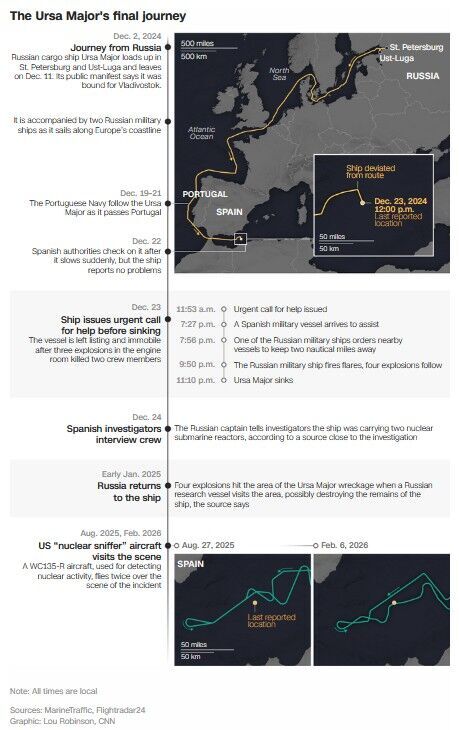
© CNNCNN's timeline of the sinking of the Ursa Major
The captain came "under pressure to clarify what he meant by 'manhole covers,'" the items originally listed on the ship's manifest, the statement added. "He finally confessed that they were the components of two nuclear reactors similar to those used by submarines. According to his testimony, and without being able to confirm it, they did not contain nuclear fuel."
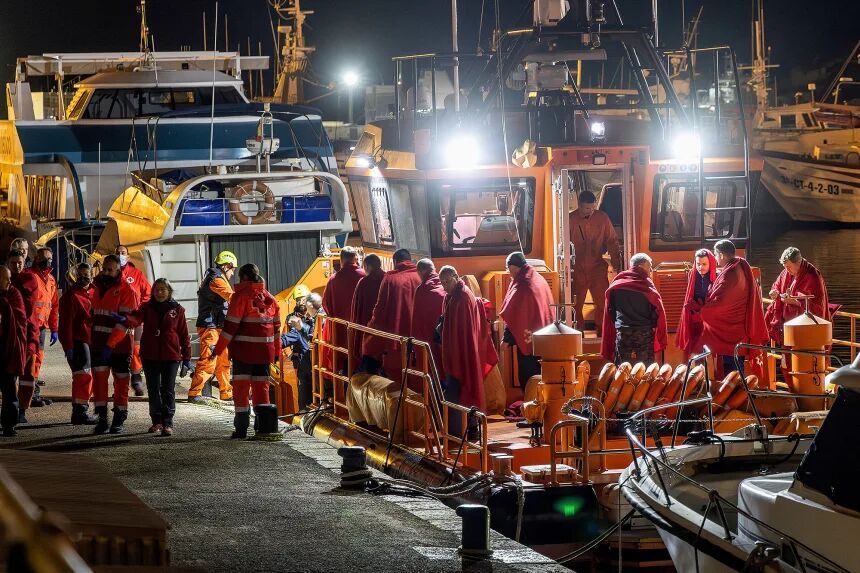
© Jose Maria Rodriguez/ReutersSurvivors of the sinking of Russian cargo ship Ursa Major stand on the deck of a Spanish Maritime Rescue ship upon arrival at the port of Cartagena, Spain, on December 23, 2024.
The ship's crew was returned to Russia days later. CNN has contacted a man bearing the name and likeness of the Russian captain. He denied involvement with the Ursa Major and said he was retired. Four days after the sinking, the ship's owner, Oboronlogistics, described it as a "targeted terrorist attack" and said there were three blasts. A 50cm by 50cm (20 inch by 20 inch) hole was found in the vessel's hull, the damaged metal facing inwards. "The deck of the vessel was strewn with shrapnel," the company's statement added.
A week later, according to the source familiar with the investigation, the Russian military returned to the scene. The Yantar - officially a Russian research ship, but accused of espionage and disruption in NATO waters - sat over the Ursa Major's wreckage for five days, the source said, before four more explosions were detected, possibly targeting the remains of the ship on the seabed.
Maritime tracking data from the trade intelligence firm Kpler shows the Yantar was in the area in January last year, mooring in Egypt then Algeria, and then sending one position ping 20 km (12 miles) from the last position of the Ursa Major on January 15.
Key evidence at the bottom of the Mediterranean
Some details of the Spanish investigation into the incident were reported first by the local Cartagena newspaper La Verdad in December, sparking a series of questions from Spanish opposition lawmakers. Lawmaker Juan Antonio Rojas Manrique told CNN: "When someone doesn't clearly and fully provide the information you request, you at least suspect they are hiding something... of course."
In its statement to lawmakers, the Spanish government said the remains of the Ursa Major lay at a depth of about 2,500 meters (8,202 feet) and that recovery of its data recorder from that depth "is not possible without significant technical resources and risks." Experts have questioned why the government considers it too risky, if no radioactive material is involved.
Rojas, a former merchant marine captain, also expressed skepticism, telling CNN: "Nowadays black boxes usually float to the surface with a locator so they can be found in any accident. I think someone has the black box. But we don't know whether it's Spain or if the Russians themselves have located it."
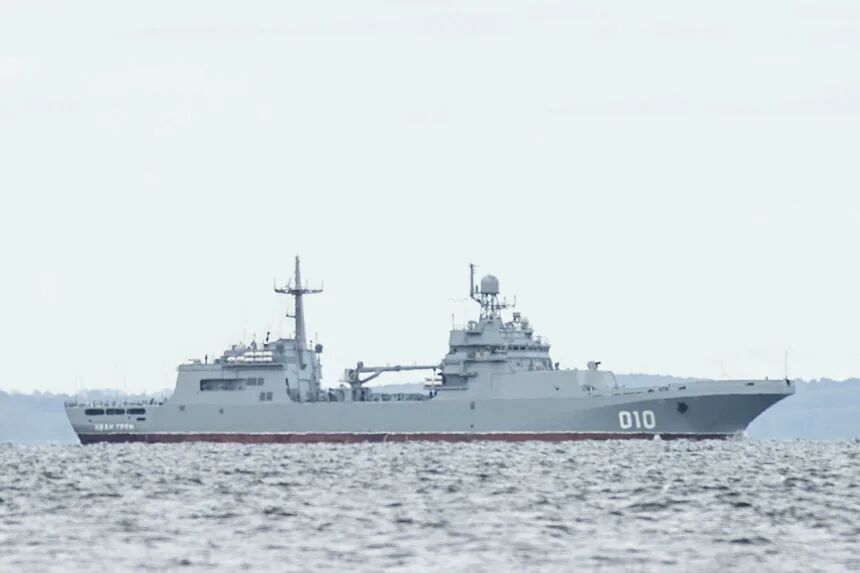
© EPA-EFE/ShutterstockThe Ursa Major sank soon after the Ivan Gren, pictured off Denmark in August 2022, arrived on the scene, letting off red flares which were followed by four explosions.
A spokesman for the 55th Wing base in Offutt, Nebraska, Kris Pierce, confirmed the aircraft's role usually "supports nuclear debris collection and analysis." He added: "We cannot provide additional details regarding specific flight routing, mission findings, or any partner-related coordination." Another WC135-R took a relatively similar flightpath 13 months before the Ursa Major sank, suggesting interest in the area may have pre-dated the sinking, or be routine.
It is unclear if these two rare and costly flights - by aircraft usually flown in secrecy and used to detect nuclear activity in the Russian Arctic or around Iran - found any contamination traces from the Ursa Major's wreckage. The Spanish government has given no indication that it fears radiation along its southern coast, a popular tourist destination, and no evidence has emerged to that effect.
Possible sharing of nuclear secrets
The claim that North Korea was the likely recipient of the two reactors allegedly aboard the ship comes after the secretive totalitarian regime released images in December 2025 of its first nuclear submarine. The still pictures, which feature leader Kim Jong Un grinning, only show the sealed hull of the vessel, and no evidence there is a functioning nuclear reactor inside.
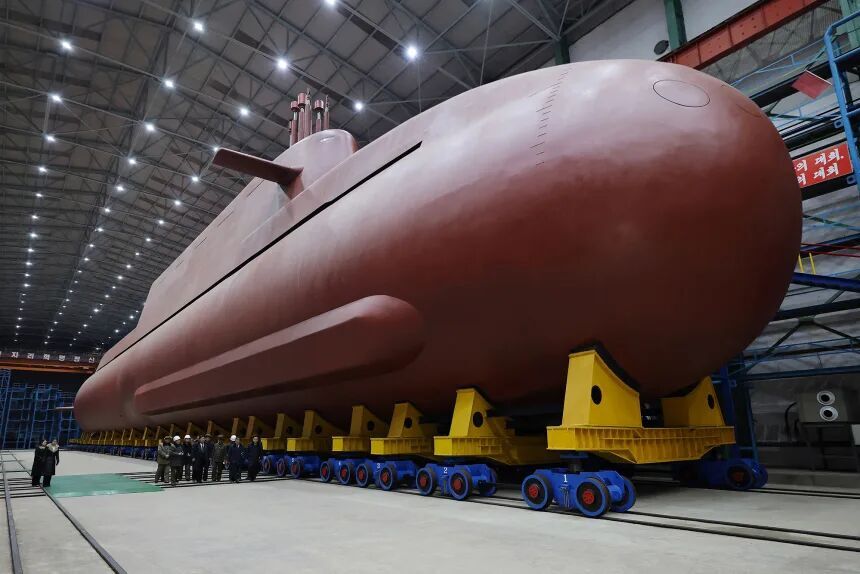
© KCNA/ReutersNorth Korean leader Kim Jong Un visits the construction site of what North Korea says is an 8,700-ton nuclear-powered submarine on December 25, 2025.
Any decision by Russia to transfer this technology to North Korea is not "undertaken lightly and it's only something that's ever done between very close allies," he added, so if true "it's a major move by Moscow." He described any such development as "very troubling, potentially, particularly if you're South Korea."
The Spanish investigation, as described to CNN, notes the status of North Korea as a Russian strategic ally, and how Pyongyang has openly urged Moscow to share its nuclear technical expertise. It is likely such demands would have increased after at least 10,000 North Korean troops went to Russia in October 2024 to fight Ukraine's incursion into the Kursk region.
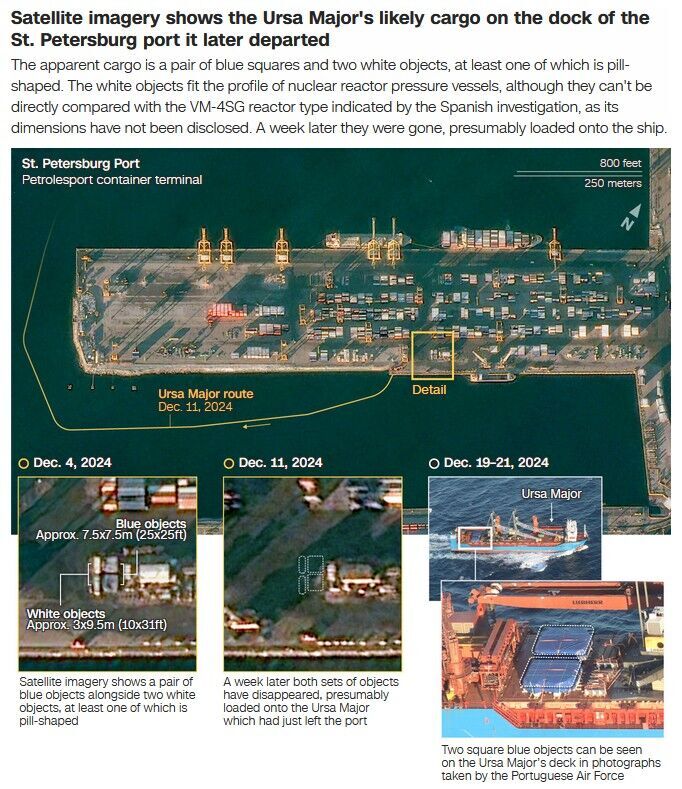
The investigation says it is likely the reactors transported were the VM-4SG model, often found in Russia's Delta IV class ballistic missile nuclear-powered submarines, but provides limited evidence to support the claim.
CNN has obtained satellite imagery from Vantor of the Ursa Major docked at the east end of the port of Ust-Luga, in the Gulf of Finland, on December 4, 2024. Geolocated timelapse videos, posted to the account of the vessel's owners, Oboronlogistics, show it being loaded with containers and cranes there.
© CNN
What put a pillow-sized hole in the Ursa Major's hull?
The Spanish investigation also tackles the initial impact that caused the Ursa Major to deviate off course and list, according to the source familiar with the report. The Russian captain told investigators he did not hear any impact or blast on December 22, when his ship suddenly slowed. It was only 24 hours later that three explosions followed near the engine room, killing two crew members, named as Second Mechanic Nikitin and Mechanic Yakovlev, whose bodies were not found.
The investigation proposes the 50cm by 50cm hole in the Ursa Major's hull would likely have been made by a Barracuda supercavitating torpedo. Only the United States, a few NATO allies, Russia and Iran are believed to have this kind of high-speed torpedo, which fires air ahead of the weapon to reduce the drag of the water. This enables them to reach very high speeds to pierce the hull of their target, with some models, as a result, not using an explosive charge to cause damage.
The source familiar with the investigation said it concluded the use of such a device would fit with the size of the hole in the Ursa Major's hull, and that it could have made a noiseless impact resulting in the sudden slowing of the boat on December 22.
Other experts consulted by CNN differed in their view. Plunkett, the Janes analyst, suggested a limpet mine was a more likely explanation for the size and location of the hole. "It sounds like a shaped-charge explosive that was placed against the hull by somebody or something," he said.
The Russian owners of the ship, Orobonlogistics, the Russian, Spanish and British militaries did not reply to a request for comment. The Pentagon declined to comment. Multiple Western security and intelligence officials approached by CNN have described the incident as strange or suggested some of the Spanish investigation's conclusions were far-fetched, but have not provided an alternative, benign explanation, for the initial blasts that hit the boat, or the acute Russian reaction to its plight.
The secrets of its cargo, and how it came to sink, rest on the sea floor.







Comment: ...but it's most likely just that, a story.
This was probably just another Ukrainian sea-drone hit - where "Ukrainian" is a placeholder for Western military-intelligence units enjoying wearing the garb of "Slava Ukraini" as a means of taking potshots at any and all economic interests of Russia.
So no "nuclear reactors," no "James Bond missions" to "save the West from those dastardly Commies," just regurgitated "greatest hits" for Westoids to enjoy as their treasuries are looted and the Western ship-of-state sinks beneath the waves.